



Access our Top Picks for 2026 with a 14-Day Free Trial and a $100 Discount
High Yield Landlord is turning eight, and to celebrate, we are opening our doors with a limited-time 14-day free trial and a special $100 anniversary discount.
If you have ever been on the fence, now is the perfect time to try. High Yield Landlord is the #1 rated real estate investing group on Seeking Alpha and Substack, trusted by over 2,000 investors worldwide. Since its inception in 2018, our portfolio has generated 3x higher returns than our benchmark, and with REITs still trading at decade-low valuations, we believe they offer a historic opportunity for significant upside in the coming years.
We have just released our Top Picks for 2026, and with the money-back guarantee, you have everything to gain and nothing to lose. Join now and access everything completely risk-free. This limited-time anniversary offer will not last.

Click here to claim this risk-free offer!
A New Buy Alert: Interview With Canadian Net REIT (Strong Buy Reaffirmed)
Our largest Canadian REIT investment has strongly recovered over the past year:
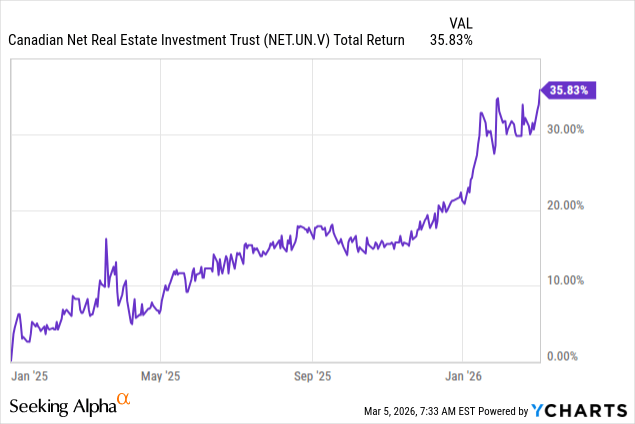
I have previously described Canadian Net REIT (NET.UN:CA) as an early day Realty Income (O). In case you didn’t know, Realty Income used to grow a lot faster and deliver a lot higher returns to its shareholders in its early days when it is much smaller in size, used more leverage, and faced lower competition for acquisitions.
This allowed it to grow its FFO per share by 8-12% annually in its early days, which coupled with its dividend commonly resulted in 15%+ annual total returns.
Canadian Net REIT is in that position today.
It has been able to grow its FFO per share by a remarkable 14% per year on average since going public because it is the only net lease REIT in Canada, it faces much lower competition for deals, it is still very small in size, and it uses more leverage to maximize the size of its spreads.
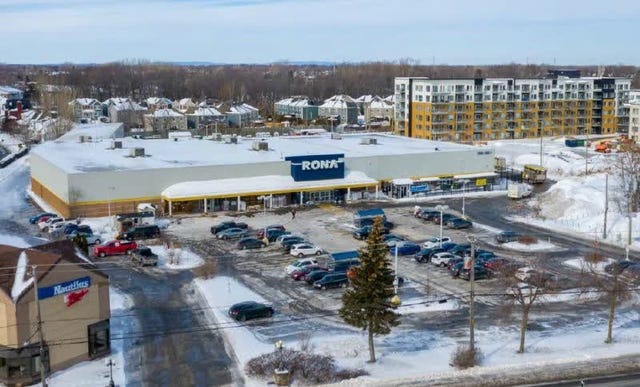

This has earned its investors a 7x on their money since its IPO in 2011.
But what now?
Is the REIT still a buy?
Or are its best days now behind?
In short, we are reaffirming our Strong Buy rating and expect a lot more growth and upside ahead.
The REIT is still just getting started with a $127 million market cap and it enjoys structural advantages that should allow it to keep growing a lot faster than its US peers over the long run.
Even then, it today still trades at a very reasonable valuation at just around 9.8x FFO because its growth stagnated in recent years.
This is now changing as the REIT returned to faster growth in 2025, growing its FFO per share by 9%, and as it regains access to equity markets, its growth could accelerate even further.
This growth, coupled with its 5.6% dividend yield, and some upside, has the potential to result in further market outperformance over the long run.
Therefore, we expect to maintain a large position in the company.
Here is our interview with their CEO, Kevin Henley:

Q1: After a few years of stagnating cash flows, Canadian Net REIT returned to solid growth in 2025, with FFO per unit up about 9% through Q3. What were the main drivers behind this renewed growth, and do you expect it to continue into 2026?
The growth we’ve delivered in 2025 is really the culmination of a deliberate strategy we executed over the prior two years. During that period, we sold five gas station properties for approximately $12.8 million in gross proceeds and reinvested those funds into four necessity-based retail assets: a Sobeys in Truro, Nova Scotia, and three single-tenant properties in La Baie, Quebec, at cap rates of 7% to 8%. That positive spread between acquisition yields and borrowing costs is a significant driver of the FFO per unit growth you’re seeing.
Beyond acquisitions, we’ve also benefited from lower interest rates on our credit facilities. As a reminder, the peak interest rate environment of 2023 hit us through mortgage renewals that year and into early 2024, but by Q4 2024, the worst of that impact was behind us. Our FFO per unit year-to-date is setting a new all-time high for the REIT, surpassing our previous peak in 2022 before rates began to rise.
Lease renewals have also contributed. Our 2025 expiring leases were renewed at an average rental spread of 6.9%, and excluding a couple of large fixed-rate leases, our renewal spreads averaged 12%.
For 2026, we see several tailwinds. The spread on leases already renewed is of 6.1%, or approximately 10% excluding those same fixed-rate leases.
The REIT also repays more than $6 million in mortgage principal annually, which creates organic refinancing capacity. In 2025, those refinancing proceeds went toward repaying our $6 million November convertible debenture, but going forward, that capital can be redirected toward funding new acquisitions. We also raised an additional $4 million convertible debenture in December. So yes, we’re confident in our ability to sustain growth into 2026 and beyond.
Q2: You also ended a two-year stretch of flat dividends by increasing the payout by 1.5% in 2025. Do you expect dividend growth to continue going forward, and could it potentially accelerate over time?
We were very pleased to announce our 12th distribution increase since 2012, bringing the annualized distribution to $0.35 per unit. It is worth noting that Canadian Net has never cut its distribution. We have only increased it, with just one year where it was held steady between 2023 and 2024.
The 1.5% increase was deliberately modest relative to our 9% Year-to-date FFO per unit growth because we want to strike the right balance between rewarding unitholders today and retaining capital for future growth. Our payout ratio is currently around 52%, one of the lowest in the Canadian REIT sector. That conservative ratio gives us flexibility: it supports the current distribution with a wide margin of safety, and it also preserves cash that we can redeploy into accretive acquisitions without relying on external capital markets. At this stage, Canadian Net remains a growth story, and the best allocation of capital is acquisition.
As FFO per unit continues to grow, through acquisitions, organic lease renewal spreads, and refinancing-driven reinvestment, we expect to be in a position to continue raising the distribution over time. The magnitude of these increases will depend on the opportunities available to us and the most effective allocation of capital. However, the trajectory remains clearly positive, and as the REIT continues to scale and growth compounds, we expect distribution increases over time.
Q3: Over the long run, Canadian Net REIT has grown FFO per unit at a pace roughly three times faster than many larger US net lease peers. What do you attribute this outperformance to?
That’s a great observation, and the analogy to Realty Income’s earlier years is one we appreciate. There are a few structural advantages that explain the differential.
First, we are the only operator in our niche of single-tenant, triple-net, necessity-based retail in secondary and tertiary Canadian markets. Competition for acquisitions is far less intense than in the broader US net lease space. Larger institutional buyers and REITs tend to focus on bigger, more liquid markets and larger transactions. That allows us to source deals at more attractive cap rates.
Second, our smaller size is an advantage at this stage. A $12 million acquisition, like the one we completed in January 2025, is meaningful for a REIT of our scale but would be immaterial for a multi-billion-dollar platform. As a result, each transaction we complete has a tangible, accretive impact on FFO per unit.
Third, our portfolio has averaged 100% occupancy since 2012, and that translates directly into higher FFO. There’s no drag from vacancies or downtime between tenants, unlike many larger US peers that carry some vacancies. That track record reflects our disciplined site selection of well-positioned locations where our tenants serve as essential community anchors, and the inherent stability of necessity-based retail in Canada, where consumers have fewer alternatives and tenants face less competitive disruption. The result is a portfolio where virtually every dollar of NOI we underwrite at acquisition shows up in our FFO, quarter after quarter.
Finally, our overhead is extremely low. The triple-net, management-free structure keeps operating costs minimal, and our administrative expenses are well-contained. All of this means more of each dollar of NOI flows through to FFO per unit.
Q4: What cap rates are you currently targeting on new acquisitions, and are you now able to raise capital at a cost that allows you to earn a positive investment spread?
We’re currently targeting acquisitions at cap rates of approximately 7%, and in select situations, we’ve been able to source deals above that. Given that mortgage financing is available in the mid 4% range, we’re generating a healthy positive spread on new investments.
That said, we’re disciplined about when we deploy capital. As we mentioned on our Q2 call, the transactional market has been fairly slow, and we will only execute when deals are meaningfully accretive to FFO per unit. We won’t stretch on cap rates simply to grow the asset base, nor will we chase the first reasonable deal that comes along just because capital is available.
In terms of how we fund acquisitions, we are currently operating independently of the equity capital markets, which continue to heavily discount CNET. Instead, we’re funding growth organically through two channels: proceeds from potential capital recycling and refinancing of existing mortgages where principal amortization has created equity. The REIT amortizes over $6 million in mortgage principal annually, which represents a meaningful and recurring source of non-dilutive capital. This approach allows us to grow without issuing equity at prices we consider to be below intrinsic value. We also successfully accessed the debt markets in late 2025 through our private placement of convertible debentures, which remains an available option going forward.
Q5: Do you still see attractive capital recycling opportunities within the existing portfolio that you could potentially act on in 2026 to support further growth?
Capital recycling will remain an opportunistic option. We will not pre-commit to selling specific assets, obliging ourselves to execute those transactions. However, when a suitable acquisition opportunity aligns with a favorable selling opportunity, we will pursue capital recycling accordingly. That said, we’ll continue to be patient and selective. We demonstrated with the La Baie acquisitions that we can move quickly when the right opportunities arise.
Q6: What types of net lease properties do you find most attractive today, and which property types are you more cautious about?
Our focus is squarely on necessity-based retail: grocery stores, pharmacies, discount stores, fast food restaurants, and convenience stores. These are the types of businesses that consumers rely on regardless of the economic cycle. Our tenants are performing well, and occupancy across the portfolio has averaged 100% for our entire history.
What makes these assets particularly attractive right now is the supply-demand dynamic. There is little new retail construction happening in our markets due to elevated construction costs and limited availability of well-located land. That means the existing supply of quality, well-located necessity-based retail is essentially a shrinking pool, which supports both occupancy and rental growth. Our below-market rents further protect us as tenants have a strong incentive to renew because replacing their space at current market rates would be more expensive. We believe the necessity-based niche offers the best risk-adjusted returns, especially with the level of knowledge we have in this asset class, and we intend to continue deepening our focus there.
Q7: Could you describe your typical lease structures, particularly in terms of rent escalations and landlord versus tenant responsibilities?
Our leases are structured as triple-net, which means the tenant is responsible for virtually all operating costs, property taxes, insurance, and maintenance. This is a true management-free model for the REIT, which keeps our overhead extremely low and makes the business highly scalable. Where we do step in, in certain cases, is on structural capital expenditures.
In terms of lease duration, our weighted average lease term is currently 6.1 years, and we have a well-diversified maturity profile. Our leases typically include contractual rent escalations, though the structure varies by tenant and property. Some leases have fixed annual increases, while others escalate at pre-set periods.
The triple-net structure also means our NOI is very close to our rental revenue. The gap between the two is minimal because we’re not absorbing operating expenses. This gives investors a high degree of visibility into our cash flows and makes the income stream predictable and resilient.
Q8: Is there anything else you would like to add that you believe investors should better understand about Canadian Net REIT today?
I think the key message is that Canadian Net is entering a new phase of growth from a position of strength. Over the past three years, we navigated the sharpest interest rate increase cycle in decades, and rather than simply weathering the storm, we used that period to strategically reposition the portfolio through capital recycling. The results are now showing up in our numbers: record FFO per unit so far in 2025, a distribution increase, increased exposure to essential retail, and a stronger balance sheet.
I’d leave investors with five key points that capture the CNET thesis.
First, we own a high-quality portfolio of necessity-based assets leased to national tenants on a net-lease basis, with 100% occupancy, which speaks to the resilience of our niche and track record.
Second, we have a compelling growth runway. The Canadian net lease market is highly fragmented with limited institutional competition, which allows us to continue sourcing accretive acquisitions.
Third, we’ve built a strong platform. Our management team is dedicated exclusively to net-lease investing, with long tenure and a proven record of disciplined capital allocation.
Fourth, there is clear alignment between management and unitholders. Insiders own approximately 16% of CNET, which means we’re investing alongside our unitholders in every decision we make.
And finally, we believe CNET represents an attractive entry point. As we continue to deliver strong FFO and distribution per unit growth, we expect the valuation gap between CNET and the broader REIT sector to narrow over time, creating an opportunity for multiple expansion on top of the underlying cash flow growth.

Want to access our Other Top Picks and Exclusive REIT CEO Interviews? Join Us Now with a 14-Day Free Trial!
Your timing is ideal. We have just released our Top Picks for 2026, and for a limited time, new members can access everything with a 14-Day Free Trial at High Yield Landlord.
We invest thousands of hours and over $100,000 annually into researching the most profitable investment opportunities—all to bring you real estate strategies at just a fraction of the cost.
Our approach has earned us 500+ five-star reviews from satisfied members who are already seeing the benefits. Don’t miss out—join now and start maximizing your returns!
Claim your spot today!
