



Alexandria Real Estate (ARE) has been one of our most disappointing investments. We started buying too early, underestimated the severity of the downturn, and have had to extend our expected recovery timeline. But after reviewing its third-quarter results, I continue to believe that the long-term opportunity remains attractive.
Before discussing the quarter, it is worth remembering how we got here.
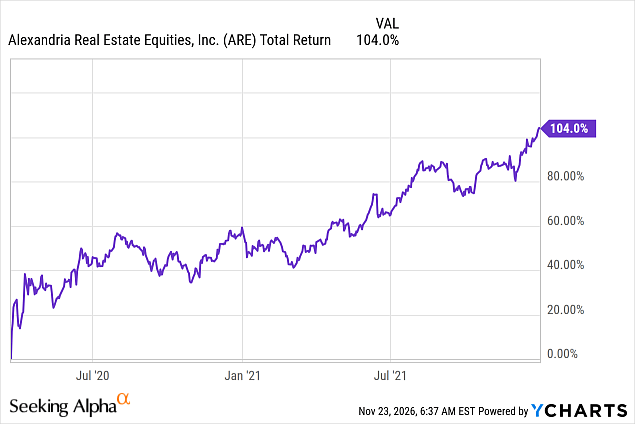
During the pandemic, demand for life science properties surged as capital poured into biotechnology and pharmaceutical research. Alexandria benefited enormously. Management recently described that period as one in which its leasing activity increased fourfold almost overnight. Investors rewarded the company with a premium valuation, expecting its strong growth to continue.
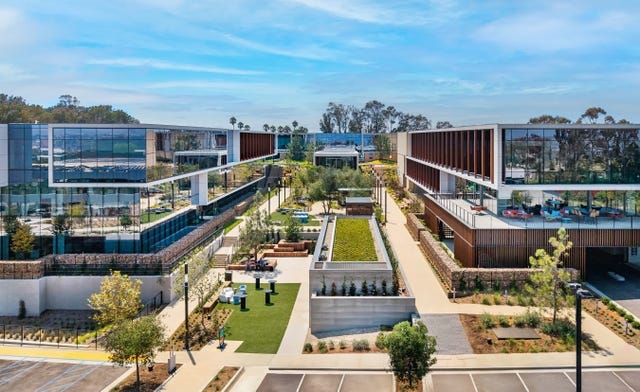
Unfortunately, those attractive fundamentals also caught the attention of developers. New laboratory buildings were developed across the major research markets, while owners of underutilized office properties began pursuing office-to-lab conversions. According to CBRE, laboratory and research space under construction across the leading U.S. markets eventually approached 40 million square feet in mid-2023. By then, the world had normalized from the pandemic and the demand was cooling, leaving the industry with a substantial supply problem.
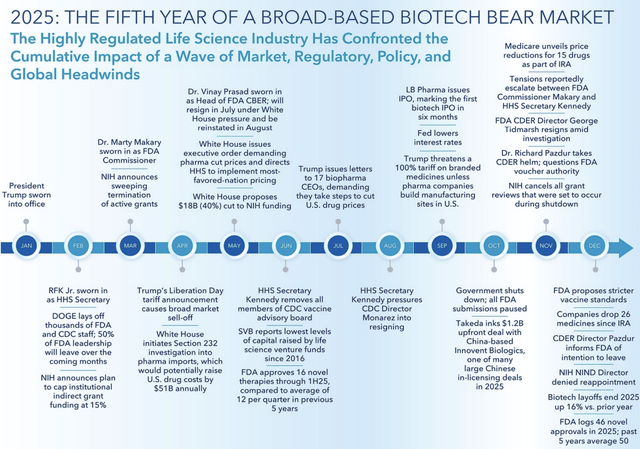
This imbalance existed before the current administration took office. But uncertainty around research funding, pharmaceutical pricing, tariffs, and policy chaos added another significant headwind. Tenants postponed leasing and expansion decisions, while difficult capital markets further constrained biotechnology companies. Politics did not create the entire problem, but it made an already difficult adjustment worse.
Our original expectation was that Alexandria’s long leases and strong balance sheet would protect it while demand caught up with supply. Instead, the recovery became a much longer process, with weaker occupancy, lower earnings, and a dividend cut. That is why we moved the investment from our Retirement Portfolio into our Core Portfolio: it became a higher-risk recovery investment rather than the defensive income holding that it used to be for most of its history.
We have nevertheless continued accumulating shares because we believe the market has become too pessimistic about the long-term value of its properties. In particular, we think AI could substantially expand the amount of research undertaken by the life science industry over the coming years.
The latest results provide some encouraging evidence, but they also show why patience remains necessary. Let’s start with the negatives.
The Bad
Leverage has increased, limiting financial flexibility
Alexandria’s debt-and-preferred-to-EBITDA reached 6.9x on an annualized third-quarter basis. Adjusting for the Campus Point transaction completed in October brings that figure to 6.6x. Management still expects to reach its year-end target of 5.6–6.2x, but getting there requires continued execution of its capital plan.
Declining earnings make this more difficult. Even without adding debt, a landlord can become more leveraged when its cash flow falls. Asset sales and joint ventures can help, but the company must balance raising capital against giving up future income.
Fortunately, Alexandria has considerable time to manage the situation. Only 6% of its debt matures through 2028, its weighted-average remaining debt term is 11.6 years, and management reported approximately $4.6 billion of liquidity. Those are important protections against having to refinance large amounts of debt during a weak property market.
This helps explain another disappointment: Alexandria had not repurchased any shares under its $500 million authorization as of September 30. I would welcome buybacks at these depressed valuations, but protecting liquidity and funding the lease-up of vacant buildings must take priority. A cheap share price does not automatically mean a company has surplus capital to repurchase stock.
Occupancy will deteriorate further before recovering
Operating occupancy actually improved slightly in the third quarter, increasing from 86.9% to 87.1%. That is encouraging, but it does not mean the operating downturn is over. Same-property NOI declined 2.8% on a cash basis compared with the prior year. Cash rental rates on renewals and re-leasing also declined 3.3%, reflecting tenants’ continued negotiating leverage.
More importantly, management expects additional occupancy pressure in the first half of 2027. Approximately 1.4 million square feet of lease expirations, representing roughly $101 million of annual rent, are expected to experience downtime averaging between 9 and 24 months.
Management expects same-property performance to improve in 2027 relative to 2026, but still remain negative. Its current expectation is for average occupancy to begin growing in 2028. That is an important distinction: a smaller decline next year would represent progress, but not yet a recovery in earnings.
Property values have declined, and some investment losses are permanent
Management’s comments on transaction pricing were less reassuring than in earlier periods. CEO Peter Moglia indicated that some exceptional properties could still command capitalization rates in the 5% range, but better-quality assets more generally would trade with a 6% handle. Other solid properties could trade at approximately 7.5–8.5%, depending on location and other characteristics.
Higher cap rates mean lower property values for a given amount of income. When that happens alongside weaker occupancy and rents, the valuation impact becomes substantial.
Alexandria also recorded approximately $638 million of real estate impairments during the quarter. These were overwhelmingly associated with development projects, land, and potential laboratory conversions. Two projects accounted for about three-quarters of the charge: 421 Park Drive in Boston and an office-to-laboratory conversion opportunity in Palo Alto. Management warned that additional impairments could follow as it makes further disposition decisions.
These are noncash charges today, but they should not be dismissed as meaningless accounting. They acknowledge that some earlier investments are no longer worth their carrying values. Our bullish thesis does not require every past development decision to have been successful, and we should distinguish recoverable cyclical weakness from capital that has genuinely been lost.
New financing is expensive, even if it provides valuable flexibility
In August, Alexandria issued $1 billion of junior subordinated notes with an initial interest rate of 7.25%. The notes mature in 2057, with the initial rate fixed until February 2032. They subsequently reset, subject to a 7.25% minimum.
That is expensive capital, but it is not directly comparable with ordinary senior debt. The notes receive 50% equity treatment from key rating agencies and allow interest deferral for up to five consecutive years, subject to restrictions that include limitations on dividends and equity repurchases. Management viewed this as preferable to issuing common shares or selling additional income-producing properties at unattractive prices.
The financing therefore improves flexibility, but it does not make the economic cost disappear.
The Good
Earnings modestly exceeded expectations, and guidance held
Despite these challenges, Alexandria reported adjusted FFO of $1.54 per share, slightly above the $1.52 consensus estimate. That remained well below the prior-year result, so this was a modest beat against already depressed expectations rather than a return to growth.
Management also reaffirmed its full-year adjusted FFO midpoint of $6.40 per share, narrowing the range to $6.38–6.42.
KKR’s investment demonstrates institutional interest in the assets
One of the most important developments was the $475 million Campus Point transaction. KKR acquired a 49% noncontrolling interest in Alexandria’s investment entity, equivalent to approximately 28.5% indirect ownership of the underlying campus joint venture. Alexandria retained control of the property operations and development.
I view this as encouraging. It shows that substantial institutional capital remains available for Alexandria’s high-quality campuses, even while public investors are deeply skeptical of the company.
However, the structure matters. This was not a straightforward sale of a proportional property interest with identical economic rights. The joint venture includes a distribution waterfall, an initial expected distribution to the new partner equivalent to at least 5.5% of its investment, and a put right exercisable after seven years. Alexandria can settle that put in cash or common shares. Management also explicitly clarified that the partner’s return is not guaranteed.
The transaction supports the argument that its better assets retain considerable value.
It provides capital without requiring Alexandria to issue common stock at its depressed valuation. Management is considering additional joint ventures, although their structures could differ.
Leasing is improving before the benefit reaches earnings
Alexandria signed 1.24 million square feet of leases during the quarter, its highest quarterly volume since the fourth quarter of 2024. More importantly, approximately 451,000 square feet involved previously vacant space—the second-highest quarterly amount in company history. Management also indicated an early fourth-quarter leasing expectation of roughly 1.25 million square feet.
Leasing vacant buildings is particularly important because it brings existing assets back toward productive use. Alexandria now has signed leases covering approximately 1.3 million square feet of vacant operating space, with expected annual rental revenue of $52 million. These leases would add approximately 3.7 percentage points to occupancy before offsetting changes elsewhere, with an average expected commencement date around June 2027.
This helps explain how leasing can improve today while occupancy remains under pressure next year. New leases take time to commence, and other tenants are moving out in the meantime. We cannot simply add those 3.7 percentage points to current occupancy and treat the result as a forecast.
There are also signs of progress with upcoming expirations. Management said it was engaged with specific tenants for more than 60% of the approximately 1.37 million square feet of major 2027 move-outs. These discussions are not all signed leases, but they suggest that the space is attracting interest.
The supply problem is becoming less severe
Demand does not have to return to pandemic levels for conditions to improve if new construction falls sufficiently.
CBRE’s midyear outlook projected approximately 3 million square feet of laboratory and research completions in 2026, the lowest level in a decade. It also reported that construction activity had fallen 88% from mid-2023 to approximately 4.7 million square feet. CBRE still expected declining asking rents and elevated vacancy, but the reduction in new supply is an important part of the eventual recovery.
AI remains the most important part of our long-term thesis
The near-term recovery depends on leasing, funding, and supply. My longer-term optimism rests on a broader possibility: AI could make drug development sufficiently productive that the industry undertakes far more research than it does today.

That has been central to our thesis. AI can help identify targets, design molecules, and improve research workflows, but promising discoveries still require physical validation. Our expectation is that better discovery tools will increase the number of programs worth pursuing and, over time, the amount of laboratory work required.
There are increasingly tangible examples of this process. On October 27, Anthropic described research partnerships with six organizations developing medicines, including Bristol Myers Squibb and Generate Biomedicines. Its reported work spans molecular design, manufacturing documentation, and other parts of drug development, not just answering scientific questions. Anthropic emphasized that most of the work remains preclinical.
Particularly relevant to our thesis is its work with The Column Group, which is establishing a company called Pleiades to use Claude to support more numerous and complex drug programs with a small team. This is an early example of the mechanism we have discussed: reducing the scientific and administrative burden of starting and operating biotechnology companies.
The implications for real estate are not automatic. An AI-enabled company could need fewer employees or less space per research program. Some work could also be outsourced rather than conducted in a company’s own laboratory.
But I think focusing only on the space required by each individual company misses the bigger opportunity. If research becomes cheaper, faster, and more productive, then barriers to entry may erode, far more companies may be formed, and more drug-development programs may become economically viable. A smaller laboratory footprint per program could be more than offset by a much larger number of programs.
The modern life sciences industry is still relatively young, having emerged just about 50 years ago. More than 90% of the 10,000-plus known diseases still lack effective treatments, leaving enormous room for medical innovation. AI could dramatically accelerate research and drug discovery, potentially unlocking unprecedented opportunities for growth in the decades ahead.
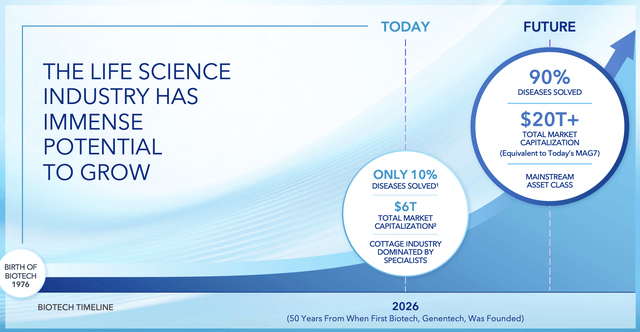
That is our long-term investment thesis. It is not something Alexandria’s third-quarter leasing results have already proved, but it explains why I see the company as a potential beneficiary of AI rather than simply a landlord waiting for the old market to return.
Moderna provides a separate reminder that important scientific progress continues despite the industry’s financial difficulties. In October, Moderna and Merck reported that their investigational personalized mRNA therapy, combined with Keytruda, reduced the risk of melanoma recurrence or death by 42% versus Keytruda alone in a Phase 3 trial following surgery. This was a clinical result, not the approval of a general-purpose cancer vaccine.
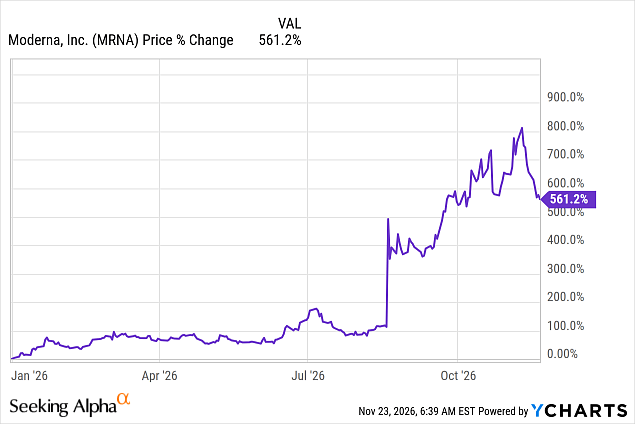
The connection to Alexandria is meaningful: Moderna was its third-largest tenant by annual rental revenue in the third-quarter filing, representing approximately 3.8% of the total. Successful drug development could strengthen such tenants and support future investment, although it does not automatically translate into additional leases.
What matters for our thesis is the potential cumulative effect of many advances over many years. If AI improves research productivity, lowers barriers to company formation, and makes more difficult drug programs economically attractive, I believe well-located life science campuses could become substantially more valuable.
In that environment, Alexandria would not simply be recovering from a downturn. It could be entering another prolonged period of growth, supported by a larger research industry and a much smaller pipeline of competing new properties. That possibility is central to how I think about its valuation.
