


Wireless communications tower infrastructure REITs have had a rough stretch over the last several years, driven primarily by macro headwinds and major tenant churn.
However, we believe that a fundamental shift has already begun that will ultimately create tailwinds for this niche of commercial real estate. We don’t know how long it will take for this shift to happen, but we are confident that it is underway.
At High Yield Landlord, we own two of the three major cell tower REITs:
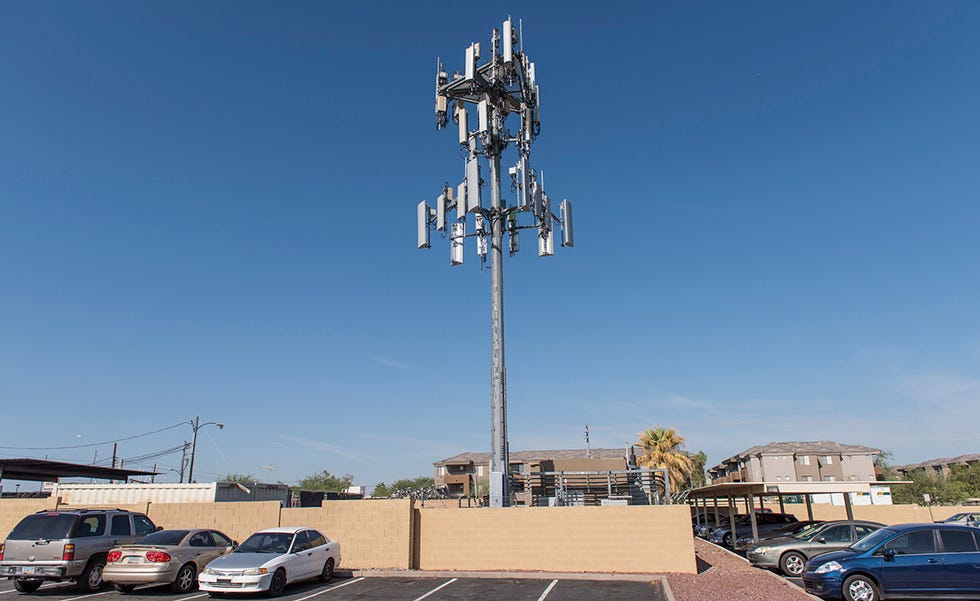
Both have, unfortunately, suffered poor performance in recent years for both macro and micro reasons.
The micro reasons for their poor performance are idiosyncratic:
Crown Castle has been weighed down by multiple CEO shakeups and a fundamental strategy review that ultimately led to the sale (at a steep loss on cost basis) of the REIT’s fiber and small cell segment.
SBA Communications went into the rate-hiking cycle several years ago with a high debt load and has been sacrificing growth for the sake of deleveraging ever since.
Both REITs’ micro headwinds are in the process of being eliminated. CCI is disposing of its small cell segment to deleverage, while SBAC has brought down its own net leverage ratio from ~8.5x in 2022 to the low-6x area this year.
Once these headwinds are in the rearview mirror, we believe both REITs will settle into a new equilibrium of roughly mid-to-high-single-digit annual AFFO per share growth rates.
At 2027 FFO multiples of ~17x for CCI and ~15x for SBAC, we see both REITs as being cheaply valued, especially given their improving fundamentals, recession-resistant cash flows, and strengthening balance sheets.
Below, we will explain the four major reasons why we see these two REITs as good values today.
1. Interest Rate Relief On The Horizon
By far the biggest potential catalyst for strong performance from the tower REITs would be interest rate relief.
Alongside net lease REITs, cell tower REITs are among the most interest rate sensitive sub-sectors in the real estate space. They sign 5-10 year contracts with carriers that feature 2-3% annual escalators and no cancellation clauses. While operating expenses are minimal, capital costs are fairly significant, because tower REITs have historically made ample use of debt (although less so in recent years).
All three of the major cell tower REITs have steady slates of debt maturities. This makes them quite sensitive to the level of interest rates, especially the BBB corporate bond yield.
Here’s a chart contrasting cell tower REIT cash flow multiples against the BBB corporate bond yield:
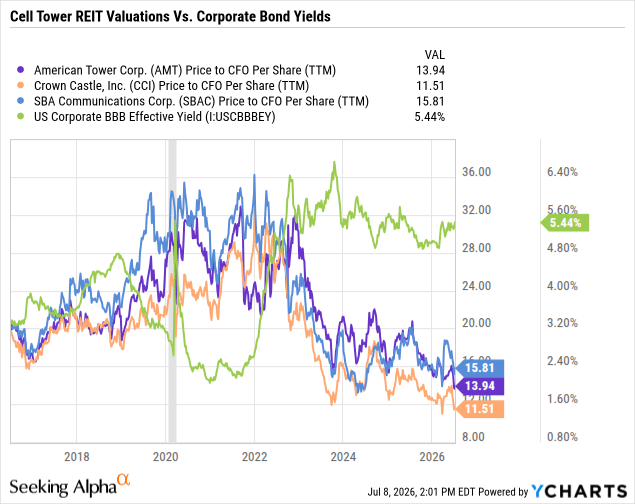
You can see that when rates shoot higher, tower REIT multiples reflexively contract. And when rates fall, tower REIT multiple inflects higher.
Today, with bond yields still elevated and lots of concerns about persistent inflation and “higher-for-longer” interest rates, tower REIT multiples remain depressed.
But as we have written about recently, we believe the CPI is near its year-over-year peak and should decline going forward.
The Cleveland Fed’s Inflation Nowcast, for example, forecasts the CPI to fall from May’s 4.2% to a rate of 3.9% in June and then 3.7% in July.
And the alternative inflation gauge Truflation likewise shows YoY consumer inflation falling in June.
Oil prices may remain volatile, but we think the general trajectory of the CPI should be downward for the remainder of the year (barring some other shock, of course). This should allow interest rates to ease lower as well.
As interest rates come down, cell tower REITs benefit due to both incrementally lower refinancing costs and lower yields on competing income investments. This should facilitate some upward re-rating of valuation multiples.
