



“Healthcare real estate” is a catch-all term for several property types that are devoted to serving some part of the medical industry.
With healthcare commanding almost 20% of US GDP, there is plenty of opportunity in this broad space for profitable real estate business models.
Let’s walk through some updates on the three major sub-categories of healthcare real estate before turning to Q3 2026 earnings updates for our healthcare REITs.
Senior Housing
Senior housing continues to be the strongest sub-category of healthcare real estate by a wide margin. The octogenarian (80+) population has entered a phase of accelerating growth that should persist for multiple decades. This growth in the senior population, along with steady home prices that create substantial equity, results in strengthening demand for senior housing.
In Q3 2026, senior housing occupancy surpassed 90% for the first time in a decade:
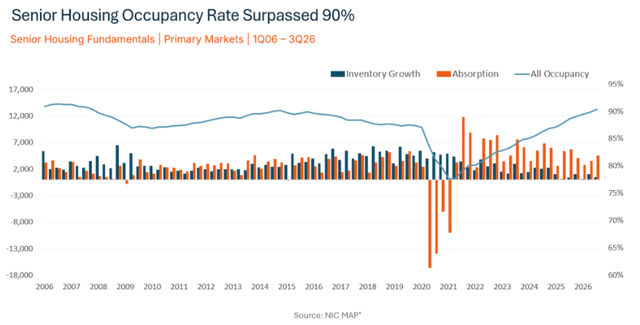
Notice the diagonal line straight up and to the right from 2021 to the present day. That signals an extremely landlord-friendly market in which absorption (tenant demand) has consistently outpaced inventory growth (new community completions).
Under normal market conditions, this would act as a powerful signal to developers to bring new supply online.
And yet, the development pipeline for senior housing is near its lowest level in two decades!
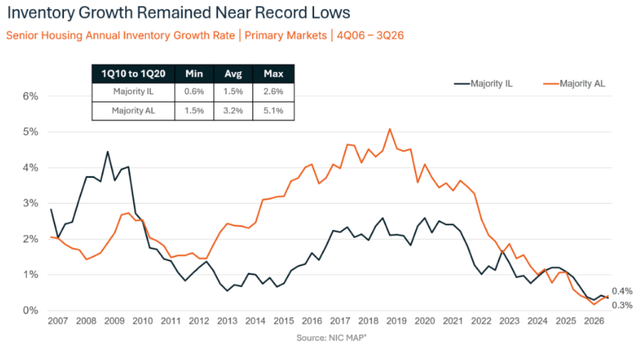
The combination of high construction costs, high interest rates, labor shortages in the construction industry, and scarce resources being devoted to the data center buildout is greatly suppressing the development pipeline.
While inflation and elevated interest rates have their obvious downsides to the real estate industry, they also offer the silver lining of lower growth in supply.
Strong demand plus little to no new supply equals very good fundamentals.
Medical Outpatient
For a highly defensive, necessity-based sub-sector like medical outpatient (formerly called “medical office buildings” or MOBs), the situation is rarely more extreme than mildly positive or mildly negative. It’s a slow-and-steady property type, much like grocery-anchored shopping centers.
Tenant retention tends to be high, while rent growth is often offset by rising operating costs to net out low- to mid-single-digit same-property net operating income growth.
As of Q3 2026, MOBs enjoy a mildly positive environment, with net absorption outpacing inventory growth.
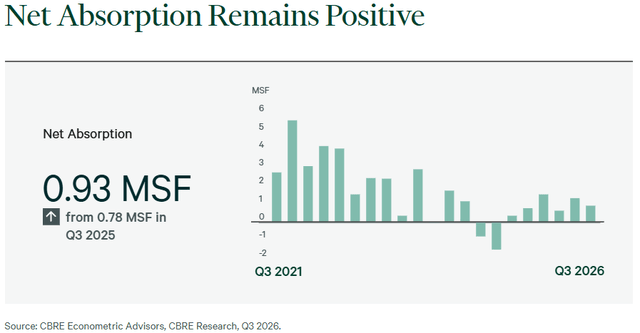
Changes to healthcare insurance coverage due to the Big Beautiful Bill could be mildly negative for MOBs in 2027, but not enough to cause concern.
Here’s another indicator of MOBs’ predictability and defensiveness: The vacancy rate has remained in a tight range of 9-10% over the last five years.
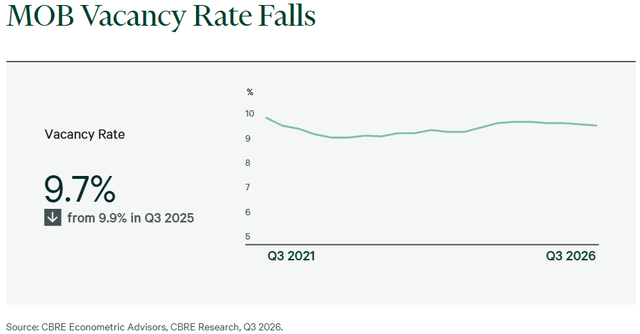
In a very good environment, the MOB vacancy rate fell to only 9% in 2021-2022.
As that good environment faded in 2024-2025, the vacancy rate rose only about 80 basis points.
Good news for the sub-sector is that, as with most parts of real estate, the development pipeline remains historically small. Completions in Q3 2026 fell to a new 5-year low.
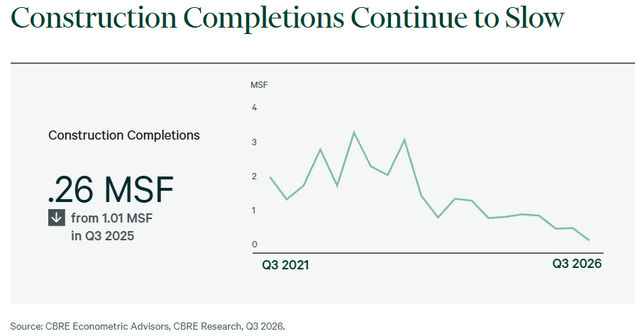
For at least the next few years, competition from new supply will remain low, providing a runway for further organic growth.
Life Science
Life science / laboratory space continues to be the weakest sub-sector within healthcare real estate.
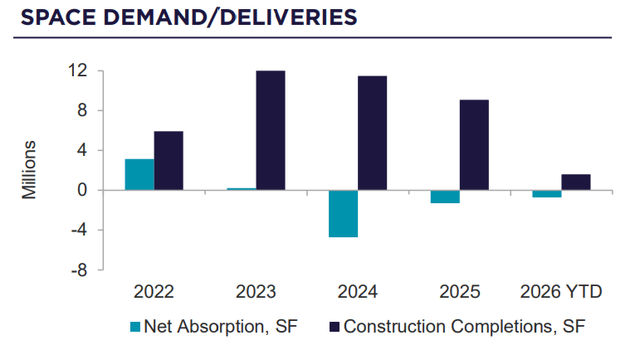
Tenant demand is not necessarily weak, although turnover has resulted in overall negative absorption in the first 9 months of 2026.
Cushman & Wakefield
The biggest problem life science real estate faces is the sheer volume of new supply that came to market from 2023 through 2025. Even if tenant demand had stayed at COVID-era levels, it would take time to absorb all of this new lab space. But with demand considerably weaker than in 2020-2021, absorbing this new supply is happening very slowly.
Some good news, albeit minor, is that life science vacancy stopped rising in Q3 and instead slightly dipped from its Q2 high of 24%.
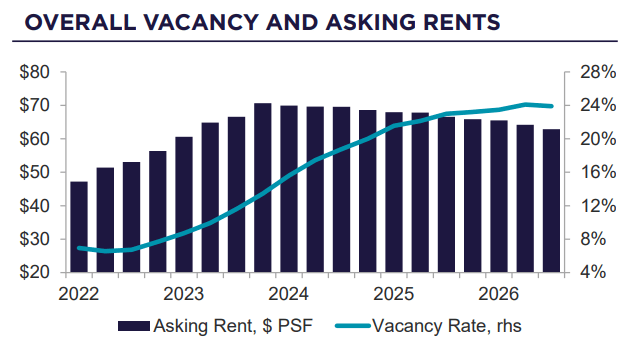
However, with this magnitude of available supply on the market, there should continue to be significant downward pressure on rent rates for the foreseeable future.
Life science is looking increasingly like traditional office. Both have national vacancy rates in the low- to mid-20% area. Both exhibit considerable weakness in Class B and C quality properties. And for both, Class A+ properties are performing extraordinarily well, especially relative to the rest of their respective property types.
Fortunately, our life science REIT Alexandria Real Estate Equities (ARE) focuses mostly on Class A mega-campuses in prime locations, and management is intentionally increasing concentration into the highest quality real estate. Unfortunately, though, ARE still has exposure to some weaker and/or worse-located properties that drag down the portfolio.
With that, let’s turn to the earnings updates for our four healthcare REITs:
