



Important Note:
I am spending this week at the REIT Week Conference in NYC, where I will be meeting with many REIT management teams. As a result, I may be a bit slower than usual to answer questions. Thank you for your patience. I expect to share exclusive insights from several REIT CEO interviews later this week. Stay tuned!
----------------------------------------------------
Earnings Update: Healthcare REITs (Q1 2026)
As we’ve explained previously, healthcare real estate is made up of four primary sub-sectors:
Medical outpatient buildings (”MOBs”)
Life science / labspace
Hospitals
Senior housing / care facilities
By far the fundamentally strongest sub-sector is senior-focused housing, which is effectively a hybrid between residential and medical real estate. Aging demographics and long-term growth in the elderly population creates an incredibly strong secular tailwind for this property type, and supply growth has not significantly picked up in response yet.
Within months, the national average occupancy rate for senior housing should rise over 90% for the first time in decades.
The weakest sub-sector is the life science space, which is still struggling amid oversupply and various leasing demand headwinds ranging from government funding cuts to elevated interest rates.
Fortunately, the pipeline of new supply coming to market has shrank to an extremely low level, but weak demand still isn’t enough to absorb the little new space being delivered.
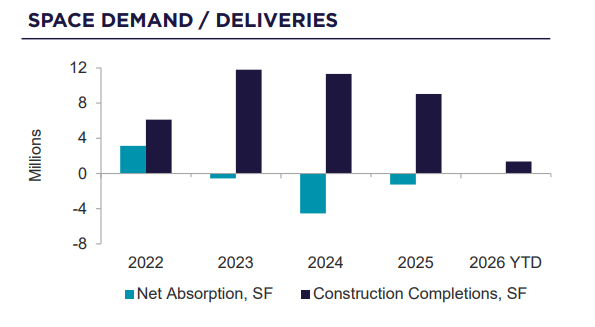
Net absorption has now been negative in the life science space for three years. The pandemic leasing boom in 2020-2021 was powerful but brief, while the development boom thereafter was even more powerful and sustained.
That has transformed the life science sub-sector from a consistently tight, low-vacancy market into a boom-bust space.
Right now, we are definitely in the “bust” phase of that cycle.
Vacancy rates continue creeping higher, while asking rent rates slowly decline.
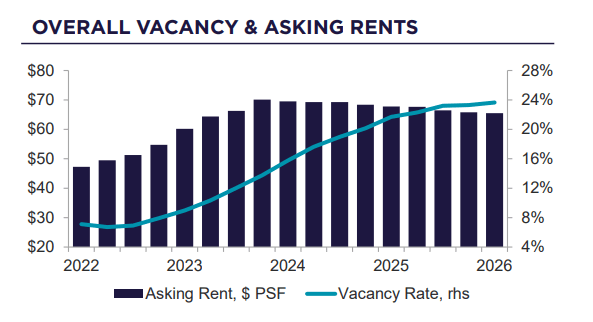
Tenants are firmly in control in lease negotiations, a situation that should persist until vacancy rates materially fall.
That said, given the prowess of American research universities as well as the robust US venture capital industry, we do believe the biotech sector will rebound -- eventually.
When it does, probably years in the future, there will be another boom in life science real estate. Until then, we take comfort in owning the highest quality REIT in this sub-sector. When life science does rebound, Alexandria Real Estate Equities (ARE) will lead the charge.
The fundamentals of medical outpatient buildings (”MOBs”) and net leased hospitals fall somewhere between the extremes of red-hot senior housing and cold-as-ice life science.
MOB asking rent rates increased 1.6% year-over-year. That slow growth rate is not unusual for this conservative, slow-growth sub-sector of healthcare real estate.
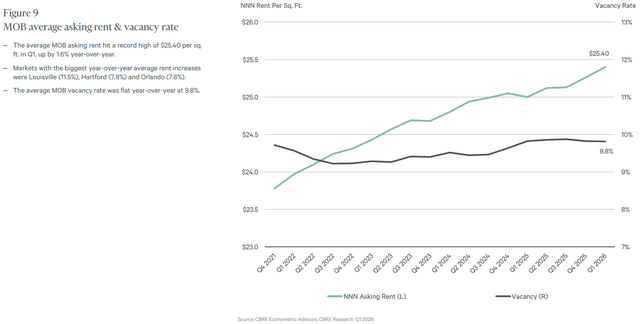
The national average vacancy rate is still almost 10%, which is where it historically tends to be.
It tends to be difficult to get MOBs 100% full (unless they are single-tenant) because there are only so many types of medical practices. For example, you often can’t put two cardiologists or two orthopedic doctors in the same building together. Sometimes lease contracts stipulate that no other equivalent practices can co-locate in the same building.
After some temporary weakness in leasing in the first half of 2025, MOB demand has rebounded and has now exceeded new supply additions over the last two quarters.
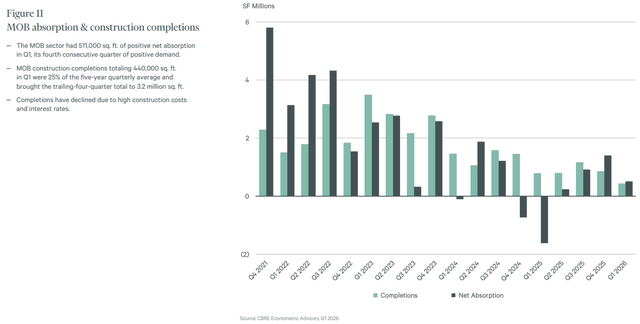
MOB is an extremely stable and moderate-growth sub-sector, which makes us highly confident in the solid return prospects of our pick in this space, Healthcare Realty (HR), especially after the management shakeup and dividend reduction.
Finally, net leased hospitals are performing moderately well, but the risk is heavily dependent on the level of interest rates. Most hospital tenant-operators are backed by private equity sponsors, and these for-profit operators tend to carry high leverage. Even as Medical Property Trust’s (MPT) balance sheet improves, the REIT’s tenant base remains sensitive to the movement of rates.
Recently, we got a reminder of the institutional attraction to healthcare real estate, especially net leased properties occupied by financially strong tenants, with Blue Owl Capital’s (OWL) ~$2.4 billion acquisition of Sila Realty Trust (SILA).
Year-to-date, our former holding of SILA, which was also by far our largest healthcare holding, has been the best performer, while HR has likewise doubled the performance of the real estate index (VNQ):
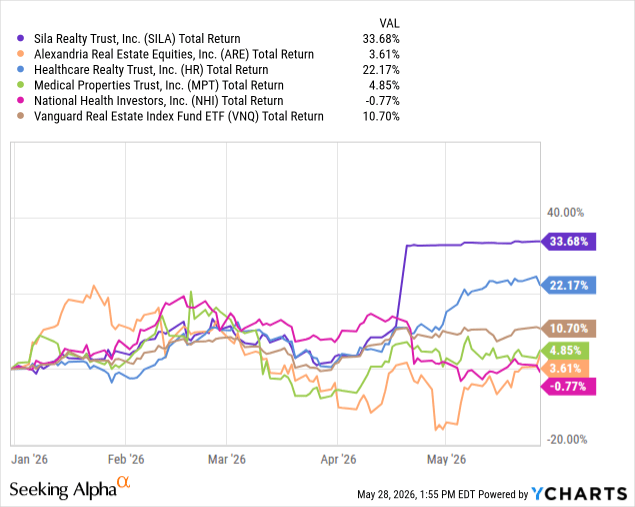
ARE, MPT, and our newest healthcare holding of National Health Investors (NHI) have all had tepid performance so far this year, each driven by idiosyncratic factors.
ARE is struggling with weak demand and rising vacancies in its core markets.
MPT is vulnerable to elevated interest rates due to its PE-backed tenants.
And NHI was performing well until the announcement of its skilled nursing facility dispositions, which will drag down FFO per share growth in the short-term but ultimately make the REIT stronger and higher quality.
With that, let’s turn to the earnings updates for our four healthcare REITs:
