



“Healthcare” is a catch-all term that includes four unique property types within commercial real estate:
Medical outpatient buildings (”MOBs”)
Life science / lab space
Hospitals
Senior housing / care facilities
Let’s briefly summarize the latest data on each sub-sector before turning to the Q2 2026 earnings updates for our four healthcare REITs.
Senior Housing
Senior housing continues to be by far the strongest sub-sector of healthcare real estate. The negative memories associated with the COVID-19 pandemic have faded, and occupancy rates at all types of senior-oriented facilities is surging higher.
This chart illustrates the degree of pain experienced by this sub-sector during the pandemic in 2020 but also the incredible strength it has enjoyed since then.
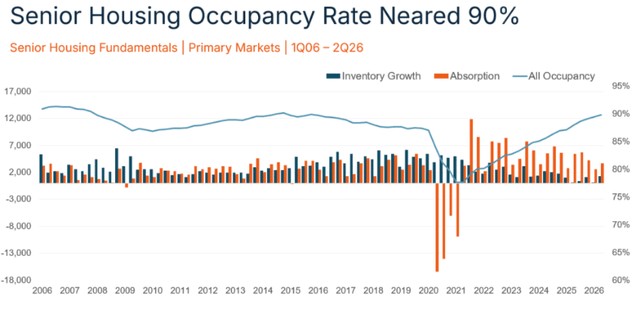
The national average occupancy rate has soared from less than 80% in 2021 to 90% today. Senior housing hasn’t seen this level of occupancy in over a decade.
There’s no end in sight to these tailwinds, given robust growth in the population of seniors as well as minimal development of new senior housing units.
Elevated interest rates and construction costs continue to suppress growth in the development pipeline, further extending the period of time in which existing supply faces minimal competition.
This translates into strong organic growth for senior housing landlords with SHOP (senior housing operating property) assets as well as stronger rent coverage for landlords of triple-net leased properties.
Medical Outpatient Buildings
Behind senior housing, the next strongest sub-sector of healthcare real estate right now is medical outpatient, formerly called “medical office buildings” (”MOB”). The industry switched to the “outpatient” terminology to differentiate these properties from the various forms of inpatient care facilities.
Medical outpatient tends to be one of the steadiest areas of commercial real estate. Like grocery-anchored shopping centers, MOBs tend to be quite recession-resistant but also limited in bottom-line growth capacity.
Traditionally, deliveries of new MOB supply have been closely correlated to net absorption. Over the last several quarters, however, net absorption has increasingly outpaced new deliveries.
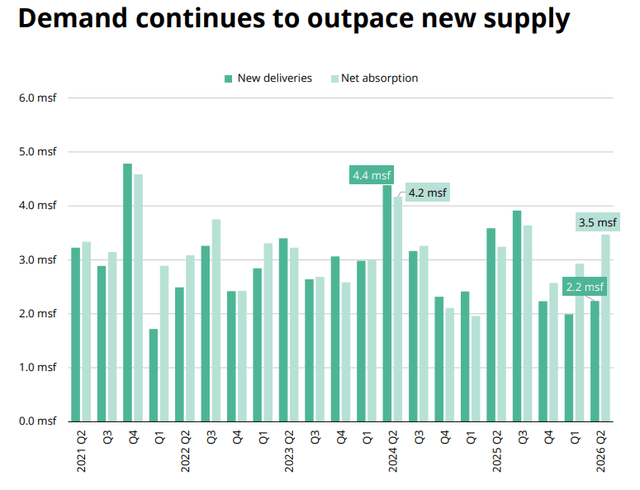
As you can see, in Q2 2026, net absorption came in an astounding 1.3 million square feet higher than additions of new supply.
The natural result of this leasing strength is a precipitous drop in vacancies and available space (including sublease space).
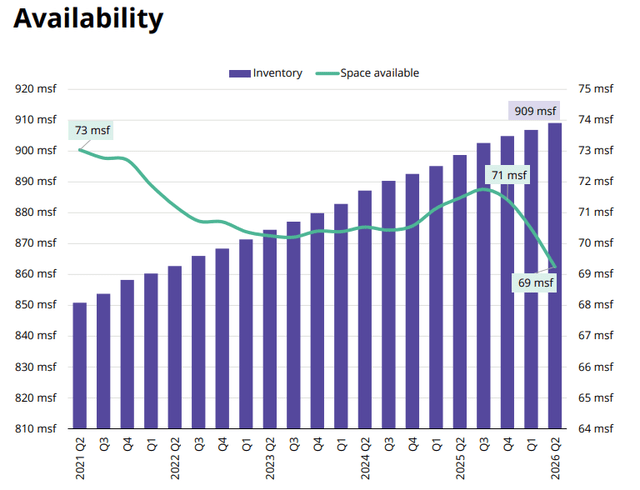
Over the last year, the MOB sub-sector has enjoyed a sharp drop in available space on the market, which in turn leads to greater competition for the remaining available space.
As the vacancy rate continues to decline, we should see a gradual pickup in market rent growth. So far, the decline in vacancy has not noticeably increased rent growth.
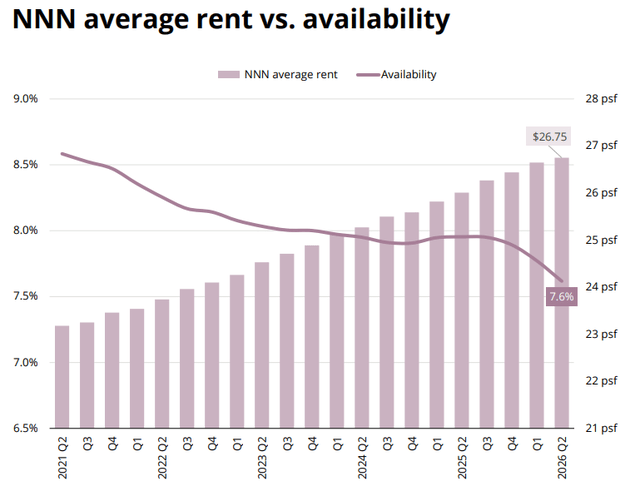
Over time, however, we should see landlords capitalize on this lower vacancy rate to push rents higher and negotiate better lease terms.
As for most other areas of commercial real estate, the development pipeline for MOBs has shrunk over the last several years.
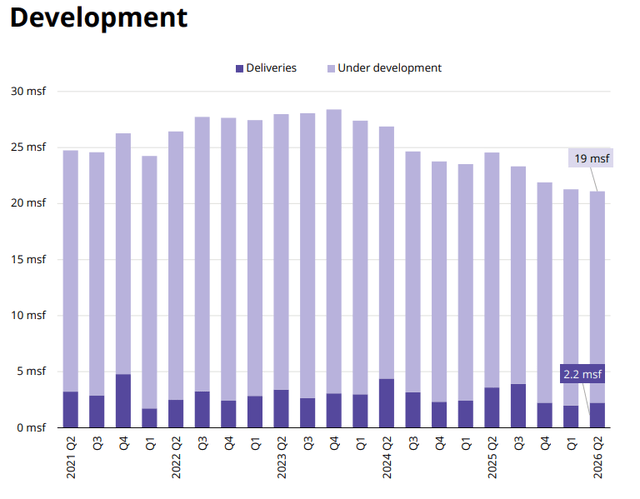
At exactly the time when construction should be increasing to match the growth in demand, it is actually shrinking. That is due, of course, to high interest rates and construction costs, which make the economics of ground-up development less attractive.
Again, this lengthens the period of time in which existing MOB properties enjoy depressed levels of new competition, creating a favorable environment for landlords (including REITs) over the next few years.
Hospitals
While most hospitals are leased on a triple-net basis, it is notable that operators continue to struggle with sub-optimal margins due to changes in government policy and reimbursement rates.
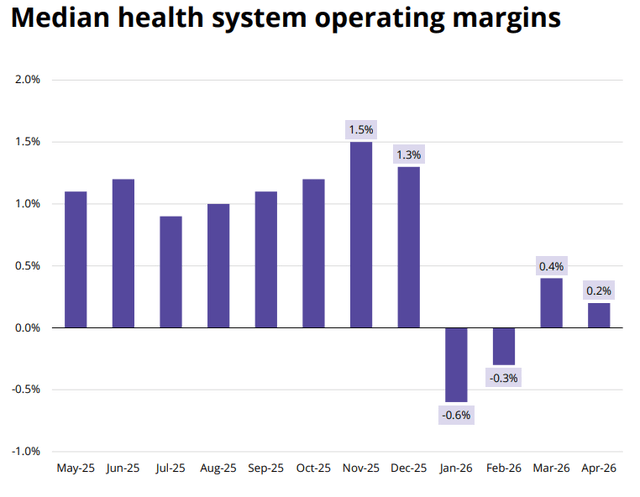
In particular, recent changes to the government-sponsored insurance market have resulted in a material reduction in the insured population. Uninsured patients often cannot obtain care outside of hospitals, which means that hospitals are extending care to more uninsured patients (thereby increasing operating expenses) while receiving little to nothing in compensation.
Running hospitals is simply a tough business. It is difficult to consistently turn a profit while performing the function that societies demand of them. That is, this is a difficult task unless the government steps in to subsidize them. When subsidies are reduced, profitability is reduced.
Life Science
Finally, we turn to the life science sub-sector. This is weakest part of healthcare real estate right now, but we see some green shoots that make us optimistic about the future.
First, we note that due to the huge level of development that occurred in the wake of the pandemic, deliveries have massively outpaced tenant demand since 2023.
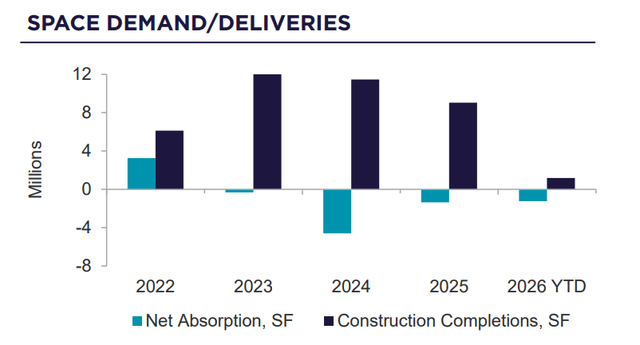
This year, finally, additions of new space have fallen to a low level, but unfortunately, tenant demand continues to be weak.
As best we can tell, artificial intelligence is not having a significant impact on leasing. New formulations still need to be tested and verified in laboratory settings, even if AI programs assisted in their discovery.
Rather, we think pharmaceutical and biotech companies engaged in over-leasing of space in 2020-2021 amid a huge wave of government and private equity funding. Since then, they have been cutting back on excess space while an abundance of new buildings have come to market.
The vacancy rate has crept above 24%, while asking rent rates have drifted steadily down.
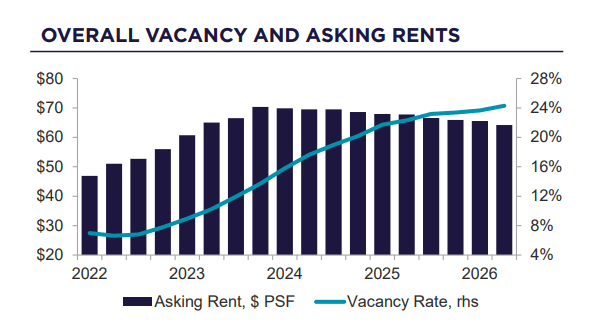
When leases are anywhere from 5 to 20 years in length, it simply takes a while for big shocks to work through the system into these numbers.
Now, all of the above is the bad news. What is the good news for life science real estate?
We see some green shoots signaling that better days are ahead, although we still cannot forecast how long they take to manifest.
First, developers have gotten the message about life science weakness in the market. The development pipeline has shrunk considerably.
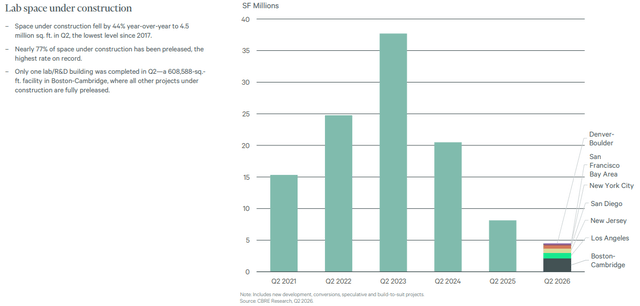
There is now less than 5 million square feet of life science space under various stages of development, with about half of that concentrated in the premier research hub of Boston.
At this point, the amount of new speculative supply under development has dropped to an extremely low level.
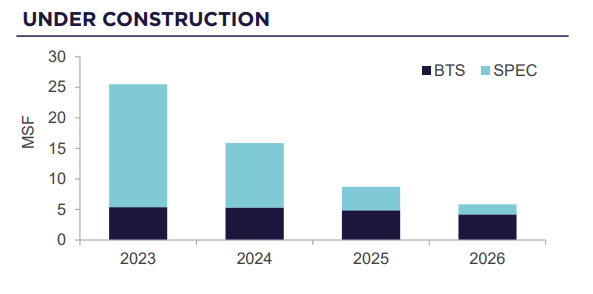
Most of the current pipeline are build-to-suit buildings that are already preleased to their intended user.
With basically zero speculative supply coming to market at this point, the only thing required for a rebound is a pickup in tenant demand.
That’s where venture capital funding comes in. When it comes to biotech companies, which are the primary tenant base of life science real estate, the biggest determinant of leasing demand is VC funding commitments.
Fortunately, over the last four quarters, VC funding for life sciences companies has picked back up.
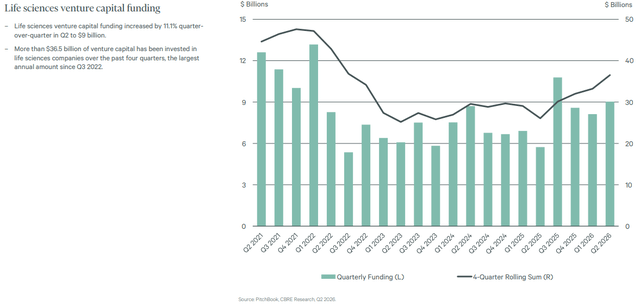
As long as this rebound in VC funding continues, we should see leasing volume from biotech tenants follow.
With such a large amount of vacant supply on the market, the life science recovery will inevitably take a long time. But we do think the cyclical trough has passed.
Better days are ahead.
With that, let’s turn to the earnings updates for our four healthcare REITs:
