



US industrial real estate now appears to be at or slightly past its cyclical trough.
The national average vacancy rate hovers in the high-6% to low-7% area. The construction pipeline has bottomed at a historically low level and now appears to be gradually inching higher. Market-rate rent has returned to slight growth after a years-long downtrend.
Fundamentally, the bottom is in. The industrial sector has turned a corner.
This chart illustrates the industrial real estate cycle over the last five years:
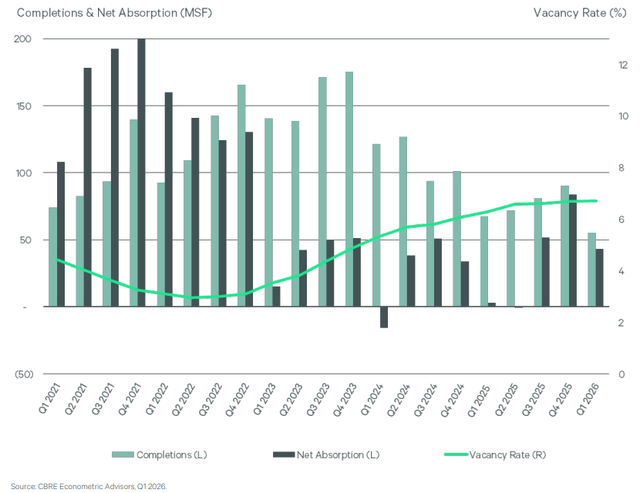
Coming out of the pandemic, in the red-hot economy of 2021-2022, net absorption significantly overwhelmed new supply. But then the economy cooled right as a big wave of new supply came to market from 2023-2024.
Only in the last few quarters has tenant demand rebounded meaningfully, reaching close to the level of completions.
Here’s a simplified version of the chart above, showing the bulge of new supply in 2023-2024 amid a soft leasing environment.
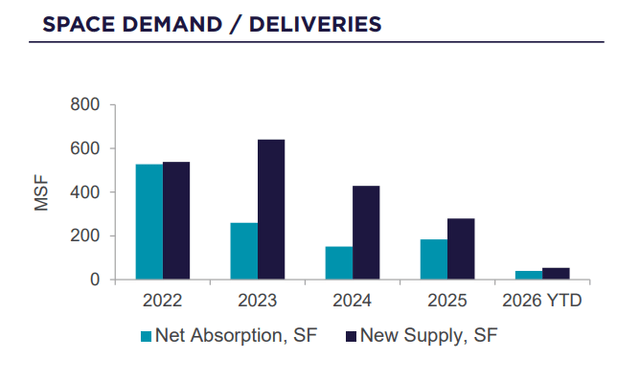
In Q1 2026, net absorption still hadn’t quite reached the level of new supply additions, but the trajectory is in landlords’ favor.
Top real estate services firms like CBRE and Cushman & Wakefield project that industrial vacancies will gradually decline over the course of this year.
Another green shoot sprouting up after a few years of oversupply is the return to slight growth in asking rents.
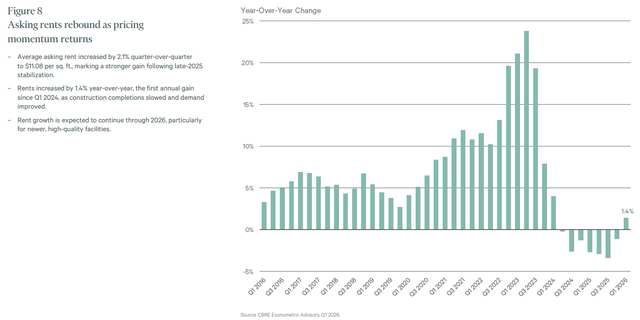
Q1 2026 saw the first quarter of positive asking rent growth since Q1 2024.
While no one is projecting wildly strong rent growth this year, it is favorable to see this metric moving in the right direction again.
Before moving on to the earnings updates for our industrial REITs, we would like to correct the record on a common talking point about industrial real estate.
It is often mentioned, even in some industry reports, that reshored manufacturing is (or is expected to be) a significant and growing source of leasing demand. Plenty of headlines and politicians would like for this to be the case.
We simply don’t see it in the data.
The only significant source of growth for US manufacturing is technology equipment and semiconductors. Output for all other types of manufacturing is stagnant or declining over time.
Total Manufacturing Production (Green) Vs. Semiconductor/Tech Hardware Manufacturing (Blue):
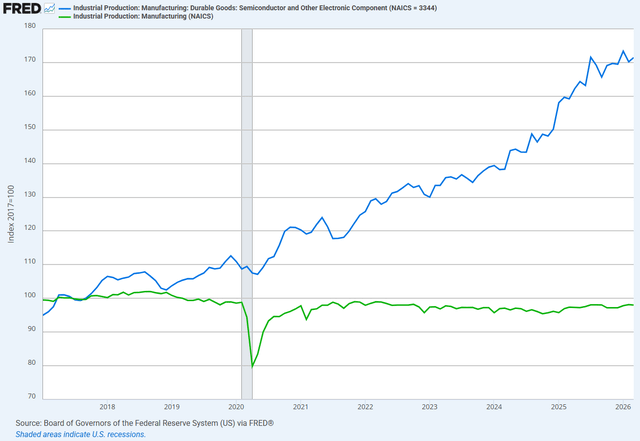
You might think that the CHIPS & Science Act of 2022 is the primary reason for this growth in US manufacturing output of tech hardware. But as you can see, growth in this part of manufacturing has been a trend for the last decade or more.
Various government policies from both Democrats and Republicans have tried to reverse this long, slow decline in the US manufacturing sector to no discernible avail.
That is largely because pro-manufacturing policies like tax incentives are offset by inadvertently anti-manufacturing policies such as tariffs on inputs and deportations of manufacturing workers.
Manufacturing tenants account for only about 10% of big-box industrial leasing, and even less of total industrial leasing.
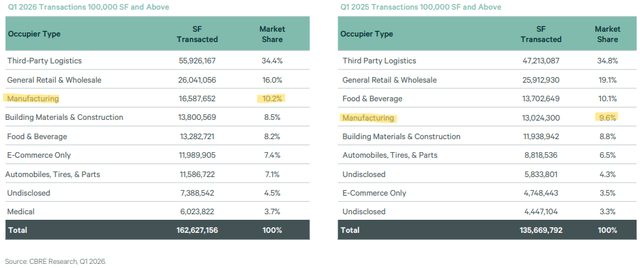
The bull case for industrial REITs does not rest on a broad-based resurgence of manufacturing in the United States.
Instead, industrial real estate fundamentals are largely tied to the growth of retail sales and especially e-commerce sales.
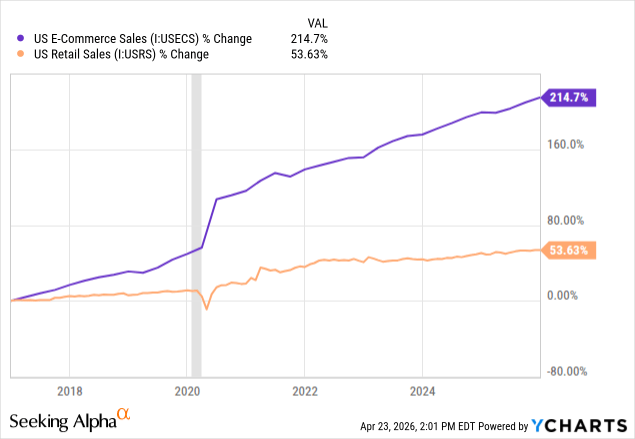
Since the beginning of 2017, US retail sales (nominal) are up over 50%, while e-commerce sales have grown over 200%.
But to be clear, the more important metric to watch for industrial real estate is real (inflation-adjusted) retail sales. This measures volumetric or unit-level growth of retail sales rather than the dollar-value of retail sales.
If you overlay real retail sales against industrial net absorption, you will find significant correlation between the two.
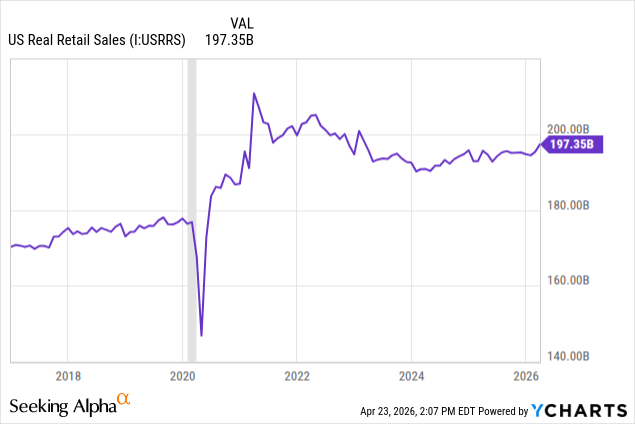
A huge spike in real retail sales in 2021-2022 led to three years of stagnation thereafter. That explains both the surge in net absorption in 2021-2022 as well as the anemic net absorption from 2023 through 1H 2025.
Fortunately, as you can see if you look closely, real retail sales turned upward in the early months of 2026. If that becomes a new growth trend (perhaps after the Iran-related inflation recedes), then an uptrend in industrial net absorption should follow.
In short, resilient consumer spending and especially continued growth in e-commerce is the primary driver of demand for industrial space. Manufacturing does not contribute meaningfully to net absorption.
Let’s now take a look at the Q1 2026 earnings update for our three industrial REITs:
