


As we have explained in the past, the US industrial real estate sector has absorbed its post-pandemic wave of new supply remarkably well -- better than any other sector of commercial real estate that experienced such a supply wave.
That is largely due to the wide-ranging tenant demand for this type of space. It is needed to support e-commerce, logistics, product storage, business-to-business supplies, raw material storage, and so on. As one type of user pulls back on their leasing footprint, another may rise up to take its place.
Data center developers and the various contractors supporting them have been perhaps the biggest source of new demand over the last few years.
After several strong leasing quarters, nationwide net absorption of industrial space has now surpassed new supply additions year-to-date:
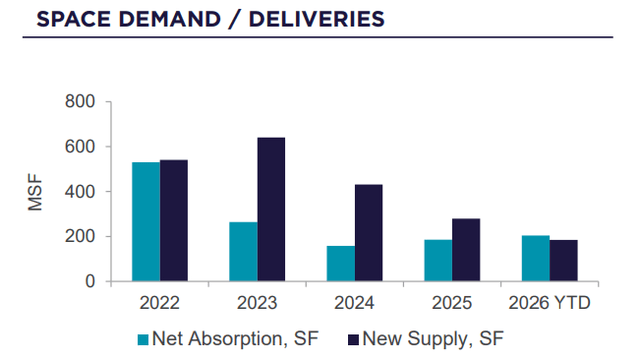
This is the first time net absorption has outpaced new supply since 2021, according to Cushman & Wakefield.
From 2023-2025, developers responded to the pandemic-era demand surge by delivering a wave of new supply. But this occurred at the same time as that stimulus-driven demand surge fizzled out.
The result, as you can see in the chart below, was a sharp rise in the industrial vacancy rate from its historic low of 3.6% in 2022 to a peak of 7.3% in early 2026.
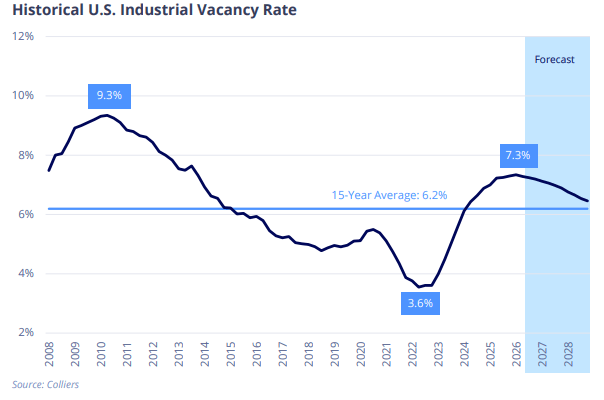
Over the course of this year, the industrial real estate sector appears to have passed the trough of the cycle and entered the early-stage rebound.
Net absorption has surpassed new supply, which allows the vacancy rate to gradually fall and rent growth to slowly pick back up.
Meanwhile, developers are incrementally responding to market signals by initiating more construction projects.
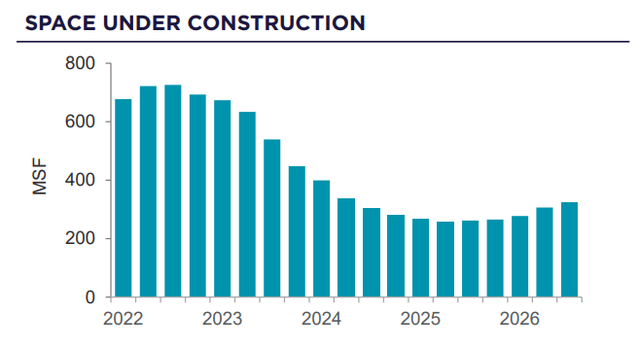
While the industrial construction pipeline has certainly rebounded off its low, we are not concerned at this point about another wave of excessive supply hitting the market in a few years. High construction costs and interest rates should effectively suppress any movement toward a surplus in speculative development.
Colliers forecasts industrial supply and demand to remain tightly correlated to each other over the next few years, with demand slightly outpacing new supply.
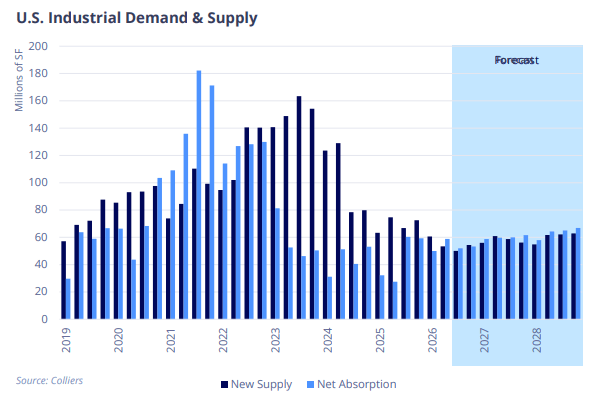
While this may not produce the kind of incredible growth we saw in 2020-2021, we actually prefer the market to be steadier and more predictable, as it prevents a boom-bust cycle.
Steady, incremental growth beats whipsawing fundamentals and uncertainty about future performance.
Let’s now take a look at the recent earnings updates for our three industrial REITs:
