



Quick Note:
I am today at a major real estate conference in Europe. It should be particularly relevant to Xior Student Housing, Vonovia, Cibus Nordics, Tallinna Sadam, Shurgard, and Branicks. I will share all my takeaways later this week.
--------------------------------------------------------------------
Earnings Update: Industrial REITs (Q4 2025)
Of all the commercial real estate sectors that experienced a surge in new supply after the pandemic, the industrial sector has been by far the best performing.
While the multifamily and life science sectors have faced strong headwinds from the magnitude of new supply, the industrial sector has taken the bulge of new supply in stride and remained largely stable.
In 2025, the recurring motif on earnings conference calls was tenant reluctance to make leasing decisions. Tariffs, changes in fiscal policy, and the trajectory of interest rates provided enough uncertainty to give occupiers pause before expanding their footprints.
That appears to have changed in the second half of the year and especially Q4 as industrial leasing came in stronger than expected.
In 2026, we expect the late-year strength to compound as uncertainty subsides and tax benefits (e.g. bonus depreciation and deductibility of manufacturing capex) give a boost to commercial construction.
Moreover, e-commerce sales continue to steadily grow, providing another secular tailwind to logistics real estate demand.
Total leasing (including new and renewal leases) held steady from 2024 levels and were about the same as those of 2019.
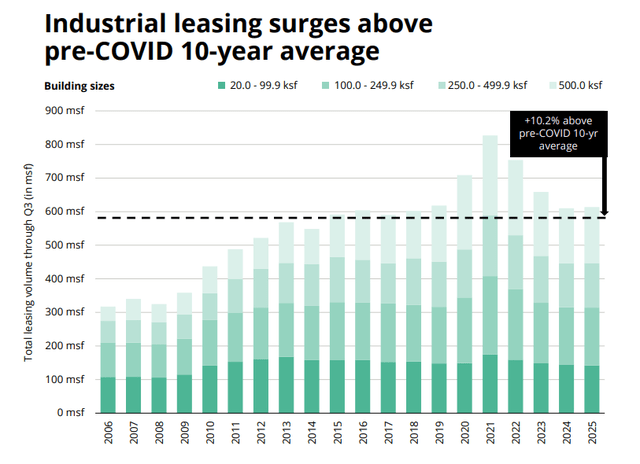
All else being equal, industrial demand looks solid.
But all else is never equal. Supply always matters in addition to demand. And there has been a huge surge in new supply over the last several years, primarily concentrated in big box warehouses.
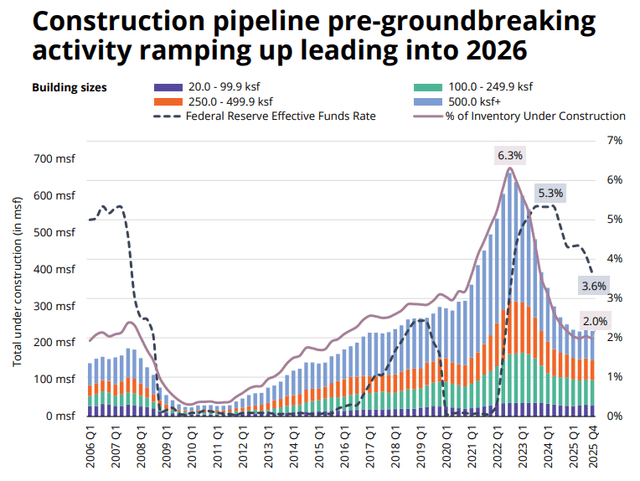
At this point, the ongoing construction pipeline is equal to 2% of total industrial supply, which is the lowest level in a decade.
Industrial deliveries hit an 8-year low in 2025.
However, while there are no signs of another boom in industrial construction, there has been an uptick in the pre-groundbreaking development pipeline as developers anticipate a swell in demand later this year.
Now, combining the last two charts above, we found that net absorption slid further downward in 2025 as total leasing demand remained steady but new (or expansionary) leasing failed to absorb the level of new supply coming to market.
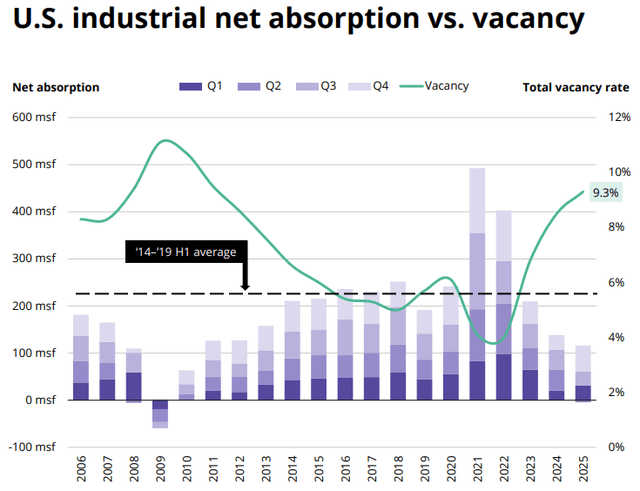
When net leasing demand falls short of net supply growth, the natural result is a rise in the vacancy rate.
The good news for our industrial REITs is that most of this increase in vacancy came from speculative (non-preleased) industrial buildings delivered to the market. Even so, competition from these brand new buildings looking for tenants puts downward pressure on net effective rents (rent rates inclusive of concessions such as free rent or interior buildout budgets) for the sector as a whole.
Much of the drop in net absorption in 2025 was concentrated in coastal/port markets like Los Angeles. To quote the Q4 industrial report from Cushman & Wakefield:
Historically, key port-proximate markets capture 20-25% of annual net absorption. In 2025, however, maritime trade moderation reduced their share to just 13% of total demand. Instead, inland markets led demand: Dallas/Ft. Worth (31.1 msf), Indianapolis (13.7 msf), Phoenix (13.7 msf), Kansas City (11.8 msf), and Columbus (9.8 msf).
We mark this up as a casualty of the trade tensions and tariff uncertainties experienced last year. As those tensions and uncertainties subside, we expect to see a rebound in port-proximate leasing activity.
As we indicated above, the majority of new supply additions over the last several years have been big box buildings that serve as warehouses and regional distribution hubs. That’s where there are currently the highest vacancy rates and the most competition for tenants.
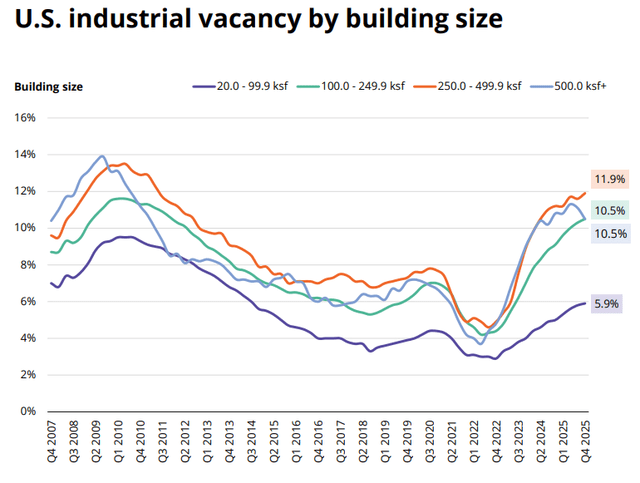
That said, tenant demand has been insufficient across all building sizes to keep up with supply additions. Hence the rise in vacancy even for smaller building sizes.
Again, though, these smaller industrial properties are mostly held by developers, who tend not to sell them until they have been leased and stabilized. REITs like ours own very little of this fresh new crop of vacant industrial supply, as they have been highly disciplined about development projects over the last few years.
Moreover, we are probably at or near the peak in vacancy rates for this cycle.
Over the course of 2026, we expect to see vacancy rates gradually come down.
Lastly, we will mention that growth in e-commerce sales continues apace, providing a sustained, secular tailwind for industrial real estate demand.
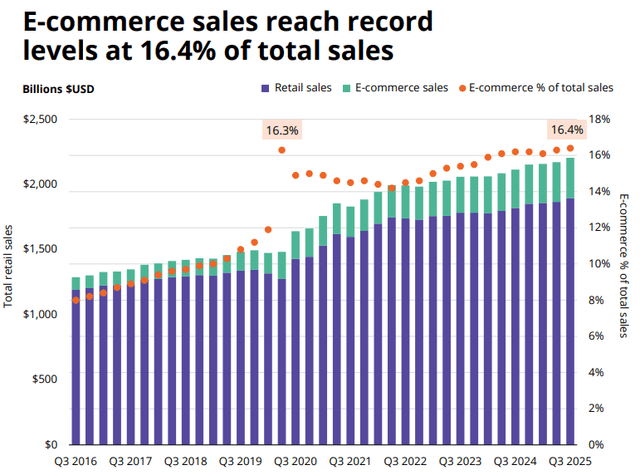
E-commerce products require significantly more industrial space than goods sold by brick-and-mortar retailers, because the retail buildings used by these retailers act as their primary “last-mile” facilities.
For e-commerce goods, infill industrial buildings act as those last-mile distribution facilities.
With that said, let’s now turn to the Q4 2025 earnings results of our three industrial REITs:
