



Recent data solidifies the thesis that US industrial real estate has passed its cyclical trough and begun a gradual rebound.
You might not have noticed any cyclical trough, especially not if your primary exposure to industrial real estate is through geographically diversified industrial REITs. That is because the fundamentals for industrial have been so strong and steady that the wave of new supply over the last few years has been steadily absorbed.
Solid economic growth has sustained demand from the usual suspects like third-party logistics, e-commerce, physical retail, manufacturing, and construction supplies, but the nationwide data center buildout has introduced another source of demand, especially for big box warehouses.
To be clear, the analyst consensus forecasts a modest, gradual rebound. It would require some unforeseen catalyst to bring about another leasing boom.
Some pundits believe that a new US manufacturing boom is coming, and that will fuel another strong wave of industrial leasing demand. We are vigilantly watching out for signs of such a manufacturing boom, but so far we don’t see any.
Let’s look at some charts that illustrate the current situation for industrial real estate.
First, after three consecutive years of supply growth outpacing leasing demand growth, the first half of 2026 has finally balanced supply and demand.
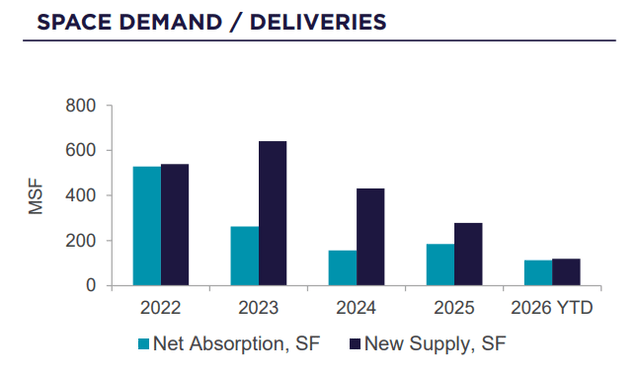
Demand appears to have bottomed in 2024 and rebounded slightly in 2025. This year, it is expected to rebound a little more.
Asking rent rates rose 2.9% YoY in Q2, up from 2.1% in Q1.
Meanwhile, on the supply side, the development pipeline remains muted, having ticked up only slightly in Q2 2026.
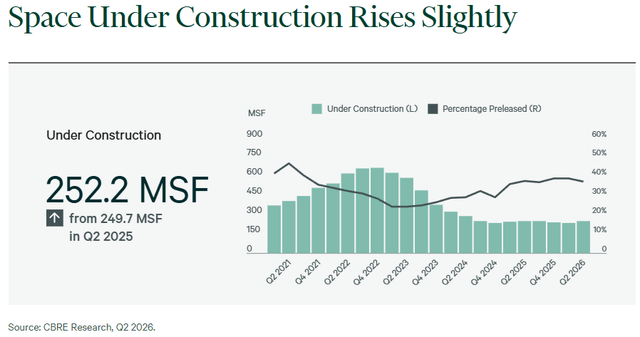
With construction costs and interest rates still high and market rent growth only just beginning to grow again, it looks unlikely that another surge in new construction will manifest anytime soon.
A little over 1/3rd of the development pipeline is preleased, meaning that about 2/3rds is being built on spec (or speculation that it will be leased). Generally speaking, the lower the spec pipeline, the better for existing properties. But this percentage of spec, combined with the relatively small overall pipeline, guarantees a low level of downward pressure on rent rates over the next few years.
Unless you have been on an expedition to Antarctica over the last three years, you know that the primary driver of economic growth today is artificial intelligence and its related infrastructure buildout. That trend has reached into the industrial real estate space as well.
Over the last decade, the majority of all growth in US manufacturing output has come from technology-related products, and that growth has accelerated over the last few years as a result of the AI trend.
US Tech Manufacturing (Blue) vs. US Non-Tech Manufacturing (Green):
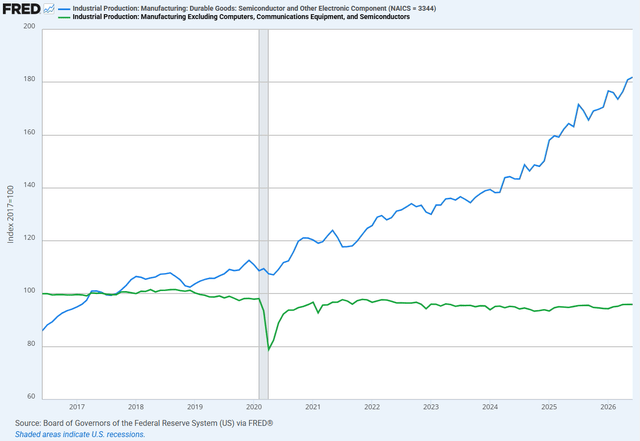
Notice in the above chart that non-tech manufacturing has been in a slow, steady downtrend over the last decade. It has seen a slight rebound over the last year or so, but much of that is due to second- or third-order beneficiaries of the AI infrastructure buildout.
We’ve been watching for signs of a manufacturing resurgence in the United States, because we’ve heard plenty of pundits predict one coming. But so far, we are not seeing signs that one is on the way.
Economic research has found very little net effect on US manufacturing of the tariffs in 2018-2019, and tariffs appear to be having a similarly muted impact on manufacturing in 2025-2026 as well.
Whether you liked or disliked it, the massive government infrastructure spending bills passed in 2021 and 2022 did prove effective at boosting construction of new manufacturing capacity.
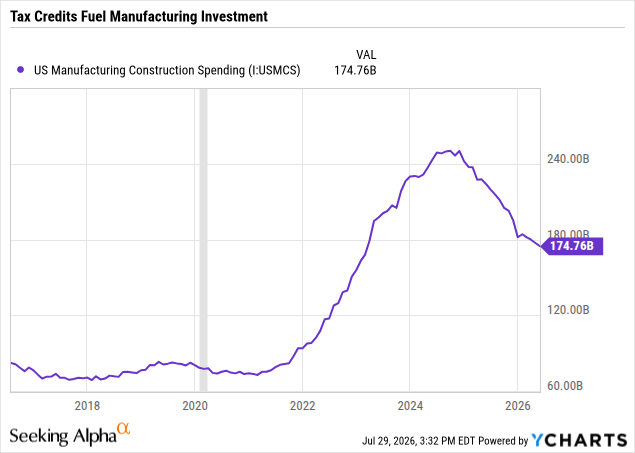
If you want private companies make huge investments they otherwise wouldn’t make, you have to pay them to do so.
On the other hand, supply chain workarounds and price increases can mitigate the potency of tariffs.
For example, the “Liberation Day” tariffs of 2025 caused a sharp drop in goods imports from China, but within a few quarters, American importing companies shifted their supply chains to other Asian countries. Now, overall goods imports from Asia is higher than before “Liberation Day” and back to growth.
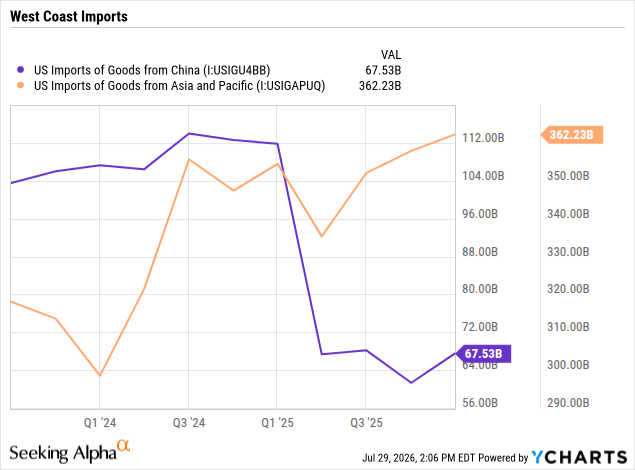
As long as import workarounds are possible, a significant wave of reshoring is unlikely to occur.
That is good news for our Southern California industrial REIT Rexford Industrial (REXR), whose industrial properties across SoCal directly or indirectly benefit from higher throughput volume at the ports of LA and Long Beach.
Meanwhile, the AI infrastructure buildout has benefited all three of our industrial REITs by creating a new source of leasing demand. It appears that big-box warehouses have been the primary property type to benefit.
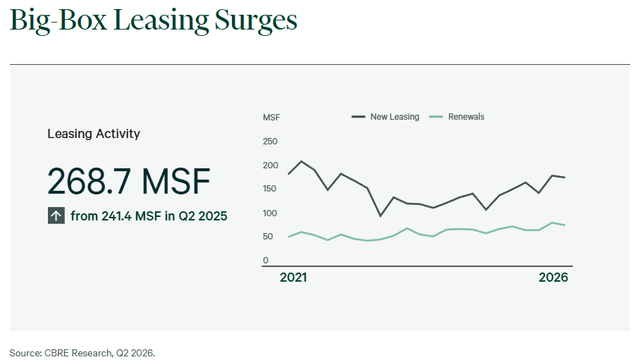
This is good news for First Industrial (FR), our only industrial REIT that focuses on owning and developing big-box logistical facilities.
So far this year, Sunbelt industrial blue-chip EastGroup Properties (EGP) has performed best, boasting ~20% total returns, followed closely by First Industrial.
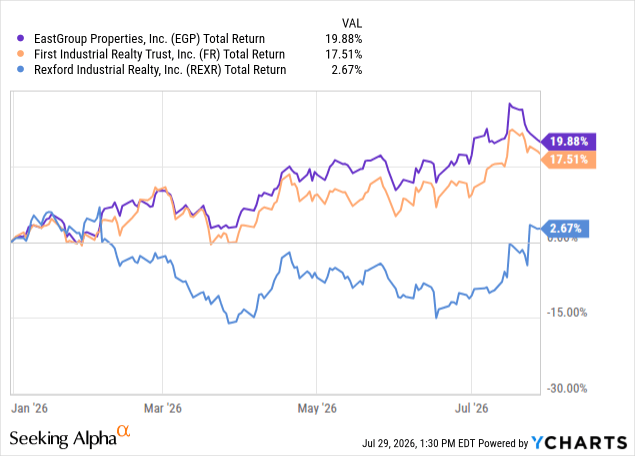
Rexford Industrial has turned in more modest YTD performance as the REIT sells assets in order to repurchase shares, but it has enjoyed a robust rally over the last month.
Let’s now take a look at the recent earnings updates for our three industrial REITs:
