



Net lease REITs account for 23% of our Retirement Portfolio, acting as the sturdy anchor of moderate yield and consistent, reliable, inflation-matching or -beating dividend growth.
They have been performing their job well this year, even amid war, oil price spikes, and rising interest rates.
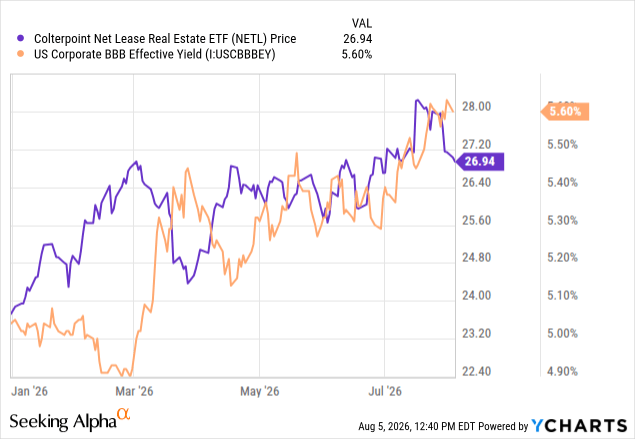
That said, in recent days, net lease REITs (NETL) have dropped in price as the relentless upward march of long-term interest rates finally begins to take a toll.
YCHARTS
The market yield of BBB corporate bonds stands as a good proxy for net lease REITs’ average cost of debt.
As you can see, up until the last month or two, net lease REIT prices remained highly negatively correlated to corporate BBB yields. When yields fell, net lease REIT stock prices rose. When yields rose, net lease REIT stock prices dropped.
We believe that from the beginning of the Iran conflict through sometime midyear, the market was looking through the current inflationary spike, seeing it as a temporary and oil-driven phenomenon.
That, we think, is why net lease REITs climbed right alongside corporate bond yields for much of the last few months.
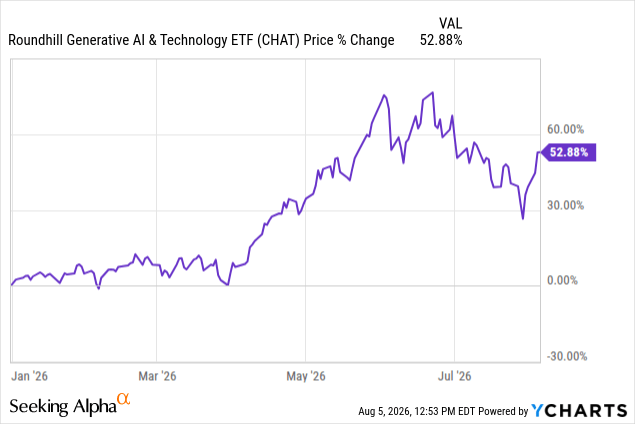
The month of July was especially good for net lease REITs, despite sharply rising interest rates. We think this is likely the result of a rotation from growth to value within the stock market. Funds flowed out of AI-related stocks and into value-oriented stocks, including net lease REITs.
As Q2 earnings results have come out, the market’s concerns about the AI trend have eased. Earnings growth continues to soar among the AI-related names, and capex plans are only rising. Funds now seem to be flowing back into growth stocks.
YCHARTS
So, is the growth-to-value rotation trade definitively over? Or is this just a brief pause?
Your guess is as good as ours.
Price discovery is hardest during periods of great uncertainty and unknowns, when rapid technological changes are creating legitimate macroeconomic debates about future GDP growth, productivity growth, labor market changes, and impacts on inflation. Add to the AI-related uncertainties the ongoing conflict in the Middle East, which may be escalating one day and deescalating the next.
The point is that high confidence about the trajectory of the macroeconomy or fund flows within the stock market is unmerited right now.
Fortunately, while we pay attention to macroeconomics, we are not macro investors.
At High Yield Landlord, we are fundamental value investors.
We believe that buying fundamentally solid assets at a discount to their fair value results in strong long-term performance.
That allows us to sleep well at night even as macroeconomic fluctuations and day-to-day developments in the AI mega-trend thrash REIT stock prices up and down.
Here’s the bottom line: Our four net lease REITs continue to grow both AFFO per share and dividends.
In the short run, stock prices swing up and down based on the news headlines. In the long run, stock prices remain tethered to AFFO per share.
Let’s turn now to the Q2 2026 earnings results for our net lease REITs.
