


Net lease is perceived to be among the most vulnerable property types to rising interest rates.
Of course, a variety of factors make the fundamental situation more complicated than that. But in the stock market, perception becomes reality.
As higher oil prices driven by the Iran conflict have pushed up long-term interest rates this year, the impact has been a headwind to net lease REITs.
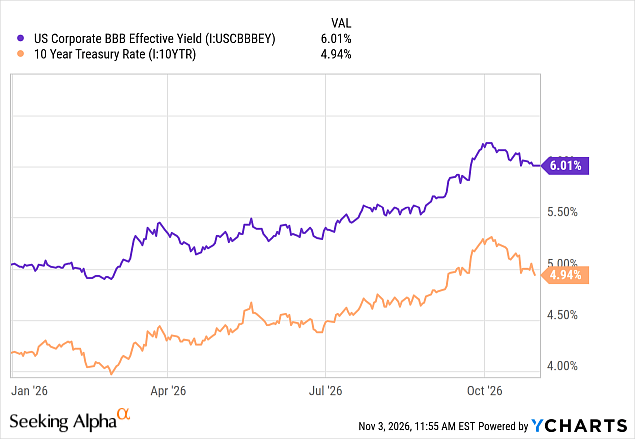
Higher rates effectively create a double hit to net lease REITs, because they directly raise the cost of debt while also causing stock price declines that result in higher costs of equity.
Single-tenant net lease cap rates do tend to follow long-term interest rates to some degree, but they are more anchored around 6%, and typically both rise and fall less than interest rates.
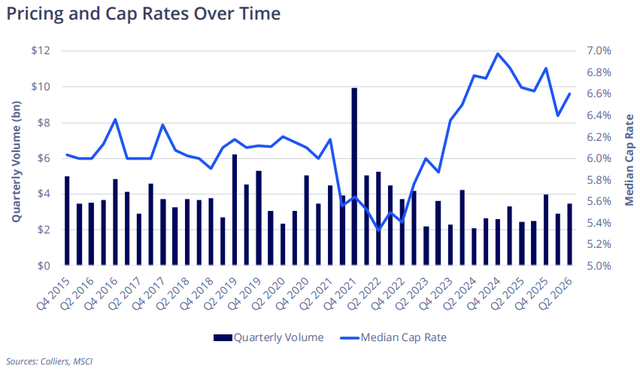
In effect, this means that net lease REITs’ acquisition pipelines open up when interest rates are low and close down when interest rates are high.
That is, their weighted average cost of capital (”WACC”) falls below market cap rates when interest rates are sufficiently low, while their weighted average cost of capital rises above market cap rates when interest rates are sufficiently high.
With BBB-rated corporate bond yields averaging 5% or a little below, the cost of debt is uncomfortably high for the purpose of acquisitions. That may sound odd when net lease REITs’ acquisition cap rates hover in the neighborhood of 6.5% to 7.5%, but you also have to consider cost of equity, which is the more important input into WACC. Equity typically makes up 60-75% of total capitalization, and cost of equity (represented by forward AFFO yield) usually runs higher than the cost of debt. Thus, net lease REITs’ cost of debt needs to be sufficiently low to offset their higher costs of equity.
If long-term interest rates remain elevated, acquisition volume will gradually decline, causing AFFO per share growth to decline thereafter.
Ironically, when net lease REIT stock prices fall as interest rates rise, it creates a self-fulfilling prophecy.
The good news for net lease REITs is that stock prices appear to have bottomed in October as interest rates peaked. There now appears to be a rebound ongoing for net lease REITs.
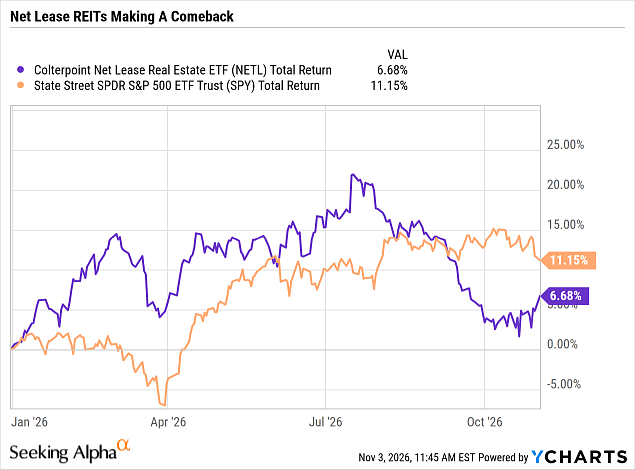
Net lease REITs (NETL) spent most of this year outperforming the S&P 500 (SPY), despite steadily rising interest rates.
If rates continue trending downward over time, we think that outperformance will return, especially considering their low valuations after the Q3 selloff.
Let’s turn now to the Q3 2026 earnings results for our net lease REITs.
