



Important Announcements:
Just a quick heads up:
We will share a Trade Alert later this week, potentially involving a new Top Pick. Stay tuned!
We expect to interview the management of BSR REIT very soon. Let us know if you have any questions for them.
I will host another live Webinar in a few weeks. Stay tuned for an announcement, and let me know if there are any specific topics that you would like me to cover.
------------------------------------------------------------------------———-
As we argued in our last earnings update for net lease REITs, the current macro environment of disinflation, falling interest rates, and steady economic growth is perfect for net lease REITs.
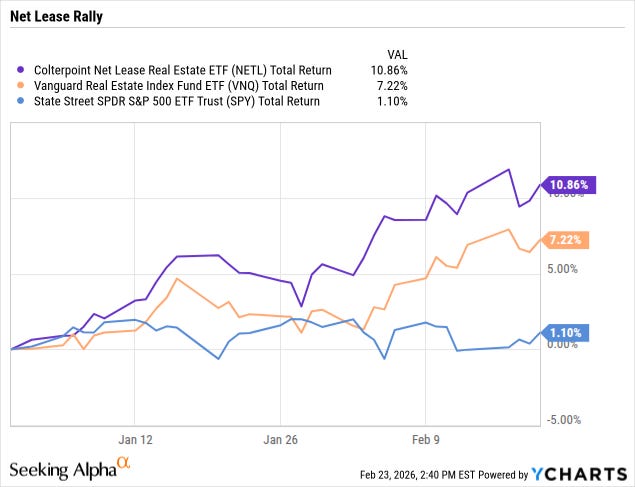
This has been reflected in net lease REIT stock prices.
Net lease (NETL) has returned more than 10% year-to-date compared to a little over 7% for the broader real estate sector (VNQ) and barely over 1% for the S&P 500 (SPY):
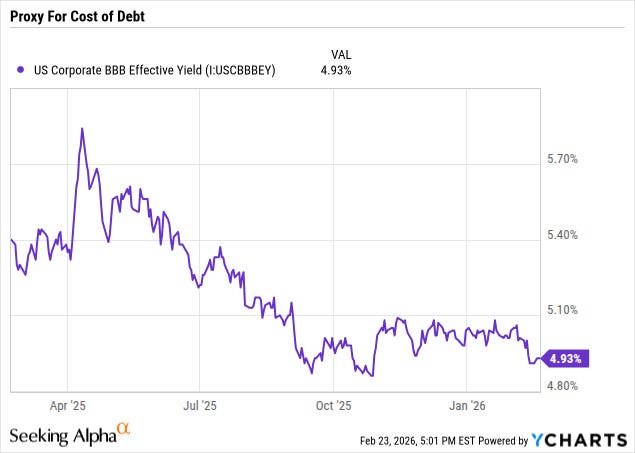
The primary reason for net lease’s strong performance recently is simple: Corporate bond yields have fallen.
The BBB (lowest rung of the investment grade credit ladder) effective yield is near its lowest point since the early 2020s.
This matters for net lease REITs for two main reasons:
It is a proxy for the average net lease REIT’s cost of debt. All else being equal, as cost of debt declines, a net lease REIT’s investment spread widens, making each acquisition more accretive to AFFO per share. This also reduces pressure on the balance sheet for those REITs with near-term debt maturities.
Net lease REITs, even more so than the real estate sector broadly, are generally treated like bond proxies by the market. That is, net lease REIT valuations are the inverse of corporate bond yields -- higher yields push down REIT valuations, while lower yields push up REIT valuations.
Thus, when interest rates decline, a virtuous cycle gets set in motion for net lease REITs.
Future interest costs decline, investment spreads widen, and AFFO per share growth rates increase, which then justify higher stock valuations and allow for cheaper equity issuance, which further widens investment spreads.
Of course, this is true in a general sense -- all else being equal.
With that said, let’s get to the earnings updates for our four net lease REITs:
