



Important Note
Last week, I attended REIT Week in NYC, the biggest annual REIT conference in the world, bringing together the management teams of most major REITs.
I had the chance to meet with many of them, as well as speak with several prominent REIT investors.
I am still digesting all the new information that I gained, and I expect to share exclusive interviews and my main takeaways with you over the coming days.
Before that, I want to wrap up Q1 earnings season with our reports on residential REITs today, followed by specialty REITs, which will be posted tomorrow.
Stay tuned!
Earnings Update: Residential REITs (Q1 2026)
In our Q4 2025 Earnings Update for Residential REITs, we gave a sober analysis of the present situation for rental housing in the United States.
In short:
While growth in new supply of all types of housing, multifamily and single-family, has fallen significantly, the sheer amount of housing built over the last five years has created an overhang that would take years to absorb even under normal demand conditions.
Unfortunately, demand conditions are below-average, as growth in the labor market and working-age population are both anemic.
Rental housing is benefiting from homebuying unaffordability across the United States, with affordability for first-time buyers still hovering near its lowest level in 40 years. This is keeping many would-be homebuyers in the rental market.
Since that last update, which admittedly was rather dour, we have seen some green shoots sprouting up — or, to mix metaphors, some light at the end of the tunnel.
On the demand side, we’ve seen job growth begin to slightly rebound, keeping a lid on the gradual, upward trend in unemployment.
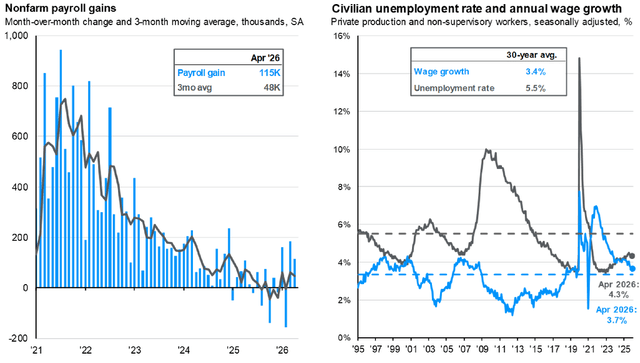
Wage growth does continue to slide, which hinders landlords’ ability to raise rents, especially at a time when gasoline prices are eating into renters’ budgets.
But job growth is arguably more important than wage growth right now, as it should lead to an increase in lease-up and a drop in vacancy rates.
In fact, nationwide data from Apartment List shows just that.
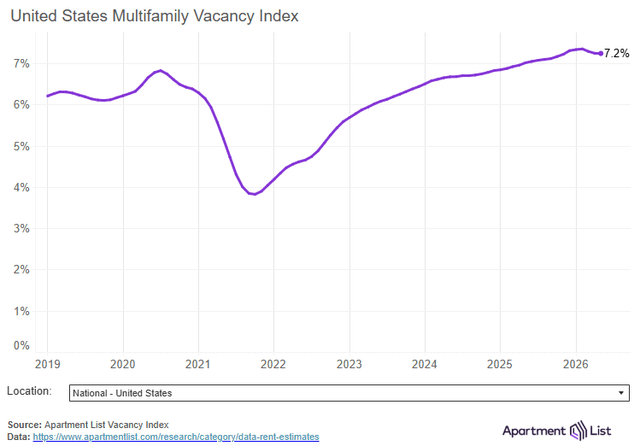
Over the last few months, the national average vacancy rate has ever-so-slightly declined from its peak of 7.3% in February to 7.2% in May.
To be fair, though, Cushman & Wakefield disagrees with Apartment List in their Q1 2026 Multifamily Marketbeat report, which shows vacancy flat quarter-over-quarter as deliveries offset net absorption.
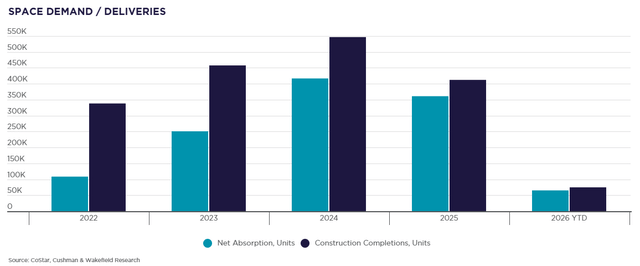
It is not surprising to see some disagreement between various data aggregators. US multifamily is a massive and highly fractured market, and it is hard to accurately capture comprehensive data about it.
While Cushman & Wakefield uses data from CoStar, Apartment List uses their own internal data.
Both, however, agree that national average apartment rent continues to be stagnant or slightly falling year-over-year, but both also express optimism that US multifamily has turned a corner and is on the path to recovery.
To quote Cushman & Wakefield:
If absorption in 2026 tracks closer to long-run averages, full-year demand would likely fall somewhere between 250,000 and 300,000 units. This level of demand should be enough to prevent further increases in vacancy and support gradual firming in rent growth by year-end, though the pace of recovery will vary by market.
Another area of agreement between the two data aggregators is in which markets are performing well and which are struggling. Both show that coastal, supply-constricted markets like San Francisco and New York City are enjoying far stronger fundamentals right now than Sunbelt markets like Austin, TX, and Tampa, FL.
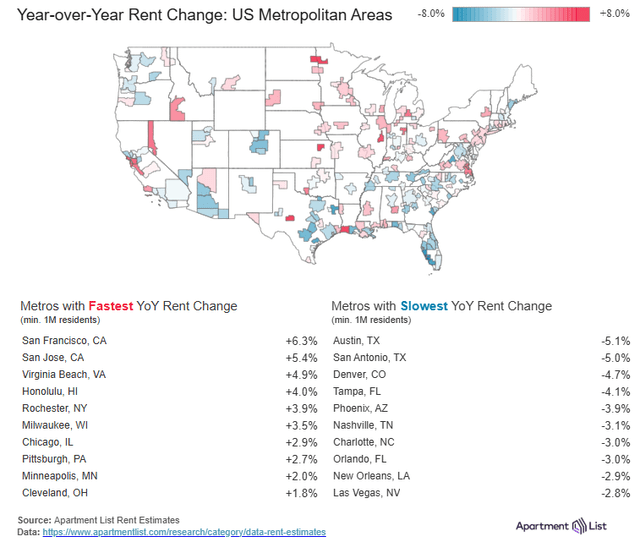
Before the pandemic, the Sunbelt tended to exhibit more stable fundamentals than coastal markets, which saw sharper booms and busts with the broader economy.
After the pandemic, however, the shift in population from coastal states into Sunbelt states caused developers to respond with a huge wave of new residential supply in those states. Then the inter-state migration trends cooled down along with the labor market, and the Sunbelt development pipeline turned out to be too big.
The Sunbelt appears to have become the new boom/bust region of the country.
To be clear, though, Sunbelt cities like Phoenix, Dallas/Fort Worth, Austin, Charlotte, and Atlanta continue to capture disproportionate renter demand in 2026.
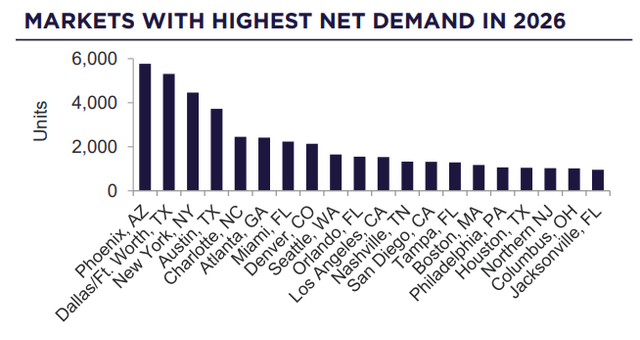
The Sunbelt is still projected to grow faster than the rest of the country.
That is why we remain confident in our Sunbelt multifamily REITs, despite the rough patch they are traversing right now.
As long as supply growth continues to fall and remain modest, the current oversupply in the Sunbelt should be absorbed within a year or so and give way to a return to bullish fundamentals.
We are also very pleased to see share buybacks as a common theme with our residential REITs as they sit at attractively low valuations. This is a fantastic allocation of capital, in our view, as it is basically tantamount to buying their own high-quality portfolios at a discount.
Let’s now turn to the earnings updates for our residential REITs:
