



Residential rental real estate has multiple forces pulling in different directions.
Unsurprisingly, it’s all about supply and demand.
There is some very, very good news for residential real estate, and that is the supply outlook.
After a record-high housing construction pipeline in the years following the COVID-19 pandemic, that pipeline is now collapsing at a rapid rate.
U.S. New Housing Units Under Construction:
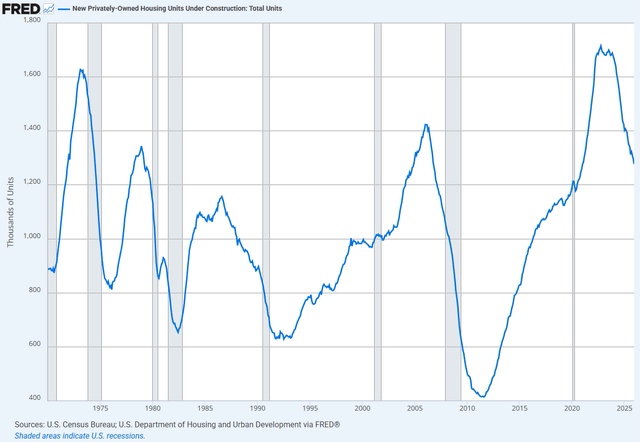
As you can see from this chart above, this degree of decline in housing units under construction is typically only seen during recessions.
Multifamily (apartments) witnessed a particularly massive level of new supply over the last several years, driven by a red-hot, stimulus-fueled post-pandemic economy that saw significant interstate migration from coastal cities to Sunbelt and heartland cities. For a few years, especially 2024 and early 2025, apartment deliveries reached a 50-year high.
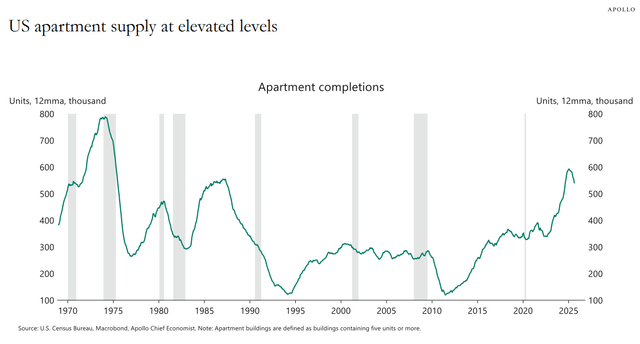
While this chart above is a bit dated at this point, multifamily completions are now collapsing rapidly.
The supply side of the equation is looking great. With multifamily development starts at a modest level, a slow (and progressively slowing) pace of completions over the next few years sets residential real estate up for a gradual rebound, as long as demand holds up.
As such, he biggest unknown in coming years is not the supply side. It’s the demand side.
The simple formula for robust growth in demand for rental housing looks like this:
Working-Age Population Growth + Job Growth = Household Formation = Residential Net Absorption
Unfortunately, neither the working-age population nor jobs are meaningfully growing in the US right now. And it is difficult to say when that situation will change.
The primary source of working-age population growth in the US today is net immigration.
After years of huge net immigration numbers after the pandemic, this surge reversed in 2025 and is set to keep declining in 2026.
In fact, the Census Bureau estimates that 1.5 million foreign-born immigrants departed the US in 2025.
We certainly do not want to be alarmist about this, but demographics are undeniable.
Using data from the nonpartisan Congressional Budget Office, the Left-leaning Economic Policy Institute recently estimated that the working-age population will shrink over the next five years unless net immigration returns to its historically average level.
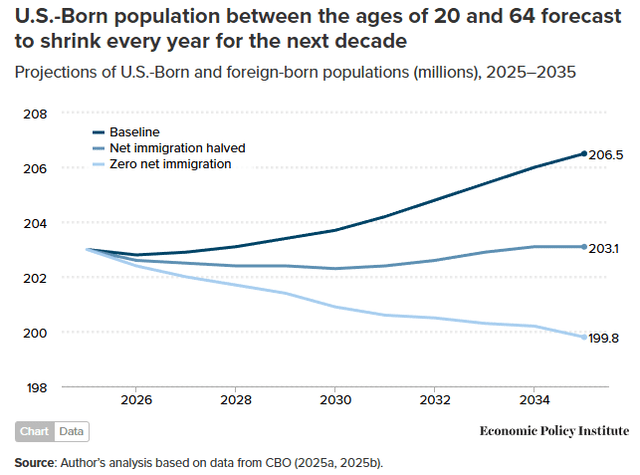
We do not wish to make any political statement about this projection whatsoever. We merely wish to explain the economic and residential real estate impact of low levels of immigration.
At the same time, the US fertility rate dropped below the replacement rate of 2.1 births per woman in 2009 and has been falling steadily ever since.
Without positive net immigration, the US population, starting with the working-age population, would soon begin to decline as deaths outnumber births and retirements outnumber entries into the workforce.
That is a terrible demographic setup for rental housing.
Residential units need people to rent them. Specifically, they need adults with adequate income.
On the “adequate income” part of that, we also note that the US labor market has been steadily softening for years now.
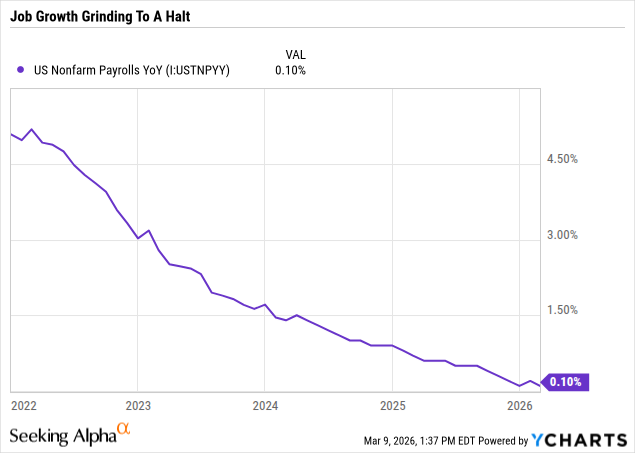
While monthly numbers may swing up or down, year-over-year growth in total payrolls clearly remains in a downward trajectory.
Without growth in the population of adults with steady labor income, it is virtually impossible to see residential net absorption improve from here.
So, the supply side is pulling in a positive direction, while the demand side is generally pulling in a negative direction.
Here is a caveat to the overall dour state of the demand side: Buying a home in the US remains unaffordable for the vast majority of renters.
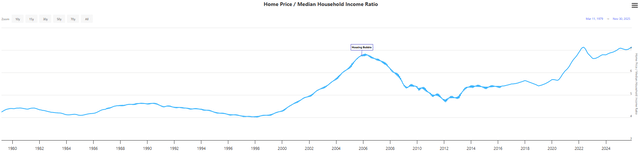
The home price to household income ratio is over 7x, which is higher than during the housing bubble of the mid-2000s. In fact, it is higher than anytime in modern history.
U.S. Home Price To Median Household Income Ratio:
If not for the sheer amount of wealth concentrated in the upper class, allowing affluent homebuyers to put down large down payments, almost no renters would be able to buy homes today.
As it is, there are still very few renters leaving the rental market to buy a home.
That pushes up the lease renewal rate and extends the length of time most renters remain in the rental market.
This has been the saving grace of the residential rental market over the last few years, which have seen remarkably high multifamily net absorption.
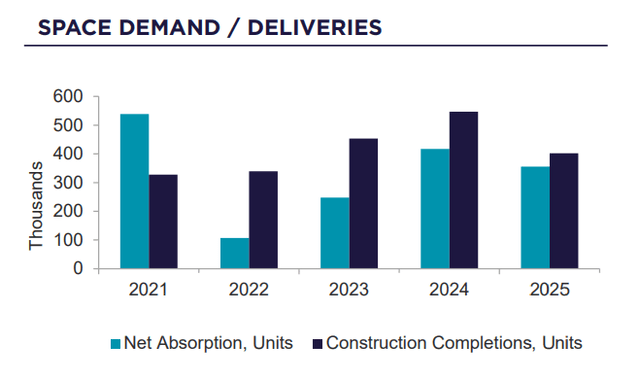
As long as total employment remains steady, this elevated level of net absorption should likewise remain in place.
As you can see, apartment completions have been historically high over the last few years, overshooting even strong net absorption, which has continued to push up the multifamily vacancy rate.
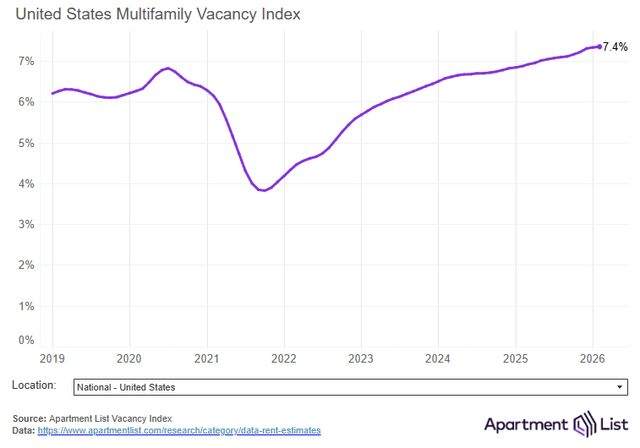
Residential completions will continue to decline over the course of this year and next year. That is certain.
But there are plenty of uncertainties that impact the demand side:
Will mortgage rates decline enough to lure more renters out of the rental market?
Will net immigration continue to decline, stabilize, or rebound?
Will the labor market continue to soften, stabilize, or rebound?
Without confident answers to these questions, we cannot issue a confident outlook for residential REITs over the next year or two.
To be clear: We are confident that residential REITs will remain one of the most stable, defensive, and recession-resistant parts of the real estate sector and expect it to do well over the long run.
But we want to be honest and transparent about the forces at play in residential rental real estate today. The rebound that was widely expected to begin in 2026 has now been pushed to 2027. But even a 2027 rebound depends heavily on the state of the economy, labor market, and net immigration over the next few years.
That is why residential REITs, especially multifamily REITs, trade so cheaply today.
While apartment properties are valued at around 5% cap rates, the average multifamily REIT trades at an implied cap rate of more than 6%.
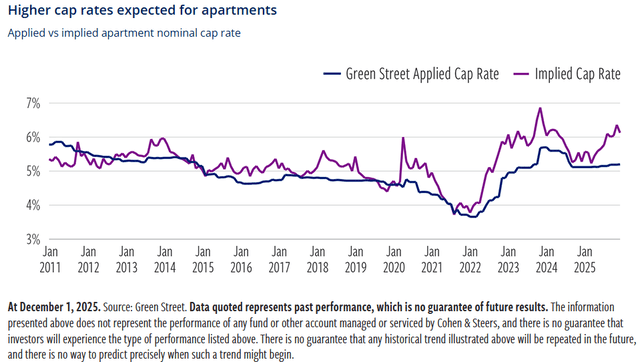
If you believe, as we do, that US job growth and net immigration will eventually rebound, this looks like a good buying opportunity for long-term investors.
Let’s now turn to the earnings updates for our residential REITs:
