



The US retail real estate sector remains solid as a rock.
Nationwide average shopping center occupancy hovers around the mid-90% area (94% according to Cushman & Wakefield), which is effectively full occupancy. This is because there is always some level of frictional vacancy in the handoff between one tenant and another, and some elbow and corner spaces in centers are simply less desirable and harder to lease.
The historical average occupancy level is in the low-90% area, roughly 92.5%.
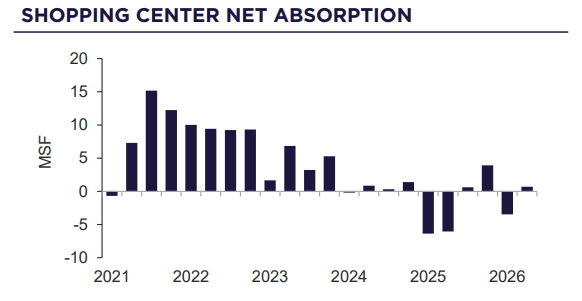
That needs to be kept in mind when we look at the slightly negative net absorption metric for the first half of 2026:
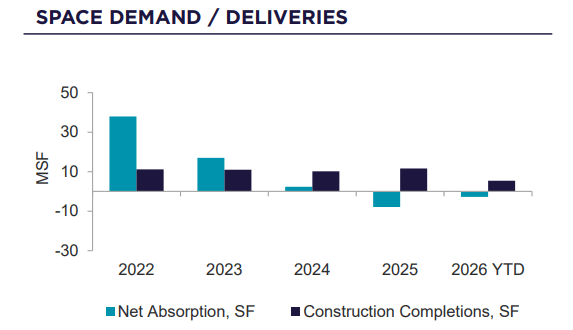
With occupancy as high as it is, there simply isn’t much more upside to net absorption. Meanwhile, new supply from completed space continues to be extremely low.
In such an environment, we should not expect much more than small moves up or down.
By all measurements, this is a tight rental market, which is favorable to landlords.
It is true that higher gasoline prices have eaten into the spending budgets of some consumers, mostly toward the lower echelons of the income spectrum.
But the US economy is extraordinarily K-shaped. While the paycheck-to-paycheck population is forced to cut back because of prices at the pump, they only accounted for a relatively small share of total consumption to begin with. Meanwhile, the affluent population barely notices the fluctuations in gasoline prices and continue to spend.
The net effect is steady growth in both nominal and real retail sales:
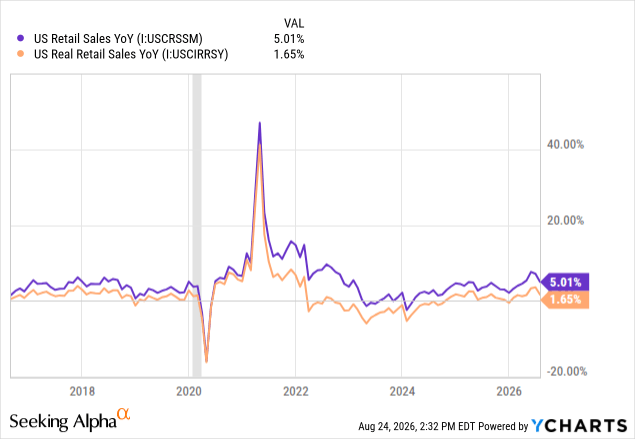
This resilience allows shopping center (and high-end mall) landlords to gradually re-merchandise their centers, replacing struggling tenants with new ones that better serve a resilient, affluent customer base.
As Cushman & Wakefield note in their Q2 2026 retail sector report, retail “spending is increasingly concentrated among the top 20% of earners, who now account for nearly 60% of personal outlays.”
Cushman & Wakefield forecasts that “well-capitalized retailers and those offering compelling value propositions” will continue to perform well for the foreseeable future. These include grocers, discount stores, and low-price gyms. Some types of discretionary retail, however, are susceptible to disruption as a broad swathe of the population cuts back on spending due to energy prices.
Overall, though, retail remains one of the most resilient, steady-growth sectors in the commercial real estate landscape.
The development pipeline has barely budged due to construction costs and interest rates, which means that at least the next few years should see little net growth in competing space. This extends the runway wherein landlords can push rents higher and re-merchandise their centers with stronger tenants.
With that, let’s get to the earnings updates for our four retail REITs:
