



While not flawless, the macro environment is very good for retail real estate in the United States.
The unemployment rate is low, and Americans have proven that they will continue to spend money as long as they are employed. Wage growth of around 3%, while currently strained by inflation, has been enough to support retailers’ profits. And a strong stock market has fueled robust consumption by affluent Americans. In their Q3 2026 US Shopping Center MarketBeat report, Cushman & Wakefield indicate that the top 20% of American earners now account for 60% of personal consumption.
Sentiment surveys indicate that Americans don’t like the current economic environment, but that doesn’t stop them (or at least a sufficient number of them) from going out and spending money anyway.
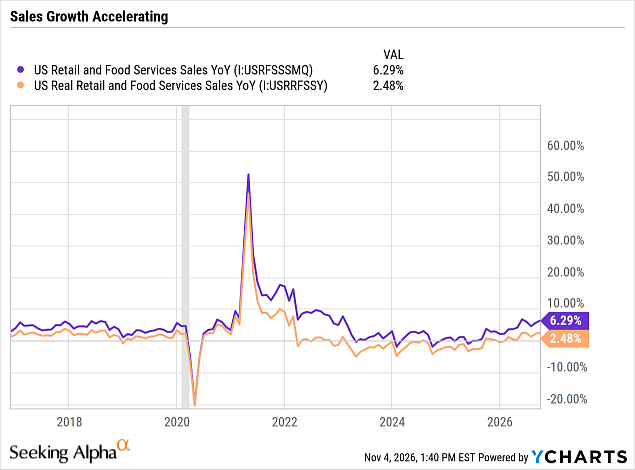
Both nominal and real (inflation-adjusted) retail and food service sales are growing at a healthy pace right now.
That’s great news in aggregate for the retailers and restaurants that lease space in shopping centers and malls.
On top of steady demand from tenants, the retail development pipeline remains extremely small at a mere 0.4% of total inventory, putting virtually zero pressure on landlords from the supply side.
Hence, we find that vacancy rates are mostly holding steady in the retail sector, after having gradually rebounded off their lows in 2024-2025.
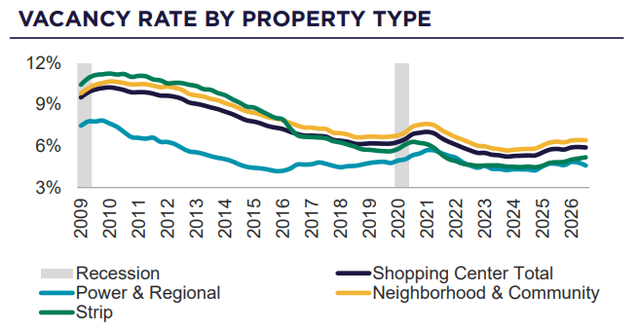
Occupancy rates in the mid-90% territory may very well be the sweet spot for retail landlords. It is high enough to keep rent rates rising, but not so high as to trigger a wave of new development projects.
To be clear, not all is rosy.
The personal savings rate sits at an ultra-low level under 4%, and the frozen housing market is weighing on the performance of certain retailers like furniture and home improvement stores. And with so much consumption coming from the highest income quintile of Americans, retailers and restaurants are at risk of taking a hit if the stock market sells off and/or white collar layoffs manifest.
Moreover, demand is steady but not that strong. Cushman & Wakefield reported 2.2% market rent growth in Q3, which represents a continued slowdown from previous years.
Lower market rent growth will naturally translate into lower same-property net operating income (”SPNOI”) growth for retail REITs, all else being equal.
The current environment looks better than the first half of 2025, in which the rapid implementation of high tariffs triggered a spate of bankruptcies among weaker retailers.
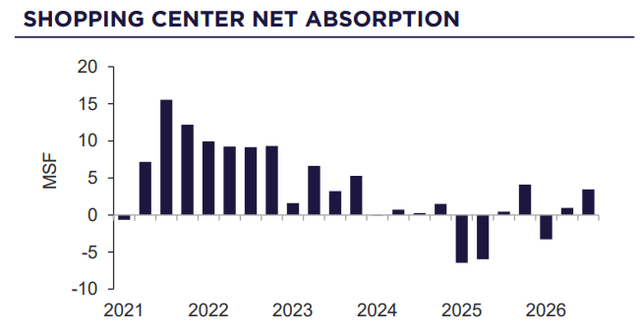
But Cushman & Wakefield does not envision a robust rebound in rent growth from here. Instead, 2027 will likely be a continuation of trends from this year: flattish occupancy levels and low but steady rent growth.
We think the rebound in retail REIT stock prices in October and into November is largely a function of falling interest rates.
With that, let’s get to the earnings updates for our four retail REITs:
