Important Announcements:
Just a quick heads up:
We will share a Trade Alert later this week, potentially involving a new Top Pick. Stay tuned!
We expect to interview the management of BSR REIT very soon. Let us know if you have any questions for them.
I will host another live Webinar in a few weeks. Stay tuned for an announcement, and let me know if there are any specific topics that you would like me to cover.
---------------------------------------------------
Over the last few years, retail real estate, especially well-located shopping centers and Class A malls, has enjoyed its strongest organic growth in decades.
Perhaps due to the lingering “retail apocalypse” narrative going into COVID-19, the red-hot post-pandemic economy did not see a surge in new construction of retail properties like other parts of CRE did. The multifamily, industrial, and life science sub-sectors are still absorbing the burst of new supply initiated after the pandemic, but retail still has extremely little new supply coming to market.
To be clear, demand for retail space is strong but not huge.
The reason why retail real estate fundamentals are strong today is that e-commerce disruption has now played out, and resilient consumer spending is supporting Amazon-resistant concepts.
If retail saw a surge in new supply like other parts of CRE did, its fundamentals would be much weaker.
It goes to show that in real estate, just as in every other part of the economy, pricing is always determined by supply and demand.
As the vacancy rate fell below 6% across the retail spectrum, asking rent rates kept inching higher and higher.
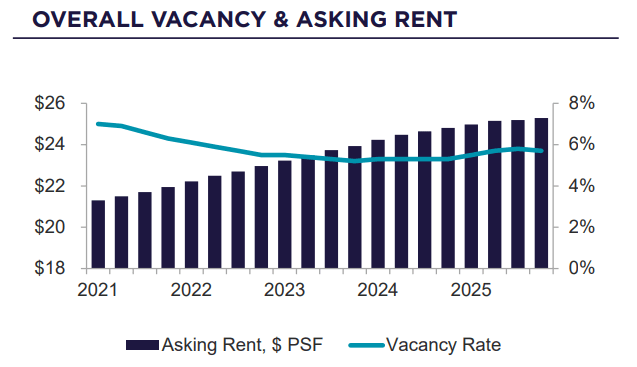
This is not heroic, double-digit average effective rent growth as was seen at the peak of the cycle for industrial, multifamily, and life science, but same-property net operating income (”SPNOI”) growth topped out in the mid-single-digit area in 2025, and guidance for 2026 forecasts fairly similar growth.
This is very impressive growth for shopping centers and malls! We are simply trying to set expectations properly.
Retail is a conservative, stable, slow-and-steady-growth type of real estate, even with occupancies in the mid-90% territory.
After a mild pullback in net absorption in 2025 due to tariffs and economic uncertainty, leading real estate services firm CBRE projects that retail net absorption will overtake the minimal completions expected in 2026.
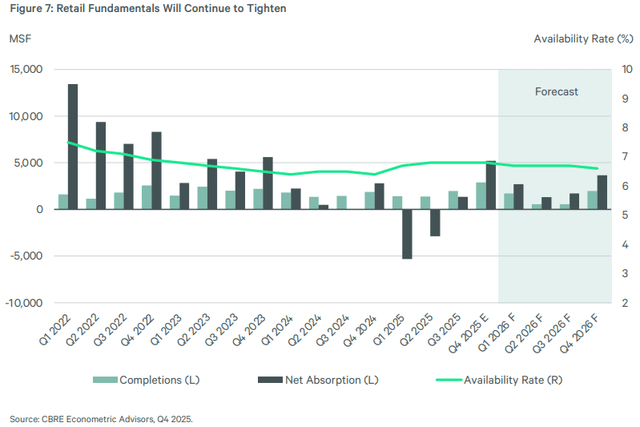
This is positive for retail REITs, but as you can see, it is not the same gap between net absorption and completions seen in 2022-2023.
That is partly because there is less available space than there was at the beginning of 2022 and partly because the economy is not quite as strong.
However, there are some signs of a potential reacceleration of growth in certain parts of the economy, such as ISM’s services surveys that are reflecting modest optimism for this year.
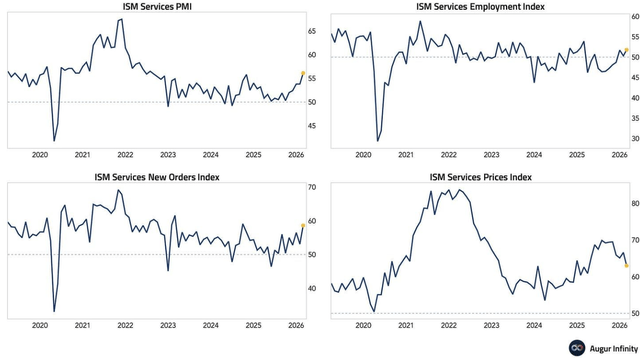
There is bound to be some positive economic impulse from the Big Beautiful Bill, tax refunds, and potential tariff refunds.
While we don’t want to overestimate retail’s future growth rate, we do think the sub-sector has entered a new and more favorable environment that should be sustained for many years.
To quote the Q4 2025 Retail Report from Cushman & Wakefield:
Retailers with strong omni-channel presence, value propositions, resilient supply chains, and tech engagement will thrive and expand into brick-and-mortar spaces. Vacancy is forecasted to remain below 6.0% for years, with rent growth tracking in the 2.0-2.5% range—marking a new retail market equilibrium.
Finally, we would note that as AI threatens to disrupt more and more industries and business models, high-quality retail real estate as an investment is one of the least susceptible to disruption.
With that, let’s get to the earnings updates for our five retail REITs. Afterward, we’ll discuss which one makes the best buy today.
Kite Realty Group (KRG): This primarily grocery-anchored retail REIT continues to enjoy tailwinds of steady demand for high-quality space and little to no competition from new supply. Organic growth is at its strongest level in decades. Same-property NOI grew 2.9% year-over-year in 2025, driven by cash leasing spreads (new and renewal lease rent growth) of over 20%, excluding option periods that are often capped at 5% or 10%. Remarkably, KRG executed 28 anchor space leases in 2025 at a weighted average cash leasing spread of 23.5%. In recent history, shopping centers simply have not seen this level of rent growth. In Q4, that organic growth cooled only slightly, with non-option leasing spreads of 18.5% and SPNOI growth of 1.7%. A little over 95% of the portfolio was leased as of year-end. Moreover, the balance sheet is in excellent shape. After selling some property at strong pricing, management has reduced net debt to EBITDA to 4.9x and also repurchased ~$230 million of shares at a roughly 8.8% core FFO yield (or ~7% AFFO yield). We consider this an excellent and shareholder-friendly allocation of capital. That said, 2026 guidance forecasts a slight cooling in SPNOI growth to 2.75% at the midpoint and core FFO per share growth of only 1.5% due to debt refinancings, but this is a one-time factor and growth should reaccelerate in 2027. With KRG now trading at a dividend yield of 4.5%, a core FFO multiple of 12.5x, we still see 15-20% upside potential to fair value.