



Quick Note:
I was yesterday at a major real estate conference in Europe. It should be particularly relevant to Xior Student Housing, Vonovia, Cibus Nordics, Tallinna Sadam, Shurgard, and Branicks. I will share all my takeaways later this week.
--------------------------------------------------------------------
Interview With Canadian Net REIT (Strong Buy Reaffirmed)
Our largest Canadian REIT investment has strongly recovered over the past year:
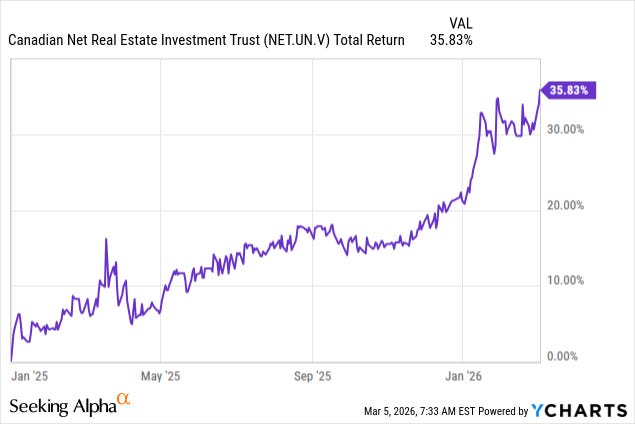
I have previously described Canadian Net REIT (NET.UN:CA) as an early-day Realty Income (O). In case you didn’t know, Realty Income used to grow a lot faster and deliver a lot higher returns to its shareholders in its early days when it is much smaller in size, used more leverage, and faced lower competition for acquisitions.
This allowed it to grow its FFO per share by 8-12% annually in its early days, which, coupled with its dividend, commonly resulted in 15%+ annual total returns.
Canadian Net REIT is in that position today.
It has been able to grow its FFO per share by a remarkable 14% per year on average since going public because it is the only net lease REIT in Canada, it faces much lower competition for deals, it is still very small in size, and it uses more leverage to maximize the size of its spreads.


This has earned its investors a 7x on their money since its IPO in 2011.
But what now?
Is the REIT still a buy?
Or are its best days now behind?
In short, we are reaffirming our Strong Buy rating and expect a lot more growth and upside ahead.
The REIT is still just getting started with a $127 million market cap, and it enjoys structural advantages that should allow it to keep growing a lot faster than its US peers over the long run.
Even then, it today still trades at a very reasonable valuation at just around 9.8x FFO because its growth stagnated in recent years.
This is now changing as the REIT returned to faster growth in 2025, growing its FFO per share by 9%, and as it regains access to equity markets, its growth could accelerate even further.
This growth, coupled with its 5.6% dividend yield and some upside, has the potential to result in further market outperformance over the long run.
Therefore, we expect to maintain a large position in the company.
Here is our interview with their CEO, Kevin Henley:

Q1: After a few years of stagnating cash flows, Canadian Net REIT returned to solid growth in 2025, with FFO per unit up about 9% through Q3. What were the main drivers behind this renewed growth, and do you expect it to continue into 2026?
