



The Fed has now delivered the rate hike that the market had increasingly come to expect. After a period of falling inflation, improving sentiment, and renewed expectations for lower rates, we are now dealing with another setback. This is not what REIT investors wanted to see, and the immediate market reaction makes sense. REITs are interest rate sensitive, and when rates move higher, investors quickly start worrying about borrowing costs, cap rates, property values, and the relative appeal of fixed income.
This is why REITs sold off so badly in 2022 and 2023, and it is also why the sector has recently come under pressure again. Higher rates hurt sentiment almost immediately, even before they have any material impact on the actual cash flows of most REITs. Investors see higher Treasury yields, assume higher refinancing costs, apply lower multiples, and move capital away from real estate. That is the short-term mechanism, and there is no point in denying it.
But I think it is important to keep some perspective here. Our REIT thesis had been playing out. REITs have already recovered strongly from their late 2023 lows, rising by close to 50% as inflation moderated, rate cuts began, and capital slowly started to return to discounted real estate.
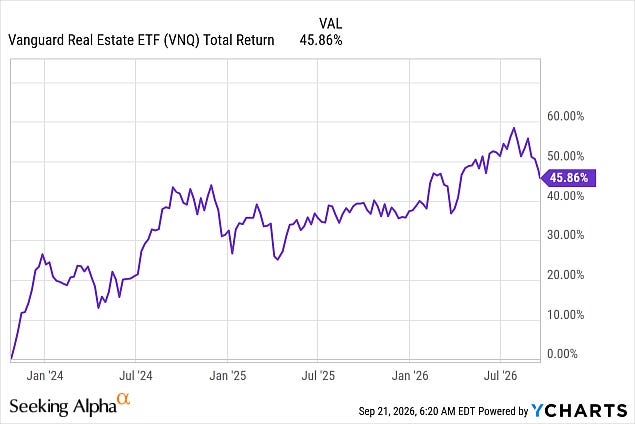
The recovery was not complete, and many REITs were still trading at historically low valuations, but the direction was clearly improving. Had the rate-cutting cycle continued without interruption, I think REITs would likely already be trading materially higher today.
Now that recovery has been delayed. The question is whether it has been destroyed. My answer is no. The rate hike is a setback, but I do not think it changes the long term outlook for inflation, interest rates, or REITs. To understand why, we need to understand what caused this rate hike in the first place.
