



The recovery of REITs ultimately depends on one variable more than any other: interest rates.
Yes, fundamentals matter, and yes, sector and stock selection matter.
But in the short to medium term, REIT valuations are still heavily driven by the same force that drives all long-duration assets, the discount rate investors apply to future cash flows. When that discount rate rises, REIT multiples compress. When it falls, REIT multiples expand.
That is why the entire REIT debate increasingly comes down to one question:
Is AI going to be deflationary or not?
If AI becomes a powerful deflationary force, then interest rates could trend lower over time. If interest rates trend lower, REITs will likely rerate higher, especially the high-quality names with durable cash flows and visible long-term growth. In other words, if AI-driven deflation is real, then a significant portion of the REIT recovery is not only plausible, it becomes likely.
The market is still treating AI primarily as a stock-picking theme. Buy the chipmakers and the data center winners and sell the software losers. That may be true, but it misses the bigger picture.
AI is not only a technology, it is a general-purpose productivity shock. And productivity shocks have consequences for inflation, wages, and ultimately interest rates.
Why AI is highly likely to be deflationary
Deflation is not about prices falling everywhere all at once. It is about persistent downward pressure on the marginal cost of producing goods and services. AI is uniquely positioned to create that pressure because it scales, improves, and spreads faster than past technologies.
Here are the main channels.
1. AI pushes the marginal cost of knowledge work lower
A large share of modern inflation comes from services. Services inflation is largely labor inflation. AI directly targets labor-intensive service activity, especially tasks that are repetitive, standardized, and digital.
This includes:
Customer support, sales development, and basic account management
Bookkeeping, compliance support, and basic legal drafting
Marketing production, content creation, translation, and editing
Entry-level analysis, research synthesis, and reporting
Coding assistance, testing, documentation, and maintenance tasks
When the marginal cost of these activities falls, service prices face downward pressure. Even if the final price does not immediately fall, the rate of price increases slows. That is disinflation, and it tends to pull interest rate expectations down over time.
2. AI changes labor bargaining power
Inflation is not only about costs, it is also about negotiating power. When workers are scarce and difficult to replace, wages rise, and inflation becomes sticky. When replacement becomes easier, wage growth cools.
AI does not need to eliminate every job to be deflationary. It only needs to:
Reduce the number of workers required per unit of output
Increase substitution options for employers
Create a credible threat of automation in more occupations
That shifts bargaining power away from labor, which is disinflationary.
3. AI creates a supply shock, not only a demand shock
Many discussions focus on AI as if it is just demand for chips and data centers. But the macro impact is more about supply. AI improves the economy’s capacity to produce output with fewer inputs, especially labor.
When supply expands faster than demand, inflation falls. When productivity rises meaningfully, central banks can achieve growth without inflation, which historically leads to lower policy rates over time.
4. Competitive markets force pass-through over time
Even if companies initially keep the savings as margin expansion, competition tends to force pass-through eventually.
The pattern typically looks like this:
Phase 1, productivity gains boost profits
Phase 2, competition compresses pricing power
Phase 3, consumers capture more of the gains through lower prices, higher quality, or both
That is how deflationary forces spread. They are not always immediate, but they become difficult to avoid once adoption reaches scale.
5. AI-powered robotics extends deflation beyond services into physical goods
Most discussions about AI today still focus on software, data, and knowledge work. That alone is deflationary, but it only addresses part of the economy. The next phase, which is already underway, is the integration of AI into robotics and automation in the physical world.
AI-driven robotics has the potential to dramatically reduce the cost of producing goods by:
Lowering labor requirements in manufacturing, logistics, and warehousing
Increasing utilization rates by enabling round-the-clock production
Reducing error rates, waste, and downtime
Allowing production to be reshored or near-shored without higher labor costs
Historically, goods inflation has been constrained by globalization and automation. AI-powered robotics accelerates that trend by making machines more adaptable, cheaper to deploy, and capable of handling a wider range of tasks that previously required human intervention.
As robotics improves, the marginal cost of producing many goods declines. Even if demand rises, increased productive capacity limits price increases. That dynamic is inherently deflationary.
This also matters geopolitically. Governments may seek supply chain resilience and domestic production, but AI-driven robotics allows this to happen without reintroducing labor-driven inflation. In other words, reshoring does not have to be inflationary if machines do most of the work.
Once both services and goods production face sustained productivity gains, the deflationary impulse becomes broader and harder to offset. That is when interest rate expectations tend to adjust more decisively.
The key objection: governments can offset it
The strongest counterargument is fiscal policy.
If AI weakens labor income and creates political pressure, governments may respond with:
Larger transfer programs
Expanded unemployment support
Public sector job creation
Tax credits, subsidies, and industrial policy
Some form of basic income or wage support
These policies can be inflationary, especially if they are deficit-funded. So the question becomes, will the government response cancel out the deflationary impulse of AI?
My view is that it will not, at least not quickly.
Governments are slow, rigid, and reactive
Major policy changes typically come with delays:
Data arrives with a lag
Policymakers debate causes and blame
Legislation takes time
Budgets, agencies, and programs take time to implement
The response is often incremental at first, not immediate and decisive
Even if governments eventually respond in a meaningful way, the transition period can still be deflationary, because the productivity shock happens faster than the policy adjustment.
That lag matters for markets. Markets reprice on expectations and forward-looking probabilities. If the next several years are characterized by disinflationary pressure and weaker labor bargaining power, then interest rates can move lower well before governments fully adapt.
This is especially important for REITs, because REIT valuations respond quickly to changes in rate expectations.
Why this is bullish for REITs
REITs are today discounted due to the higher interest rates for the most part:
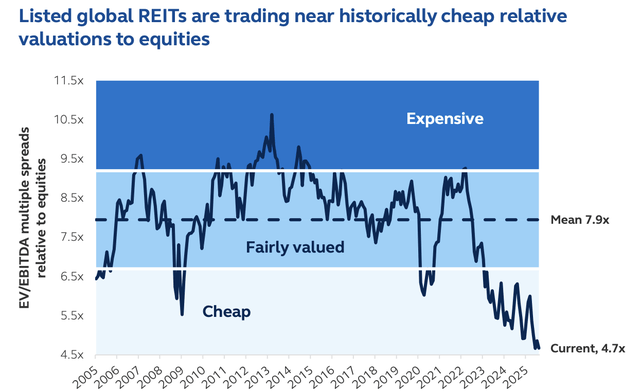

When interest rates fall, several positive things happen at once:
1. The discount rate falls, and valuations rise
A lower required return increases the value of stable cash flows. This is the simplest and most powerful driver of REIT reratings.
In a lower-yield environment, it becomes harder for investors to earn sufficient income from fixed-income investments, making REIT dividends more competitive and boosting demand for their shares. Historically, this has often led REITs to trade at premiums to NAV.
Beyond that, private market cap rates also tend to reflect long-term interest rate expectations. Lower rates typically support higher real estate values, which lifts REIT NAVs and reduces perceived risk.
2. The spread becomes attractive again
As REIT valuations recover and their cost of capital declines, acquisition spreads widen, allowing them to return to faster external growth.
In recent years, it has been very difficult for REITs to pursue accretive acquisitions. That could change quickly if interest rates decline and equity multiples recover.
3. Refinancing pressure eases
Lower rates reduce interest expense and improve coverage ratios. That supports faster FFO growth and reduces tail risk, particularly for REITs with higher leverage.
Conclusion
The REIT recovery is not only a rates story, but it does matter a lot, and the rates story increasingly depends on AI.
If AI drives a sustained productivity shock that cools wage growth and service inflation, then the most likely path is lower interest rates over time. Even if governments eventually respond, they are unlikely to do so quickly enough to prevent a meaningful disinflationary transition period.
That is why I believe AI is not only a technology theme, it is a macro theme, and it is one of the most underappreciated bullish forces for high-quality REITs today.

Finally, please note that we have exceptionally posted this article without a paywall. If you found it valuable, consider joining High Yield Landlord for a 2-week free trial.
We expect to share a Trade Alert with our paid members tomorrow, and by starting your free trial today, you will also gain access to it. You will also get immediate access to my entire REIT portfolio, our exclusive REIT CEO interviews, and much more. We are the largest and highest-rated REIT investment newsletter online, with over 2,000 paid members and more than 500 five-star reviews.
We spend thousands of hours and over $100,000 per year researching the market for the most profitable investment opportunities, and we share the results with you at a tiny fraction of the cost.
Get started today - the first 2 weeks are on us:
Analyst’s Disclosure: I/we have a beneficial long position in the shares of all companies held in the CORE PORTFOLIO, RETIREMENT PORTFOLIO, and INTERNATIONAL PORTFOLIO either through stock ownership, options, or other derivatives. We also own a position in FarmTogether. High Yield Landlord® (’HYL’) is managed by Leonberg Research, a subsidiary of Leonberg Capital. All rights are reserved. No recommendation or advice is being given as to whether any investment is suitable for a particular investor. The newsletter is impersonal and subscribers/readers should not make any investment decision without conducting their own due diligence, and consulting their financial advisor about their specific situation. The information is obtained from sources believed to be reliable, but its accuracy cannot be guaranteed. The opinions expressed are those of the publisher and are subject to change without notice. We are a team of five analysts, each contributing distinct perspectives. Nonetheless, Jussi Askola, the leader of the service, is responsible for making the final investment decisions and overseeing the portfolio. We do not always agree with each other, and an investment by Jussi should not be taken as an endorsement by other authors. Past performance is no guarantee of future results. Our portfolio performance data is provided by Interactive Brokers and believed to be accurate but its accuracy has not been audited and cannot be guaranteed. Our portfolio may not be perfectly comparable to the relevant index. It is more concentrated and may at times use margin and/or invest in companies that are not typically included in REIT indexes. Finally, High Yield Landlord is not a licensed securities dealer, broker, US investment adviser, or investment bank. We simply share research on the REIT sector.
