



The January CPI report came in milder than expected.
The post-COVID-boom disinflationary period has not been a smooth, downward-sloping line but rather a bumpy roller coaster ride. Over the last six months or so, we have been in a distinct downshift, as measured by the CPI.
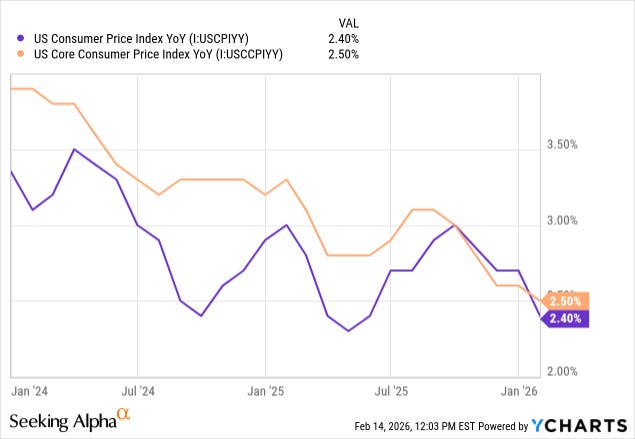
This latest CPI report continued in that trend of milder-than-expected releases, driven primarily by housing disinflation and year-over-year declines in gasoline prices.
As we have been predicting for a while now, this cool inflation report caused a sharp drop in long-term interest rates as well as a significant bump in REIT stock prices (XLRE):
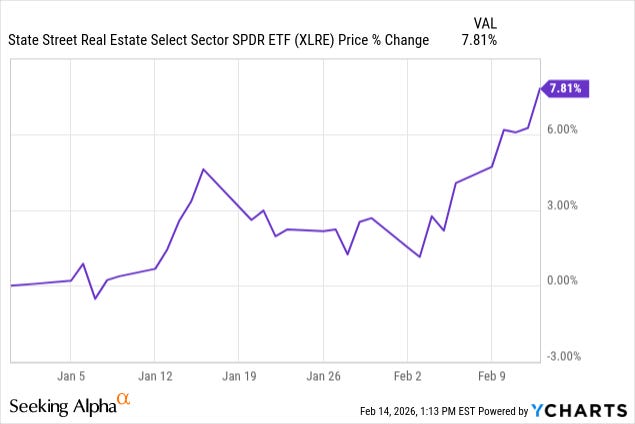
As you can see, though, this was on top of an already strong rebound in REIT prices year-to-date.
As long as this disinflationary trend lasts, we think our portfolios of undervalued REITs should continue to outperform as funds rotate from AI-related parts of the market to the real, physical, cash-flowing assets in the commercial real estate sector.
This accords with our thesis from the last CPI update: “MARKET UPDATE: Disinflation Is Likely To Resume In 2026.”
As we explained in the conclusion section of that article, we do expect a minor bump in the CPI at some point this year, probably in the Spring or Summer, but we think that the disinflationary trend will ultimately win the day and pull the CPI down to about 2% by year-end.
With inflation mild and interest rates coming down, we continue to expect 2026 to be a fantastic year for REITs.
Although other dividend-paying sectors like energy and staples have so far performed better this year, we now see the average valuations of those sectors as stretched. On the contrary, REITs have ample valuation headroom (relative to the rest of the market) to rally.
We expect the intra-market rotation to progressively favor REITs this year.
What About Tariffs?
It is a legitimate and interesting question why tariffs have not had a more significant impact on overall CPI.
The average effective tariff rate jumped from 2-3% in 2024 to 14-15% in 2025, and there has been a lot of discussion (including from us) about how tariff costs will ultimately be passed through to consumers in the form of higher prices.
So where’s the tariff inflation?
Well, it’s there, but the simple fact of the matter is that imported goods make up a small portion of the economy. Imports account for about 15% of US personal consumption. Imported goods (excluding tourism and other services) make up about 10-11% of US GDP.
Other, non-imported goods and services account for a far larger portion of the CPI than import-sensitive goods.
That said, we do see the impact of tariffs in the CPI if you dig into the data.
Tariffs are the primary reason why core goods (excluding autos) are now contributing 50 extra basis points to the CPI, while everything else in the CPI has now roundtripped back to healthy levels.
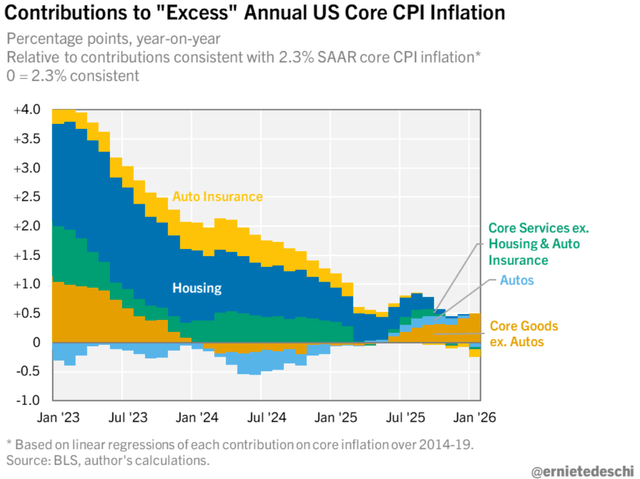
Ernie Tedeshi
In other words, if not for tariffs, the CPI rate would plausibly be at or slightly below 2% right now.
Then again, there could have been a trade-off effect from tariff-induced price increases. That is, consumers may have spent less on other items because of the need to pay higher prices for tariffed goods, putting downward pressure on those other items’ prices.
In any case, the CPI would be somewhat lower today if not for tariffs, so they are showing up in the data.
Although the US is the largest importing nation in the world, that status proved ineffective in negotiating lower prices with foreign exporters, who have so far not budged on prices for their goods.
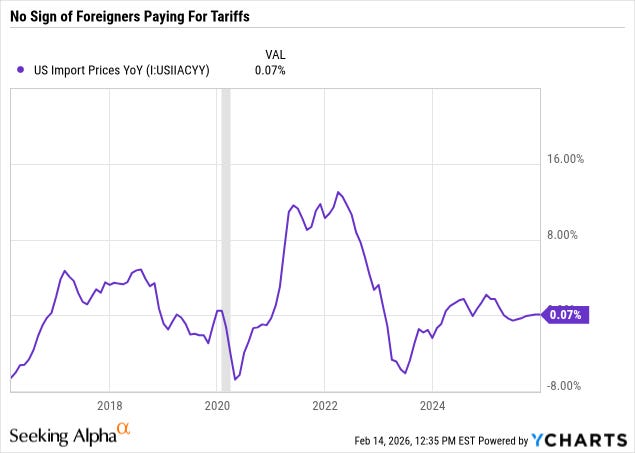
The Kiel Institute released a report early this year estimating that US businesses and consumers have so far paid for 96% of the tariff burden.
Recent research from the New York Fed estimates that Americans have shouldered a little over 90% of the tariff costs.
The Congressional Budget Office recently estimated that Americans have shouldered 95% of the tariff costs.
To quote the Fed researchers, “In sum, U.S. firms and consumers continue to bear the bulk of the economic burden of the high tariffs imposed in 2025.”
What portions exactly have been borne by American businesses versus American consumers is somewhat of an open question. However, based on previous assessments by Goldman Sachs and others, we would guesstimate that over half the tariff costs -- perhaps as much as 3/4ths -- have been passed through to consumers so far.
As such, we think over half of the tariff costs have already been passed through in the form of consumer price hikes.
But we also think that another round of price increases is likely to show up this year, fueled by above-average tax refunds.
Real-Time Inflation Gauges Show Even Milder Inflation
There are multiple ways to measure inflation. In fact, there’s no perfect way to measure inflation, because every individual consumer’s basket of goods and services is unique to them.
Our main complaint about the CPI, as we have written about numerous times over the last few years, is the lagged nature of the shelter metrics it uses. Changes in market rent take a year or more to meaningfully influence the shelter component of the CPI.
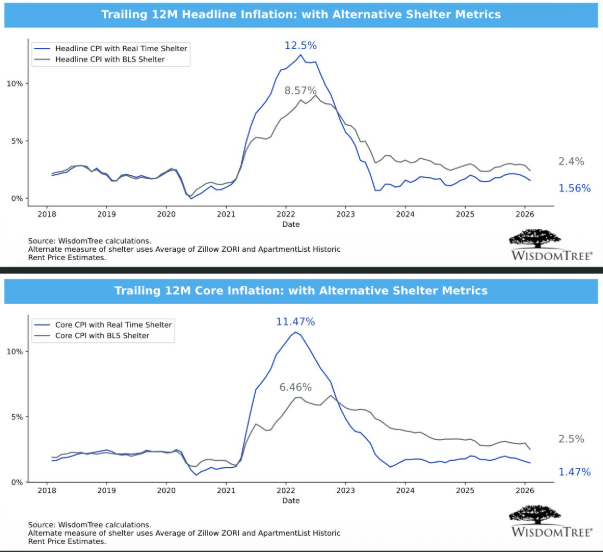
If you substituted the CPI’s lagged shelter metrics for real-time housing inflation data compiled by private sector sources (Zillow and Apartment List), the CPI would have been at or below 2% for the last 2.5 years.
Jeremy Schwartz
The official CPI and this alternative real-time CPI have been slow re-converging, but it has been a long, gradual process due to the continuously lagged shelter data within the official CPI.
Nevertheless, we have argued that the official CPI and real-time CPI should eventually converge and move in a tighter correlation to each other, as they did prior to COVID-19.
While the CPI’s Owners’ Equivalent Rent is now down to 3.3% and Rent of Primary Residence down to 2.8%, Zillow’s YoY rent metric sits at 2% while Apartment List shows -1.4% YoY. Redfin shows less than 2% national rent growth, including both apartments and single-family rentals.
The gravitational pull on the CPI’s shelter metrics down to the low real-time residential rent metrics is the strongest disinflationary force in the CPI right now.
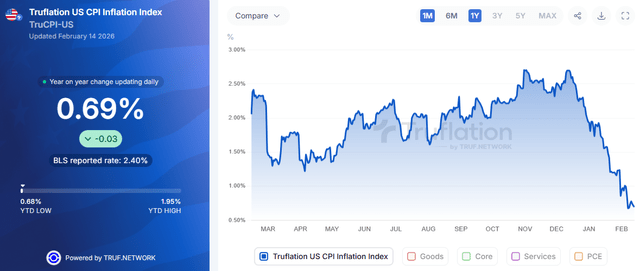
Interestingly, Truflation is also registering a huge collapse in consumer inflation in the US since mid-December.
Truflation
This is an index we watch closely, because Truflation captures millions of data points on countless consumer prices, effectively creating a consumer inflation index from the bottom up.
A collapse in real-time inflation like this is striking.
Pair this with the last US retail sales report, which came in remarkably weak.
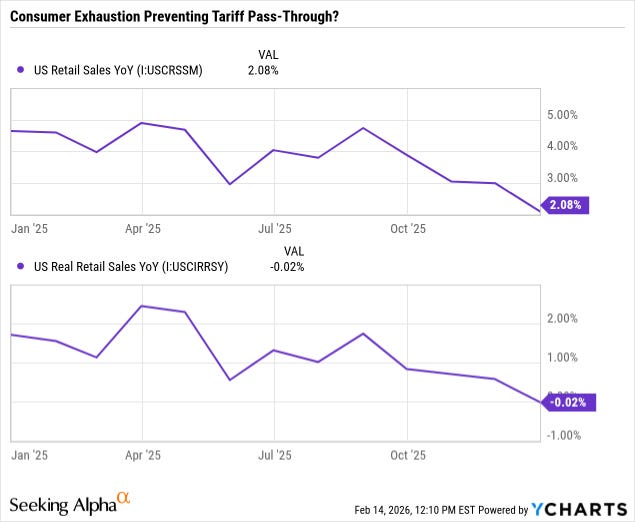
From October through December, nominal retail sales growth cooled to a little over 2%, while real (inflation-adjusted) retail sales growth effectively halted, registering a very slightly negative YoY number in December 2025.
While it is impossible to say for certain, we surmise that Paycheck-to-Paycheck consumers are reaching a point of spending exhaustion, largely though not entirely due to tariff pas-throughs.
If so, this could suggest that any inflationary bump to come from tax refunds later this year will be even more modest than we currently expect.
Bottom Line
The macro backdrop in 2026 -- steady economic growth combined with falling inflation and interest rates -- could scarcely be better for REITs.
Indeed, we are already seeing some big gains wracking up in our portfolios this year. Here’s a handful of the biggest winners:
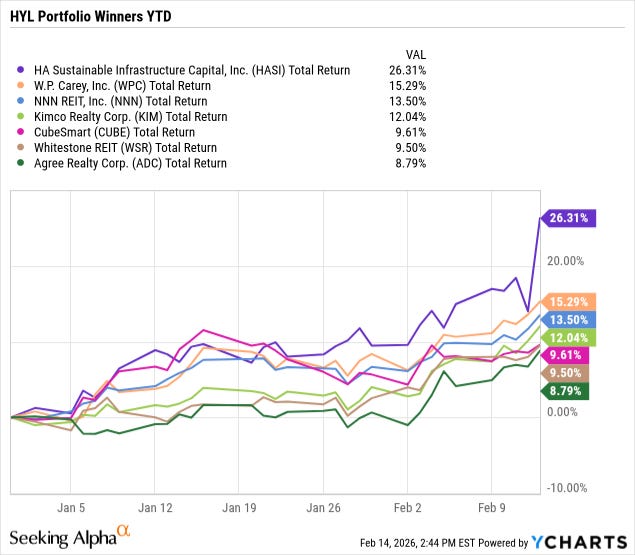
Granted, this is a cherrypicked list of our best performers, but we think this is just the beginning for the return of robust REIT performance. The gains are likely to continue and broaden out into other, neglected areas of the real estate sector.
For example, although Healthcare Realty (HR) has rebounded this year, the stock still trades at less than 12x FFO and less than 15x AFFO. This despite the very positive developments related to capital allocation and balance sheet strengthening coming from the new CEO.
There are many special situations and unique opportunities in the REIT space, and we are constantly on the lookout for them.
In this strong macro environment, we expect to see our portfolios continue to recover, return to acquisitive growth, and raise dividends.
As always, we will keep our members well-informed about any notable developments along the way.

Finally, please note that we have exceptionally posted this article without a paywall. If you found it valuable, consider joining High Yield Landlord for a 2-week free trial.
We expect to share a Trade Alert with our paid members tomorrow, and by starting your free trial today, you will also gain access to it. You will also get immediate access to my entire REIT portfolio, our exclusive REIT CEO interviews, and much more. We are the largest and highest-rated REIT investment newsletter online, with over 2,000 paid members and more than 500 five-star reviews.
We spend thousands of hours and over $100,000 per year researching the market for the most profitable investment opportunities, and we share the results with you at a tiny fraction of the cost.
Get started today - the first 2 weeks are on us:
Analyst’s Disclosure: I/we have a beneficial long position in the shares of all companies held in the CORE PORTFOLIO, RETIREMENT PORTFOLIO, and INTERNATIONAL PORTFOLIO either through stock ownership, options, or other derivatives. We also own a position in FarmTogether. High Yield Landlord® (’HYL’) is managed by Leonberg Research, a subsidiary of Leonberg Capital. All rights are reserved. No recommendation or advice is being given as to whether any investment is suitable for a particular investor. The newsletter is impersonal and subscribers/readers should not make any investment decision without conducting their own due diligence, and consulting their financial advisor about their specific situation. The information is obtained from sources believed to be reliable, but its accuracy cannot be guaranteed. The opinions expressed are those of the publisher and are subject to change without notice. We are a team of five analysts, each contributing distinct perspectives. Nonetheless, Jussi Askola, the leader of the service, is responsible for making the final investment decisions and overseeing the portfolio. We do not always agree with each other, and an investment by Jussi should not be taken as an endorsement by other authors. Past performance is no guarantee of future results. Our portfolio performance data is provided by Interactive Brokers and believed to be accurate but its accuracy has not been audited and cannot be guaranteed. Our portfolio may not be perfectly comparable to the relevant index. It is more concentrated and may at times use margin and/or invest in companies that are not typically included in REIT indexes. Finally, High Yield Landlord is not a licensed securities dealer, broker, US investment adviser, or investment bank. We simply share research on the REIT sector.
