



We are currently in the midst of a rare crash in preferred stock prices, including REIT preferreds, and also including investment-grade REIT preferreds.
While most IG-rated REIT preferred stocks tend to yield around 6% or less, they can today be bought at 7% or higher yields.
And many non-IG REIT preferred stocks that typically yield about 7% now offer yields of about 8%.
We think this represents a phenomenal buying opportunity, especially for income-seeking investors.
Let’s briefly discuss why this preferred stock selloff is happening right now. Then we will take a selective survey of REIT preferred stock buying opportunities across the credit spectrum from investment grade to sub-IG.
Bond Proxy Downturn
Luckily, it is pretty simple to explain why preferred stock prices are falling right now: interest rates are rising.
When rates rise, bond prices fall. That’s another way of saying that when interest rates rise, bond yields rise. When rates fall, bond yields fall.
Likewise for bond proxies such as preferred stocks, which are basically fixed-income securities. Rates are rising due primarily to high oil and diesel prices and secondarily to uncertainty about the number of Fed Rate hikes that are coming this year as a result of oil-driven inflation.
The sudden shift in market expectations during the month of September toward another Fed rate-hiking cycle caused all kinds of fixed-income securities to sell off.
As you can see from this chart, REIT preferred stock yields tend to be highly correlated to the 10-year Treasury rate (except during recessions):
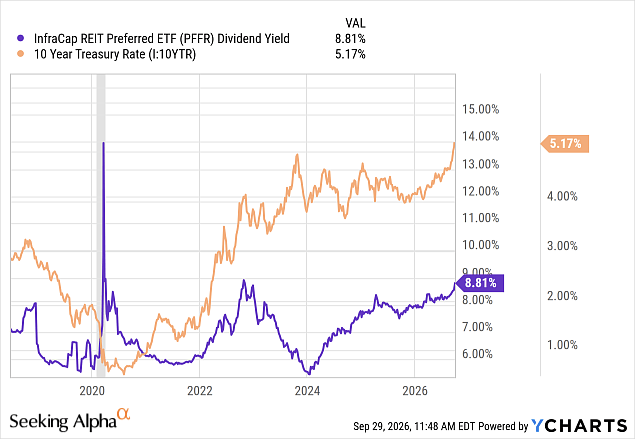
Don’t get too excited about the 8.8% yield you see from the InfraCap REIT Preferred ETF (PFFR), because that includes a number of lower-quality preferred stocks issued by hotel REITs or mortgage REITs. Those tend to sport higher yields for good reason.
Even so, this chart illustrates how REIT preferred stock yields are at a non-recessionary peak right now. That is, outside of recessions, they rarely yield higher (on average) than they do right now.
We think that makes them an attractive place to look for buying opportunities right now.
To be clear, if interest rates kept going higher and higher indefinitely, then there would be an indefinite amount of further downside for REIT preferred stocks.
But as we have explained in the past, we think the current rising rate environment is driven overwhelmingly by two temporary factors:
The war in Iran, which is disrupting global oil flows, and
Hyperscaler debt issuance, which will probably begin to decline over the next year or so.
It is impossible to time the end or phase-out of these two factors. They could occur separately, or they could happen simultaneously.
In either case, we think it is telling that long-term (next 3-5 years) inflation expectations remain pretty well anchored at around 2.5-3.0%, which is about average.
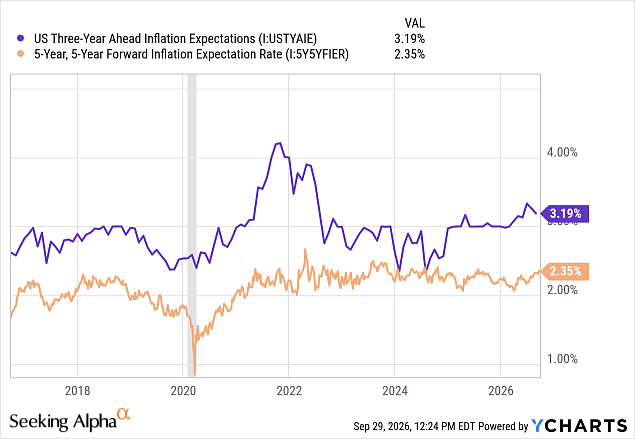
The market does not expect the current inflationary environment to turn into a new secular inflationary period like the 1970s. Neither do we.
Of course, we cannot time the top in interest rates, nor the bottom in preferred stock prices. We don’t try to time the market.
Rather, we simply recognize a good buying opportunity when we see one, and we deploy capital into that opportunity in increments.
Let’s take a look at some attractive REIT preferred stocks, starting with IG-rated ones and then moving to the higher-yielding non-IG-rated names.
Opportunities Among REIT Preferred Stocks
In some ways, the fundamental case for a REIT’s preferred stock is similar to what it is for its common stock. If cash flow grows while preferred equity shares outstanding stay flat or grow slower, then preferred dividend coverage increases, making the payout safer.
On the other hand, preferred stocks pay fixed dividends and have fixed redemption prices, typically $25. That gives them less upside than common stocks.
As it pertains to preferred dividend coverage, keep in mind that while higher interest expenses are negative, stronger operating fundamentals are positive and more than offset that negative. Given the favorable supply-demand dynamics for the next several years, most REIT preferred stocks should see dividend coverage increase for the foreseeable future as EBITDA (earnings before interest, taxes, depreciation, and amortization) rises faster than interest costs.
That’s another reason this REIT preferred stock selloff is so attractive to us.
The selloff is basically mechanical, as bond proxies fall along with bonds. But preferred dividend coverage, especially for low-leveraged investment-grade REITs, should only expand over the next few years.
Here are six IG-rated REIT preferred stocks to consider:
