



US inflation has rebounded above 4% for the first time in three years.
Not since the painful, post-COVID inflationary surge have we seen the CPI at these levels.
But, as always, the situation is more complex than the headlines may suggest.
Yes, inflation is hot right now, but it is overwhelmingly driven by the price of oil.
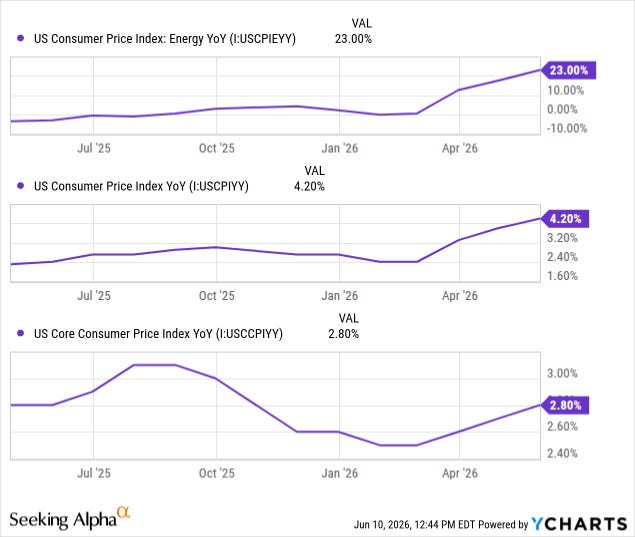
The core CPI index, which excludes food and energy, has rebounded much less significantly in recent months. This indicates that the broader CPI index is being driven higher overwhelmingly by energy prices.
But to be fair, the core CPI rate is higher. It has not quite reached the 3%+ level seen last summer when businesses were passing through tariff costs, but the trajectory is undoubtedly up.
SoFi Chief Market Strategist Liz Thomas also shared this chart after the May CPI release, showing a rising percentage of CPI items cresting 4% YoY price growth.
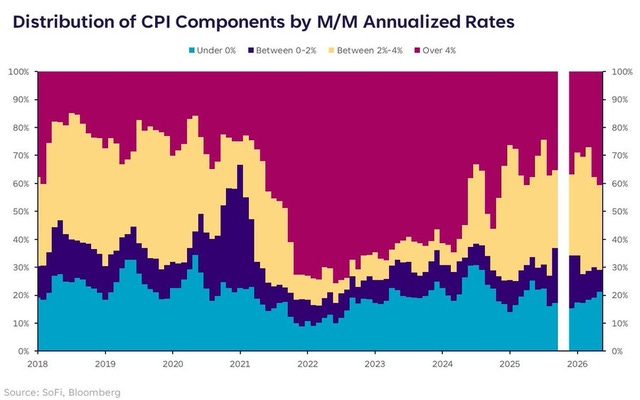
About 40% of CPI items are seeing price increases of at least 4%. Another 30% have price increases between 2-4% YoY. That’s 70% of the CPI basket with price increases higher than the Fed’s 2% target.
The good news, such as it is, is that the percentage of items showing YoY price decreases (less than 0%) is slowly rising. And the share of items with 2% or less price increases is holding steady at around 30%.
As we have argued in previous inflation reports, this oil-driven inflationary surge will be transitory.
To be clear, the length of this transitory bout of inflation had kept extending as the critical Strait of Hormuz remained effectively closed to oil tanker traffic. But just as we were finalizing this article, it was announced that the U.S. and Iran had reached a preliminary agreement to end the conflict and reopen the Strait of Hormuz, with oil prices already dropping sharply on the news.
This supports our view that the recent inflationary spike is likely transitory. If oil tanker traffic normalizes in the coming days and weeks, energy prices should continue to ease, reducing pressure on headline CPI. That said, inventories have been depleted, and it may take time for energy markets to fully normalize, so we would not expect inflation to immediately return to target overnight.
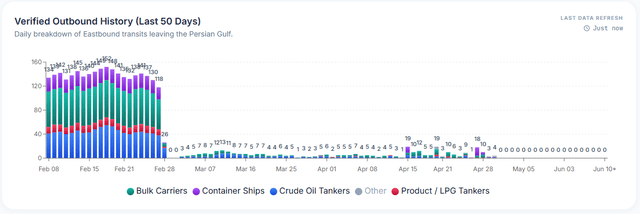
But for a number of reasons, the economy lacks the fundamental ingredients to support sustained, secular inflation.
Therefore, we think higher oil prices will mostly just poach consumer dollars from other parts of the economy, including from savings. This will put downward pressure on other prices as consumers have less available to spend after paying for gas.
What does this mean for REITs?
It appears as though the market has now decoupled REIT stock prices from inflation and interest rates, which is extremely rare. The market now seems focused on REITs’ solid positioning in the current economy, including their status as HALO (”heavy assets, low obsolescence”) businesses immune from AI disruption, as well as the lack of new supply on the horizon.
We think the market might also see this inflationary event as transitory and spare REITs from the selloff as a result. The more rate-vulnerable stocks in this environment appear to be the priced-for-perfection tech stocks.
Let’s go over the case that this inflationary event will ultimately prove transitory.
The Case For Transitory
The first and one of the most important points to mention as it relates to inflation is growth in the money supply.
The single biggest predictor of broad-based inflation is significant fluctuations in the money supply. When there is a big increase in the amount of dollars in circulation in the economy, consumers and businesses have more purchasing power. This swell in demand for goods and services usually outstrips the economy’s capacity to ramp up the supply of goods and services, leading to higher prices a.k.a. inflation.
Over the last 20 years, the average year-over-year growth rate of the money supply has been 6.3%. Currently, the money supply is growing at around a 4.7% pace.
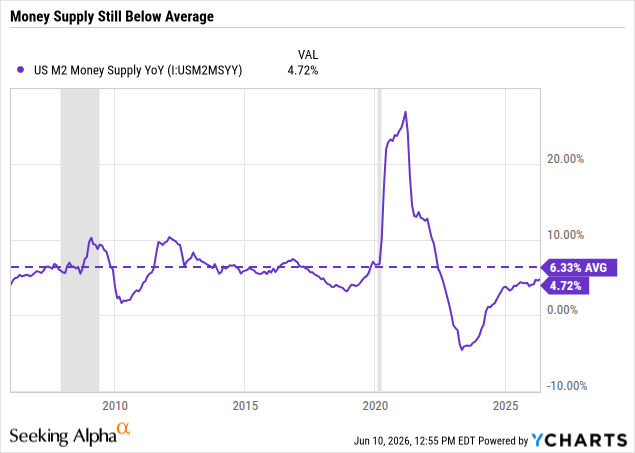
That is not only below the long-term average. It is also at the bottom end of the range seen during the 2010s, when inflation remained consistently muted.
This is even below the growth of nominal GDP, which has been running above 5% recently. It is also only about 50 basis points higher than the May CPI rate.
In short, then, the money supply is not fueling broad-based inflationary pressures right now.
Nor is the labor market.
When the labor market is hot and wages are rising rapidly, it can result in a wage-price spiral in which higher wages fuel price increases, which in turn puts pressure on employers to raise wages further.
From 2023 through 2025, wage growth exceeded the rate of inflation, which gave consumers the opportunity to “catch up” after the inflationary surge of 2021-2022.
But after the Iran conflict began, especially since May, the CPI has now exceeded wage growth.
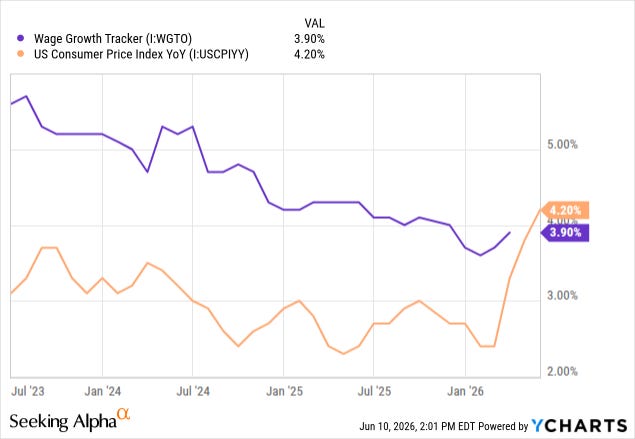
To be clear, we have a more recent reading from the CPI than we do from wage growth. But assuming wage growth has not materially risen over the last few months (as of April, it was 3.7% YoY), real wage growth is now negative.
Negative real wage growth is the opposite of inflationary.
Of course, this assumes that the CPI is an accurate reflection of US consumer inflation.
But we think there are better inflation measurements.
For example, every month, WisdomTree’s Jeremy Schwartz puts out a “real-time” CPI metric that substitutes the lagged shelter component of the CPI with private sector rent indices. This “real-time CPI” metric shows headline inflation running at 3.2% and core (ex. food & energy) inflation running at 1.6% in May.
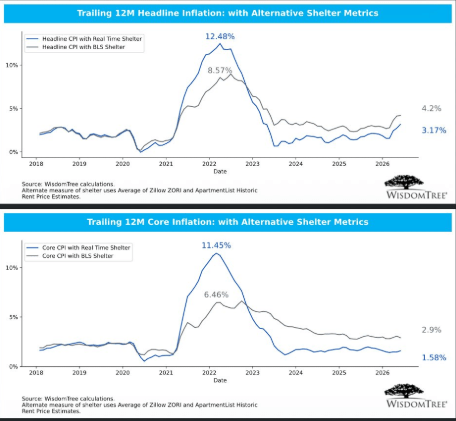
This metric changes nothing about the CPI except its measurement of housing inflation.
Notice that this alternative measurement of core CPI shows virtually no uplift in inflation at all. (Neither, for that matter, does unadjusted core CPI.)
Contributing to the increases in headline and core CPI in recent months has been a bounce in shelter inflation metrics (”Rent of Primary Residence” and “Owners Equivalent Rent”).
Shelter YoY:
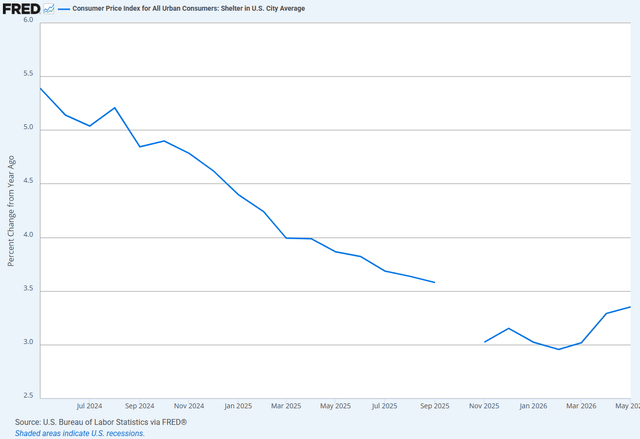

This makes no sense, given all private market data on housing prices.
Apartment List shows a national YoY rent change of -1.5%. Zillow shows 1.9%. Average the two and you get a barely positive number. Moreover, the most recent national US home price index reading showed home prices rising less than 1% YoY.
We think two quirky things are going on within the CPI’s shelter component to cause this rebound.
The Owners’ Equivalent Rent surveys are conducted every six months. Since these surveys weren’t conducted in September-October 2025, the surveys in April-May 2026 (six months later) are building in too much costs to compensate.
The government’s Rent of Primary Residence metric gives a heavier weight to lease renewal rent growth than the private sector rent indices that are primarily concerned with the market rate. Renewal rent growth has remained firm despite softness in new lease rents.
We think shelter CPI disinflation should resume in the coming months, alleviating some of this pressure on headline and core CPI.
Truflation, which does a good job of capturing real-time housing inflation, showed inflation of around 2% in May, falling below 2% in June.
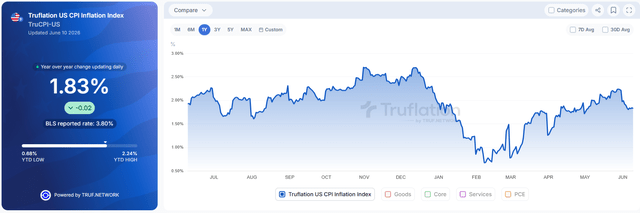
According to Truflation, last year’s tariffs caused broader and larger price increases than this year’s Iran conflict.
Here’s more good news on the inflation front: Items in the CPI that change price infrequently have not experienced an increase in price growth along with the broader CPI.
“Sticky Price” CPI Items Excluding Shelter YoY:
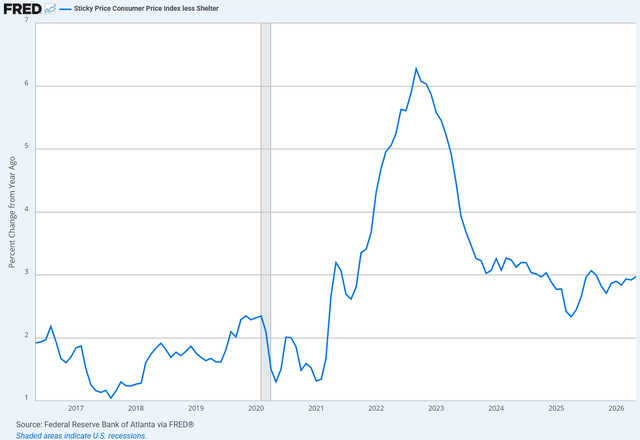
These “sticky price” items include medical care, prescription drugs, school tuition, childcare, cell phone bills, haircuts, dry cleaning, sewer & trash utilities, car insurance, restaurant menu prices, and gym memberships. They are items that typically stay the same price for at least a year, sometimes multiple years in a row or longer.
In 2021-2022, we saw what happens when a massive wave of money supply growth sweeps across the economy. Prices of almost everything went up.
But since 2024, sticky price inflation has cooled to about 3%. That is higher than the 1.5-2% rate experienced prior to the pandemic, but it was a dramatic improvement from the red-hot post-COVID inflation days.
It is reassuring to see that the “sticky price CPI” has essentially not budged even as the headline CPI has surged over the last few months.
Another piece of good news relates to food, both groceries (”Food At Home”) and restaurants (”Food Away From Home”). Price growth in these categories have picked up very little, if any, due to the Iran conflict.
Food At Home (Blue) & Food Away From Home (Green) YoY:
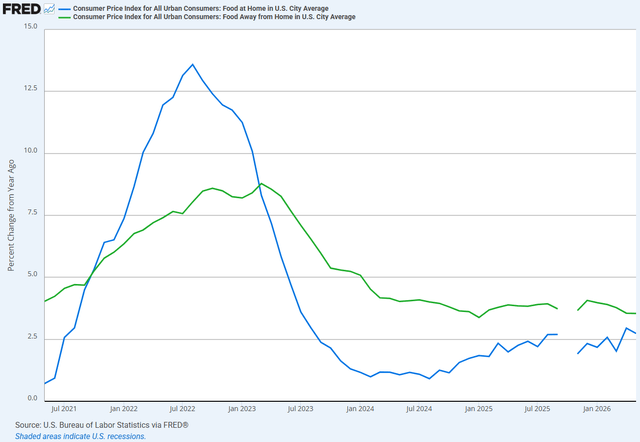
Of course, the longer oil prices stay high, the more likely it is that higher transportation costs filter through into higher food costs.
We may see some increase in food inflation due to persistently high oil prices, but we don’t think it will be significant. After all, transportation costs represent only a small minority of input costs for food.
On the other hand, higher oil prices may actually put downward pressure on food prices, because consumers will have to devote more of their scarce disposable income to gasoline and will thus have less left over to spend on food.
Yet another category of the CPI showing no inflationary increases is durables, which includes new and used cars, furniture, and large appliances.
Durables YoY:
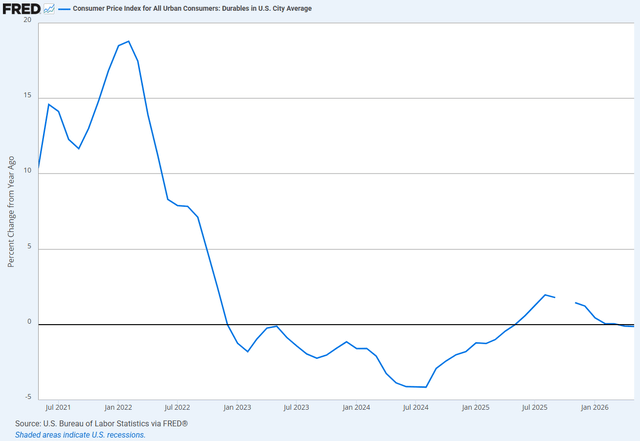
In this category, we see zero year-over-year price increases on net. There are some small upward or downward price adjustments here and there, but overall, durables prices are stable.
Prices for big-ticket items like these are far more swayed by the financial health of the consumer, sentiment, and interest rates than the price of oil.
Finally, we will mention that electricity prices are still experiencing elevated price growth of over 5% YoY.
Electricity YoY:
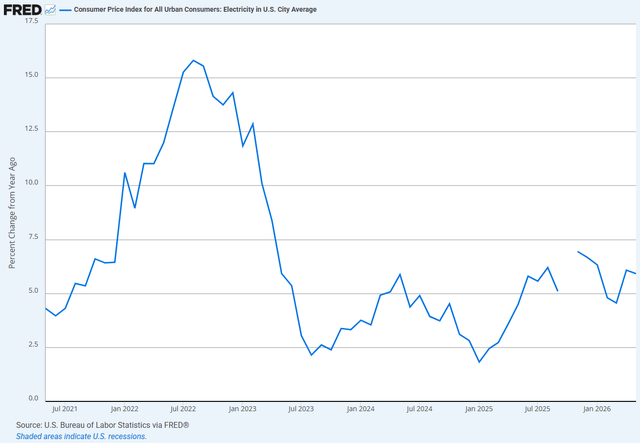
But this small component of the CPI has basically nothing to do with the price of oil. It is overwhelmingly driven by the AI infrastructure buildout, which results in a supply-demand imbalance in the power market. Demand for electricity exceeds supply, which is pushing up prices.
The positive spin here is that electricity price growth is nowhere near the 15% peak reached in the post-COVID inflationary surge. And there has been no upward trajectory so far this year.
REITs Looking Through The Noise
Inflationary spikes that are driven by oil shocks like the current one almost certainly won’t result in a broad-based uplift in inflation. Businesses know this, which is why most of them are choosing to eat the higher transportation costs rather than hike prices right now.
Three-year inflation expectations have risen only slightly above their long-term average level of about 3%.
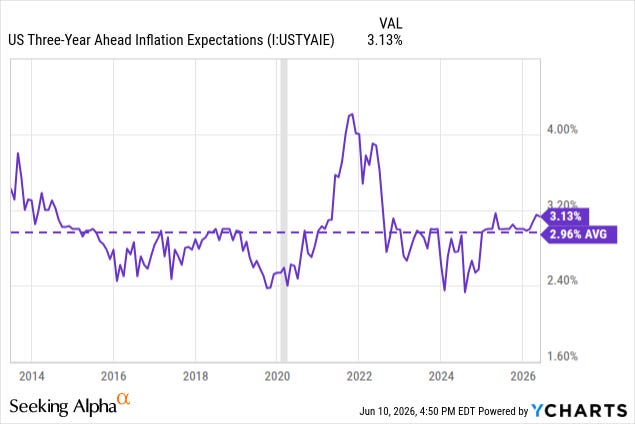
We think the CPI will drop back below 3% by the end of this year and likely end up back in the mid-2% area by the middle of next year.
In short, we believe this inflationary bout is transitory.
That, we think, is a big reason why REITs have had such a good year this year, outperforming the S&P 500 (SPY) by several points as of June 10th.
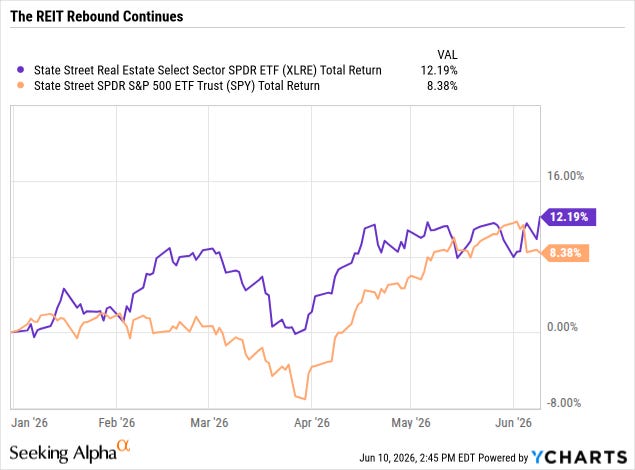
It is as if the market is saying that higher interest rates are an annoyance for any debt that needs to be refinanced this year, but rates will almost certainly be lower next year. Thus, this inflation/interest rate bounce is not a long-term threat.
Even more importantly, the market is watching as the development pipelines of virtually all types of commercial real estate are falling. This means that the growth of new supply is shrinking, even as demand from all types of CRE tenants remains robust.
From 2023 through 2025, CRE suffered from softening demand and a huge wave of new supply.
This year, however, the pendulum has swung in the other direction. Demand has either remained steady or rebounded, while additions of new supply have slowed to a trickle.
Better yet, there is basically no cyclical upswing in new construction across the various sectors of CRE because of high capital and construction costs.
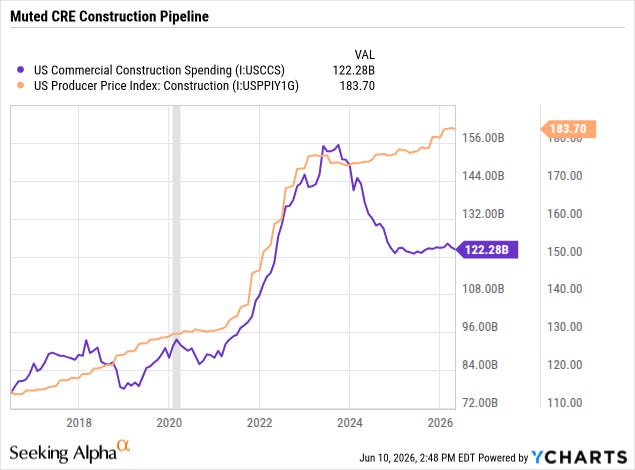
This chart makes it look like commercial construction spending is still significantly higher than it was before the pandemic, but that is entirely due to the huge increase in construction costs.
In today’s environment, elevated construction costs and interest rates paradoxically benefit REITs by diminishing the amount of new supply coming to market to compete with their existing property portfolios.
That diminished development pipeline does not appear to be turning into growth mode anytime soon.
This results in a period of time for at least the next few years in which REITs’ existing portfolios have very little new supply to compete with. And the longer capital/construction costs remain high, the longer this period of low supply growth will last.
We think the REIT rebound is still in early innings.
There’s plenty of upside left, and we remain confident that we will realize it over the next few years. Finally, please note that we have exceptionally posted this article without a paywall. If you found it valuable, consider joining High Yield Landlord for a 2-week free trial.
We expect to share a Trade Alert with our paid members tomorrow, and by starting your free trial today, you will also gain access to it. You will also get immediate access to my entire REIT portfolio, our exclusive REIT CEO interviews, and much more. We are the largest and highest-rated REIT investment newsletter online, with over 2,000 paid members and more than 500 five-star reviews.
We spend thousands of hours and over $100,000 per year researching the market for the most profitable investment opportunities, and we share the results with you at a tiny fraction of the cost.
Get started today - the first 2 weeks are on us:
Analyst’s Disclosure: I/we have a beneficial long position in the shares of all companies held in the CORE PORTFOLIO, RETIREMENT PORTFOLIO, and INTERNATIONAL PORTFOLIO either through stock ownership, options, or other derivatives. We also own a position in FarmTogether. High Yield Landlord® (’HYL’) is managed by Leonberg Research, a subsidiary of Leonberg Capital. All rights are reserved. No recommendation or advice is being given as to whether any investment is suitable for a particular investor. The newsletter is impersonal and subscribers/readers should not make any investment decision without conducting their own due diligence, and consulting their financial advisor about their specific situation. The information is obtained from sources believed to be reliable, but its accuracy cannot be guaranteed. The opinions expressed are those of the publisher and are subject to change without notice. We are a team of five analysts, each contributing distinct perspectives. Nonetheless, Jussi Askola, the leader of the service, is responsible for making the final investment decisions and overseeing the portfolio. We do not always agree with each other, and an investment by Jussi should not be taken as an endorsement by other authors. Past performance is no guarantee of future results. Our portfolio performance data is provided by Interactive Brokers and believed to be accurate but its accuracy has not been audited and cannot be guaranteed. Our portfolio may not be perfectly comparable to the relevant index. It is more concentrated and may at times use margin and/or invest in companies that are not typically included in REIT indexes. Finally, High Yield Landlord is not a licensed securities dealer, broker, US investment adviser, or investment bank. We simply share research on the REIT sector.

We might have temporary food inflation the next year, because the Hormuz fertilers blockage works through a delayed effect.
It's not certain yet if the current ceasefire extension will hold. But overall, a very interesting analysis and article.