



The REIT recovery is gaining momentum.
The Vanguard Real Estate ETF (VNQ) has generated a total return of approximately 55% from its late 2023 lows, while the broader equity REIT sector delivered a total return of nearly 15% during the first half of 2026 alone.
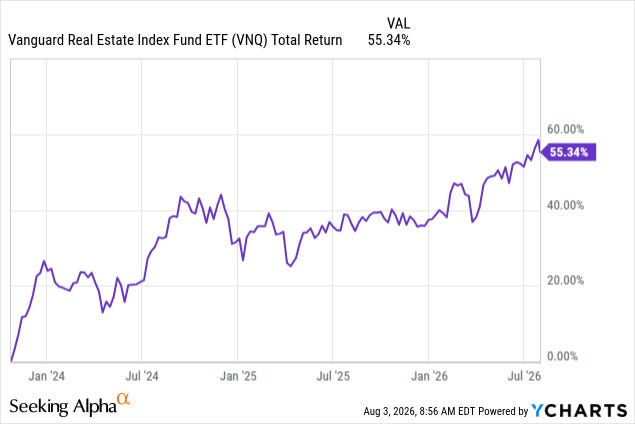
This is not surprising. REIT fundamentals have remained resilient, property values are stabilizing, interest rate fears have eased, and institutional investors are returning to the sector. As sentiment has improved, common shares have repriced rapidly.
But one corner of the REIT market has largely missed the recovery:
Preferred shares.
Many REIT preferreds continue to trade between $17 and $21 per share, despite generally having a $25 liquidation preference. Investors can still earn dividend yields of 6%–10%, while potentially enjoying meaningful appreciation if these securities eventually recover toward par.
The disconnect is particularly interesting because many underlying REITs are becoming safer. Cash flow is growing, leverage is declining, and rising common equity values are increasing the cushion beneath the preferred shares.
Yet many preferreds remain priced as if the REIT bear market had never ended.
Why Preferred Shares Are Often Slow to Recover
Our view is that the explanation is primarily structural.
REIT common shares generally trade millions of dollars daily, allowing institutions to establish meaningful positions quickly.
Preferred shares are different. Many issues trade only a few thousand shares per day. Pebblebrook’s Series H preferred, for example, often trades fewer than 10,000 shares daily. At approximately $18 per share, even 10,000 shares represent less than $200,000 of trading volume.
A large institution cannot build a meaningful position without moving the price substantially. When sentiment improves, institutional capital therefore enters through the liquid common equity first. Preferred shares remain dominated by smaller income-oriented investors, whose decisions tend to be driven more by current yields and interest rates than by changes in property values, forward EBITDA, or private market NAV.
This can cause preferred shares to reprice much more slowly than common equity, creating an opportunity for smaller and more agile investors.
Why Preferred Shares Fit Our Retirement Portfolio
Preferred shares sit between common equity and debt in the capital structure. They rank ahead of common shareholders for dividends and liquidation proceeds, but they generally do not participate directly in the long-term growth of the business. Their dividends are fixed, and the issues are typically perpetual unless the company chooses to redeem them.
This makes them suitable for the income-oriented portion of our Retirement Portfolio. They can provide predictable income, priority over the common dividend, less dependence on earnings growth, and upside when purchased below the $25 liquidation preference.
Preferreds can still decline when credit spreads widen, or interest rates rise. But their fixed dividends and seniority can stabilize portfolio income and reduce dependence on common-share appreciation.
The key is to avoid reaching blindly for the highest yield.
What We Look for in a REIT Preferred
A preferred share trading at a discount is not automatically cheap.
The $25 liquidation preference is not a guaranteed future price. Most REIT preferreds are perpetual, and redemption is entirely at the issuer’s discretion. A company is unlikely to redeem a low-coupon preferred if replacing it would require more expensive capital.
We therefore focus on six criteria:
Reasonable leverage: A modest decline in property values should not threaten the preferred equity.
A substantial common equity cushion: Common shareholders absorb losses before preferred shareholders suffer an impairment.
A manageable preferred layer: Preferred equity should represent a relatively small portion of the capital structure.
Strong dividend coverage: Recurring cash flow should cover the preferred dividend several times over.
Manageable debt maturities: The company should have adequate liquidity and no refinancing cliff that could force distressed asset sales.
Attractive valuation: We ideally want a price below $21, a yield above 6%, and either an improving credit profile or a credible path toward price appreciation.
After reviewing a large portion of the REIT preferred market, the following eight issues stood out. Prices and yields are approximate as of early August 2026 and will fluctuate. Limit orders are essential because many of these securities are thinly traded.
