



Cell tower REITs have been some of the more disappointing real estate investments of the past few years.
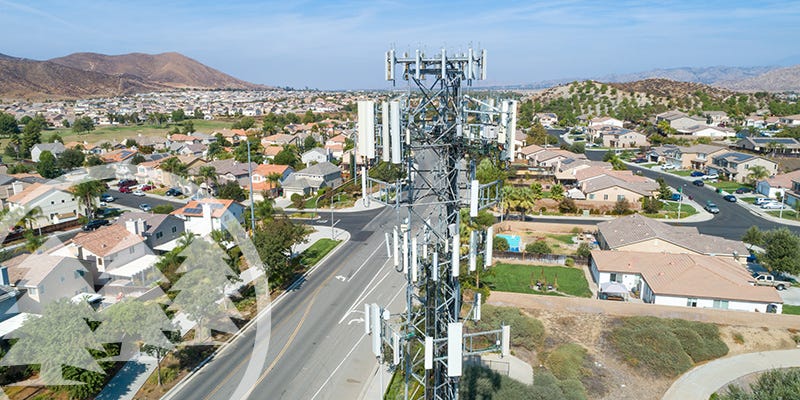
Crown Castle (CCI), American Tower (AMT), and SBA Communications (SBAC) have all suffered major declines from their prior highs as their growth rates slowed and investors became increasingly skeptical about their long-term prospects.
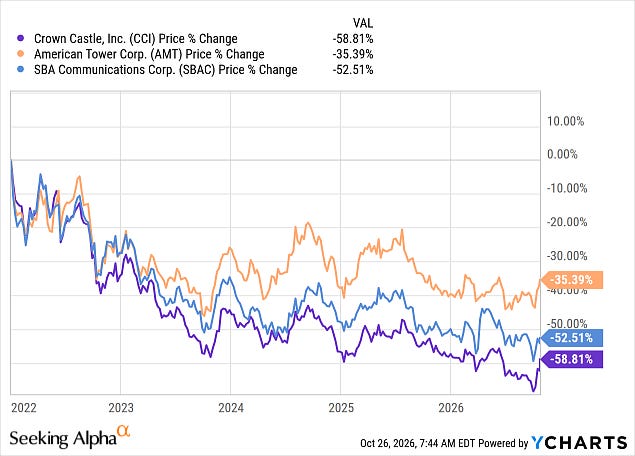
There were several reasons for this.
First, interest rates surged, which hurt nearly all REITs by increasing financing costs and making their dividend yields less attractive relative to bonds. Cell towers were particularly sensitive because they are long-duration infrastructure assets with very predictable cash flows, and therefore their valuations had benefited greatly from the ultra-low-rate environment of the prior decade.
But the bigger issue specific to towers was that their organic growth rates also slowed significantly because of tenant consolidation. The merger of T-Mobile and Sprint created a lot of redundant equipment across the country. T-Mobile did not need to continue paying rent on two nearby towers serving essentially the same customers, and so Sprint-related leases were gradually cancelled.
More recently, DISH also failed to develop into the fourth major nationwide wireless carrier that many had expected, creating another round of lease terminations.
This was especially painful for tower landlords because their business model is largely built around increasing co-tenancy. You build or acquire a tower, lease space on it to one carrier, and then gradually add more equipment from additional carriers. Since much of the cost of owning and maintaining the tower is already fixed, each additional tenant can generate very attractive incremental returns.
Instead of co-tenancy steadily rising, the industry suddenly experienced the opposite. Some existing equipment was removed, leases were cancelled, and organic growth slowed.
Then, just as these lease cancellations were beginning to work their way through the numbers, another concern emerged: Starlink.
The bear thesis was that satellite-based communications could eventually make traditional cell towers less important, further reducing the long-term growth prospects of these REITs.
We disagreed with that view and continued buying the dips at High Yield Landlord.
Our argument was not that the headwinds were imaginary. Sprint cancellations were very real, and DISH created an additional setback. But these were largely temporary issues that would eventually disappear from the year-over-year comparisons. Meanwhile, we saw satellite connectivity as complementary to terrestrial networks rather than a replacement for them.
Now, we have received an important new piece of evidence supporting that thesis.
SpaceX is reportedly looking to secure access to at least 80,000 cell sites across the United States as it works toward becoming a fourth nationwide wireless carrier. Bloomberg reported that the company is in discussions with cellular infrastructure providers, including Crown Castle. Crown Castle’s CEO declined to discuss specific negotiations on its latest earnings call but said that investors could assume the company was “talking to all parties” when specifically asked about potential agreements with SpaceX, Amazon, and other satellite operators.
That does not mean that SpaceX has already signed leases on 80,000 towers. It hasn’t. Negotiations are still taking place, and we do not yet know how many sites will ultimately be needed or what the economics will look like.
But I think the strategic implications are already quite significant.