


One of the most common arguments I hear against REITs today is that their dividend yields are not attractive enough relative to government bonds.
The reasoning sounds straightforward: why buy a REIT ETF yielding roughly 4-5% when Treasuries can offer a higher yield without taking equity-market risk?
I think this comparison is highly misleading for three reasons.
First, broad REIT ETFs are market-cap weighted and therefore dominated by mega-cap companies, including lower-yielding REITs in growth sectors such as data centers and cell towers. They do not reflect the much higher yields available below the surface of the REIT market.
Second, a REIT’s dividend yield is not its actual cash-flow yield.
Third, and more importantly, REITs can grow their cash flows over time, and could enjoy significant repricing upside over the coming years.
Once you account for these distinctions, today’s REIT income opportunity looks considerably more attractive.
REIT Share Prices Fell. Their Dividends Didn’t.
The past few years have been brutal for listed real estate.
Interest rates surged, investors moved capital into bonds, and REIT valuations compressed sharply. Many REIT share prices dropped 20%, 30%, 40%, or more.
But the underlying properties did not suddenly stop generating rent. In most cases, rents continued rising, cash flows kept growing, and dividends continued increasing even as share prices collapsed.
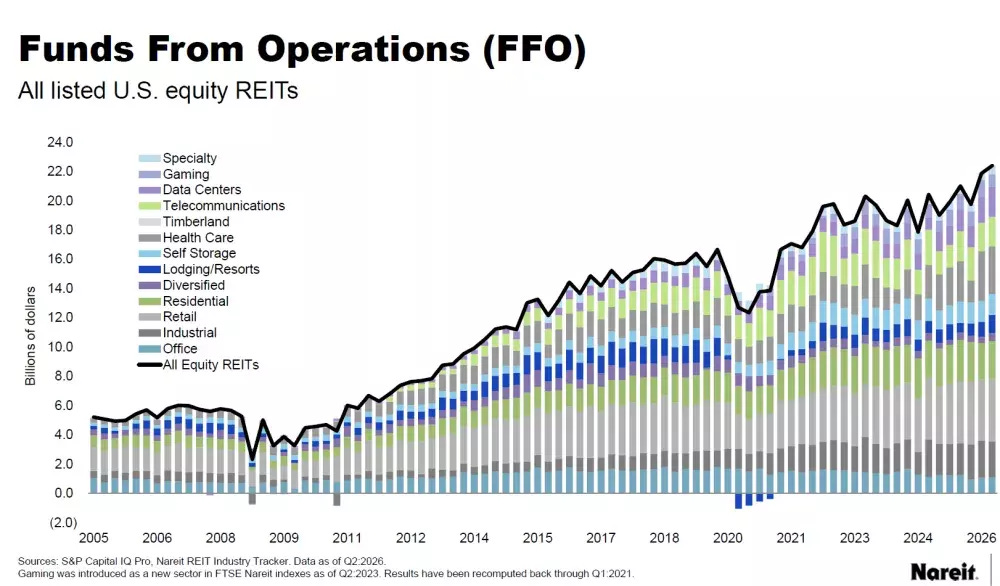
That is what has created today’s opportunity.
If a REIT pays a $2 annual dividend when its shares trade at $50, the yield is 4%. If the share price drops to $30 while the dividend remains unchanged, the yield suddenly rises to 6.7%.
If the dividend also continues growing, the opportunity becomes even more attractive for investors putting fresh capital to work.
So the high yields we see today are not necessarily the result of deteriorating businesses. In many cases, they simply reflect the fact that share prices have fallen much more than cash flows and dividends.
Dividend Yield Is Not Cash-Flow Yield
This is perhaps the most important point when comparing REITs with Treasuries.
A lot of investors compare:
5% Treasury yield vs. 6% REIT dividend yield
But that is not an apples-to-apples comparison.
A Treasury distributes essentially all of the return it generates as interest. There is no additional cash flow being retained and reinvested on your behalf.
REITs are different.
Most quality REITs distribute only around 70–80% of their recurring cash flow, retaining the other 20–30% for reinvestment.
That means a REIT yielding 6% with a 75% payout ratio is actually producing an underlying cash-flow yield of roughly 8%.
You receive about 6% directly as dividends, while another roughly 2% is retained inside the company and reinvested into developments, acquisitions, debt reduction, property improvements, or share repurchases.
So the more appropriate comparison is closer to:
5% Treasury yield vs. ~8% REIT cash-flow yield
And there is another major difference: REIT cash flow can grow.
Rents increase. Retained earnings are reinvested. Properties appreciate over long periods. Dividends can rise accordingly.
A Treasury coupon does not.
This is why comparing a bond yield directly with a REIT dividend yield can materially understate the economics of owning real estate.
Income Plus Growth Changes the Math
Suppose you buy a REIT yielding 6% that can grow its cash flow per share by roughly 4% annually.
Without assuming any improvement in its valuation, you already have a rough path toward:
6% dividend income + 4% annual growth = ~10% potential annual total returns.
Meanwhile, a Treasury yielding 5% gives you approximately 5%.
The difference becomes even more significant over time because the REIT’s dividend and underlying cash flow can compound.
There is also the issue of inflation and taxation. Imagine, purely for illustration, that a bond yields 5%, inflation averages 3%, and taxes consume another roughly 1–1.5% of income depending on the investor’s jurisdiction. Your real after-tax return could be somewhere around 0.5–1% annually.
That may still make Treasuries useful for capital preservation and portfolio stability, but it is not especially attractive for long-term wealth creation.
A REIT producing something closer to an 8% cash-flow yield and growing that cash flow over time has a very different economic profile.
And that still ignores one of the biggest potential sources of returns today: valuation recovery.
Many REITs remain priced at substantial discounts to the estimated value of their properties. If those discounts eventually narrow as rent growth accelerates and interest rates normalize, shareholders could earn substantial capital appreciation on top of the income and growth. They historically have enjoyed such upside following periods of steep discounts.
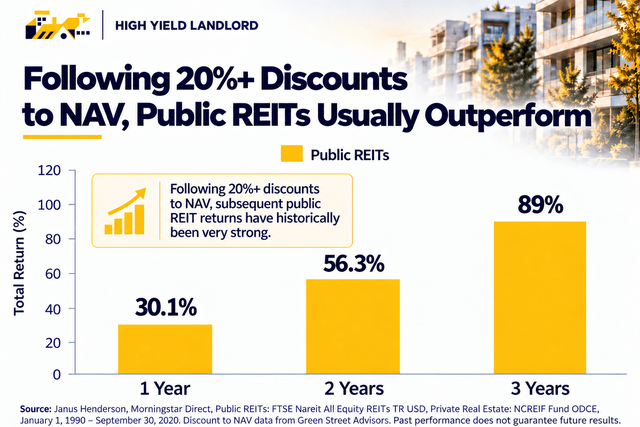
This is why I personally find carefully selected REITs far more compelling than simply locking capital into long-duration government bonds today.
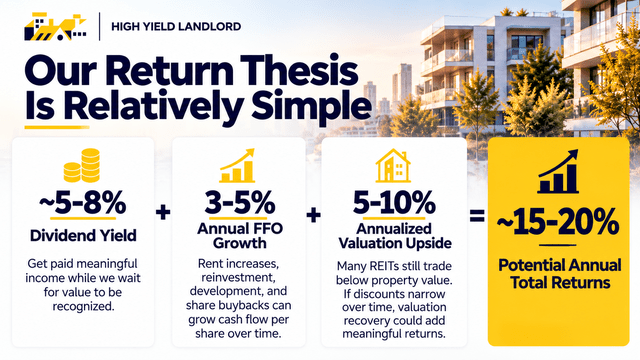
The higher yield, coupled with growth and repricing upside potential, offers a path to 15-20% average annual total returns in many cases:
Three Examples of What We Are Seeing
There are many opportunities across the REIT market, but three examples illustrate the point particularly well.
Xior Student Housing (XIOR / XIORF)

Xior is the leading listed student housing REIT in continental Europe.
It currently offers a dividend yield of roughly 7.5%, and yet it still retains approximately 20% of its cash flow for reinvestment. That means the actual cash-flow yield investors are buying is even higher than the quoted dividend yield.
The business is also growing. Rents have been increasing at roughly 5% annually, new development projects are coming online, and management has guided for approximately 4% growth in both FFO and dividends per share in 2026 and 2027.
Management also owns roughly 10% of the equity, creating strong alignment with shareholders.
Yet despite the high yield and continued growth, Xior trades at approximately a 35% discount to its net asset value.
Using our broader return framework, the math could look something like this:
~7.5% dividend yield + ~4% annual FFO growth + ~5–10% annualized valuation upside = ~16.5–21.5% potential annual total returns.
That is not a forecast or guarantee, but it illustrates why we find the starting valuation so interesting.
W.P. Carey (WPC)

W.P. Carey offers another attractive combination of income and growth.
Its portfolio consists largely of industrial, warehouse, and other mission-critical properties leased under long-term net leases.
The shares currently offer roughly a 6% dividend yield, which we believe is well covered and positioned to grow.
One of W.P. Carey’s biggest advantages is that many of its leases contain CPI-linked rent escalations. During periods of elevated inflation, those contractual increases can result in stronger organic rent growth than the fixed escalators found in many traditional net lease portfolios.
Its industrial properties should also benefit from several long-term trends, including reshoring and nearshoring of supply chains, rising defense spending, continued e-commerce growth, and the increasing importance of physical logistics infrastructure in an AI-driven economy.
W.P. Carey also has a strong investment-grade balance sheet and a multi-decade track record of creating substantial value for shareholders.
Yet the valuation remains discounted, allowing investors to collect roughly 6% while rents and cash flow continue growing.
Again, the potential return equation is fairly straightforward:
~6% dividend yield + ~3–4% annual FFO growth + ~5–10% annualized valuation upside = ~14–20% potential annual total returns.
The key is that the 6% dividend is only the starting point.
VICI Properties (VICI)

VICI may be the most striking example.
It currently offers roughly an 8% dividend yield, despite continuing to grow its AFFO per share.
Its valuation has fallen toward the lowest levels in its history, comparable to where it traded during the pandemic.
Think about how different the situation was back then. Casinos were literally closed. It was arguably the worst possible crisis imaginable for casino real estate.
Yet VICI made it through that environment, collected its rents, expanded substantially, strengthened its balance sheet, diversified its portfolio, and was eventually added to the S&P 500.
Today, the company is fundamentally stronger than it was during the pandemic, yet investors can once again buy it at a similarly depressed valuation.
VICI grew AFFO per share by roughly 5% last year and expects another approximately 4% increase this year, while the shares trade at around a 25% discount to our estimate of NAV.
The return equation therefore looks especially compelling:
~8% dividend yield + ~4% annual AFFO growth + ~5–10% annualized valuation upside = ~17–22% potential annual total returns.
Again, those numbers are illustrative rather than guaranteed. But they show why a high current yield combined with continued growth and a depressed valuation can produce a very attractive setup.
This Is Where High Yield Landlord Comes In
The challenge is that high yield alone tells you very little about whether a REIT is actually attractive.
One 8% yielding REIT may own excellent properties, have modest leverage, retain cash flow for growth, and trade at a huge discount to NAV.
Another 8% yielding REIT may be overleveraged, own declining assets, and be months away from cutting its dividend.
Both screen as “8% yielding REITs,” but the investment outcomes can be completely different.
That is precisely why we built High Yield Landlord.
We do not simply screen for the highest dividend yields. We analyze hundreds of listed real estate opportunities and try to identify the relatively small number where we believe the market has mispriced the risk.
We look at property values, rents, lease structures, tenant quality, debt maturities, refinancing risk, payout ratios, capital allocation, private-market comparable transactions, and the quality and incentives of management.
Our team spends thousands of hours every year doing this work and invests more than $100,000 annually into research, data, conferences, travel, property visits, and direct access to management teams.
And then we put our own money behind the research.
When we issue a Buy Alert, we are not publishing a theoretical idea and moving on. We are investing our own capital alongside members.
Members can see what we bought, how much we invested, our fair-value estimate, the key risks, which portfolio owns it, and what would cause us to change our thesis.
We Are Looking for More Than Just Yield
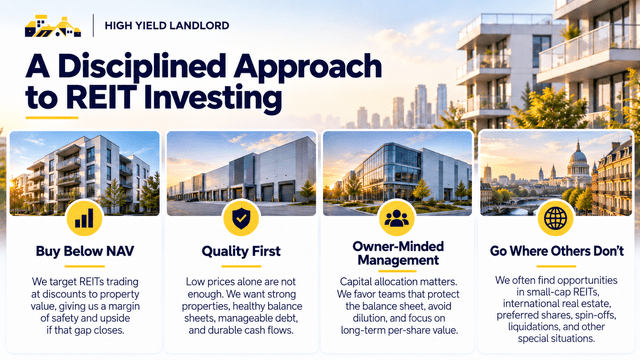
Xior, W.P. Carey, and VICI illustrate what we are looking for.
We want attractive current income, but we also want the underlying cash flow to grow.
We want sustainable payout ratios so that the company can retain capital and compound value internally.
And ideally, we want to buy the shares at a large discount to the value of the underlying real estate, giving us a third potential return driver if the valuation eventually normalizes.
This is why our objective is not to build the portfolio with the highest headline yield. It is to find the best risk-adjusted combination of income, growth, and upside.
That selective approach has also helped our Core Portfolio meaningfully outperform its REIT benchmark since its launch, despite going through one of the most difficult REIT bear markets in decades.
And from today’s much lower starting valuations, we think the prospective opportunity is even more compelling.
See Exactly What We Are Buying
High Yield Landlord has now been the #1-rated real estate investment service on Seeking Alpha for seven years in a row, is trusted by more than 2,000 investors, and is rated 4.9/5 from 500+ reviews.

Members receive immediate access to:
Our latest Top Picks
Three real-money portfolios
Real-time Buy & Sell Alerts
Our NAV and valuation estimates
Exclusive CEO interviews
Our complete REIT research library
Quarterly webinars and member chat
Our REIT investing course and portfolio tools

You pay nothing today and can see exactly what we own, what we are buying, and which high-yield opportunities we currently believe offer the best risk-to-reward before deciding whether the service is right for you.