



Today, I am kicking off a new series covering our Top 5 REIT Picks for 2027, which I will be sharing over the coming week. These are investments that I believe offer particularly attractive long-term return potential, often because the market has not yet fully recognized their growth prospects or underlying asset values.
Our first pick is Blackstone Digital Infrastructure Trust (BXDC), a newly listed data center REIT that we began buying earlier this year and subsequently added to following its recent selloff.

As explained in our recent update, BXDC presents a rather unusual opportunity. It had raised nearly $2 billion through its IPO, but had not yet invested that capital into any properties. When the stock subsequently dropped to around $16–17, we were effectively buying a pile of cash at approximately a 15% discount, with Blackstone, the world’s largest real estate investment managers, preparing to deploy it into data centers.
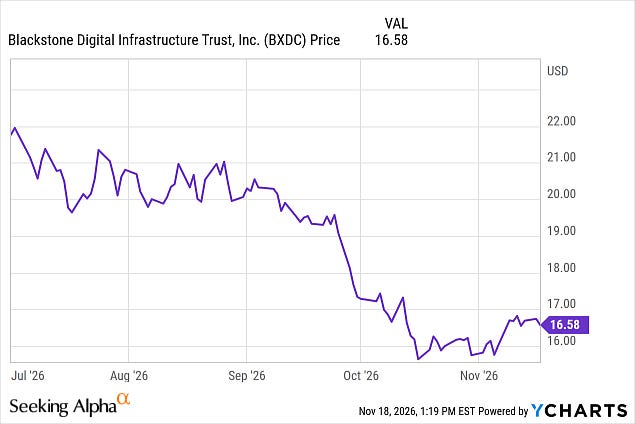
Our expectation was that this cash would eventually be invested into data centers, generating rental income and allowing BXDC to initiate a dividend. We thought this could lead to a significant repricing because data centers are one of the hottest property sectors today, with established REITs like Equinix (EQIX) and Digital Realty (DLR) historically trading at substantial premiums to NAV. Investors are willing to pay these premiums because of the sector’s strong growth prospects, high barriers to entry, and increasing demand for computing capacity. We therefore reasoned that once BXDC had deployed its cash into high-quality data centers, established recurring earnings, and initiated a dividend, it could attract a much broader investor base and eventually earn a similar premium valuation.
That last part is especially important because our long-term thesis is that BXDC could eventually become a major external-growth platform, raising new equity at a premium to NAV and reinvesting the proceeds into additional data centers at attractive spreads over its cost of capital.
Given Blackstone’s enormous sourcing capabilities, the explosive growth of the data center industry, and BXDC’s small starting size, we believe this could eventually become one of the biggest external-growth success stories the REIT sector has seen in decades.
Of course, this strategy requires successful execution. Blackstone first needed to identify attractive investments, and there was no guarantee that it would be able to deploy the IPO proceeds at the yields we originally anticipated.
Fortunately, the latest developments are very encouraging.
The First Acquisition Looks Better Than Expected
BXDC just announced its inaugural acquisition, a $5 billion sale-and-leaseback transaction with Amazon (AMZN), involving 13 newly constructed data center buildings across two campuses in Indiana and Mississippi.
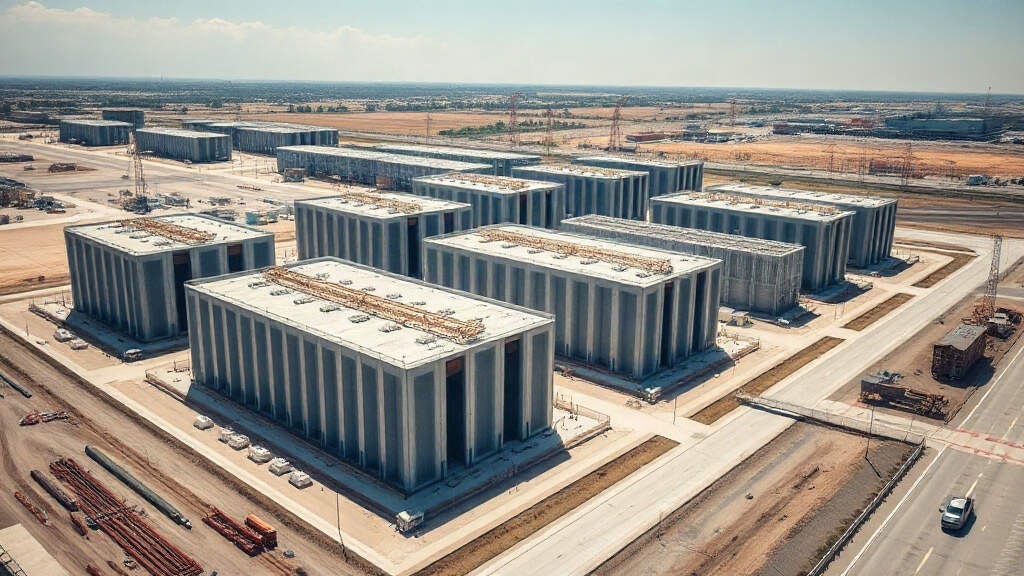
The company will acquire approximately 75% ownership through a joint venture, with Amazon retaining the remaining 25%. Its share of the transaction will amount to roughly $3.75 billion, financed with approximately $1.9 billion of equity and the balance through property-level debt.
This will effectively deploy all the equity capital raised during BXDC’s IPO, transforming it from a company holding mostly cash into a substantial income-producing data center landlord.
And importantly, the economics appear even better than we originally expected.
When we first invested, BXDC was targeting acquisition cap rates ranging from approximately 5.75% to over 7%. In our original analysis, we conservatively modeled its expected earnings using a 6.25% acquisition yield.
However, Blackstone has now secured its first portfolio at a 7% cap rate, toward the top end of its original target range.
The properties are fully leased to Amazon Web Services, with a parent-company guarantee from Amazon. The initial leases run for 12 years, with two additional 10-year renewal options, and include 2.75% annual contractual rent escalators.
The lease structure is also triple-net, meaning Amazon is responsible for most property operating expenses and maintenance.
I think these are very attractive terms. The initial yield is higher than expected, the contractual rent growth is strong, and the credit quality of the tenant is exceptional.
Amazon has an AA credit rating from S&P, putting it in a credit category comparable to, or stronger than, that of many sovereign governments. It is also investing enormous amounts of capital into its cloud and AI infrastructure, making these facilities strategically important to its operations.
The parent guarantee is particularly valuable because BXDC is not simply relying on an individual operating subsidiary to meet the lease obligations.
I also like that Amazon is retaining 25% ownership in the joint venture. Rather than selling the properties outright, it will remain economically invested alongside BXDC. This provides additional alignment of interests and suggests that Amazon expects these facilities to remain valuable over the long run.
None of this eliminates concentration risk, as BXDC will initially depend entirely on one tenant. But given Amazon’s financial strength and the mission-critical nature of the properties, this does not concern me much.
Why The Powered-Shell Structure Matters
Another important detail is that BXDC is acquiring powered-shell data centers rather than fully equipped turnkey facilities.
The distinction is that a turnkey data center includes much of the specialized equipment required to operate the facility, such as cooling and electrical systems. With a powered-shell arrangement, the landlord primarily owns the building and associated infrastructure, while the tenant is responsible for much of the specialized equipment and computing technology.
This should reduce BXDC’s exposure to technological obsolescence, which is particularly important in an industry where computing requirements are changing rapidly because of AI.
Amazon will remain responsible for much of the equipment that may require frequent upgrades, while BXDC benefits from predictable rental income and limited recurring landlord capital requirements.
Management also indicated that the transaction was completed at a price more than 50% below estimated turnkey replacement cost, with contractual rents more than 70% below comparable turnkey market rents.
These are not perfectly comparable figures because powered shells exclude equipment and infrastructure included in turnkey facilities. Nevertheless, they suggest that Blackstone is getting margin of safety.
I also see potential long-term value in the relatively low rental basis. If demand for data center capacity continues growing and power availability remains constrained, these facilities could eventually become significantly more valuable. That upside would take time to emerge because of the long leases, but it provides additional optionality.
Overall, I think the combination of a 7% starting yield, 2.75% annual rent growth, exceptional tenant credit, and limited landlord capital responsibilities makes this a very attractive inaugural acquisition.
What Could BXDC Earn And Pay In Dividends?
The next important question is what this transaction means for BXDC’s future earnings.
Management indicated that it expects the acquisition to generate an initial AFFO yield in the low-to-mid-5% range on invested equity.
Based on the announced acquisition terms, approximately 50% financing, and reasonable assumptions for financing costs and corporate expenses, I estimate that BXDC could generate roughly $1.05 of annualized AFFO per share once the portfolio is fully reflected in its financial results.
This is still a rough estimate. The final financing terms have not yet been announced, and borrowing costs will materially affect the actual outcome.
At around $16.50 per share, this would put BXDC at approximately 15.7x estimated AFFO, which I consider attractive for a new data center landlord with an AA rated tenant, strong contractual rent growth and substantial external-growth potential.
There is also one important change I would make to our original investment thesis.
Previously, we assumed that BXDC might distribute approximately 70% of its FFO through dividends. However, given the economics of this transaction, I now think management could opt for a significantly higher payout ratio.
I would not be surprised if it eventually paid out close to 90% of its recurring AFFO.
The reasoning is that BXDC owns newly constructed properties under long-term triple-net leases, with relatively limited recurring landlord capital expenditure requirements. It therefore may not need to retain as much of its cash flow as a REIT with greater operating or maintenance responsibilities.
More importantly, I think management has a strategic incentive to offer an attractive dividend yield.
At our estimated $1.05 of AFFO per share, a 90% payout ratio would support approximately $0.95 in annual dividends, equivalent to a 5.7% dividend yield at today’s share price. Even an 80% payout ratio would support a yield of approximately 5.1%.
I think this could make BXDC considerably more attractive to income-oriented investors who have largely ignored it so far because it does not yet pay a recurring dividend.
There is a trade-off, of course. A higher payout ratio means less internally retained capital, increasing reliance on external funding for future acquisitions. But given that external growth is central to BXDC’s strategy, management may consider that worthwhile if an attractive dividend helps the stock achieve a premium valuation.
Management has not yet announced a target dividend or payout ratio, so these remain our estimates rather than guidance.
The Bigger Opportunity Is Still Ahead
Even after the recent share-price recovery, BXDC continues trading below its latest reported book value of approximately $19.34 per share.
I think that discount could narrow considerably once the Amazon transaction closes, financing is finalized, and investors begin receiving recurring dividends.
If BXDC generates approximately $1.05 of AFFO per share, a valuation of 20x would imply a share price of roughly $21. At 23x, the stock would be worth approximately $24, representing substantial upside from today’s level without assuming any additional acquisitions.
Whether those multiples are ultimately justified will depend on the company’s operating track record, future growth prospects, and cost of capital. But I believe there is a reasonable path toward a premium valuation, especially if interest rates decline and investor appetite for data center REITs remains strong.
And that is when the much bigger opportunity could begin.
Once BXDC trades at a meaningful premium to NAV, it could issue new shares at attractive valuations and reinvest that capital into additional properties at higher acquisition yields. If the spreads are sufficiently positive after financing costs and management expenses, these acquisitions could rapidly increase AFFO and NAV per share.
Blackstone already has an enormous sourcing platform, with relationships across the hyperscaler, developer, and institutional investment communities. Management has also indicated that BXDC is targeting an exceptionally large acquisition pipeline.
This inaugural Amazon transaction is particularly interesting because it demonstrates that Blackstone can source major sale-and-leaseback opportunities directly from hyperscalers, potentially opening up another significant avenue for growth.
These technology companies are spending hundreds of billions of dollars developing new infrastructure. Even the largest among them may find it attractive to recycle capital tied up in stabilized real estate into new facilities and computing equipment.
BXDC could become an important financing partner in this process.
Given its relatively small starting size, it would not need to capture much of this enormous market to grow substantially. A few billion dollars of additional acquisitions could already make a meaningful difference to its earnings.
This is similar to the strategy that made Essential Properties Realty Trust (EPRT) such a successful investment for us. As EPRT established a track record and earned a premium valuation, it gained access to increasingly attractive equity capital, which allowed it to accelerate acquisitions while growing earnings per share.
I believe BXDC could eventually follow a similar path, potentially on a much larger scale given the extraordinary capital requirements of the data center industry.
The main uncertainty is whether BXDC can obtain a sufficiently low cost of capital to make this strategy consistently accretive. The announced acquisition is a promising start, but the company still needs to demonstrate that it can finance its assets efficiently and attract equity investors at favorable valuations.
Higher interest rates would make this more challenging, particularly now that the purchase price has been agreed upon while final financing costs remain to be determined. Conversely, declining rates could improve both its AFFO and the valuation investors are willing to assign to the stock.
Investor Takeaway
I remain bullish on BXDC and consider it one of our most attractive opportunities for 2027 and beyond.
Our original investment thesis was that Blackstone could take a newly listed REIT trading below the value of its cash holdings, deploy that capital into high-quality data centers, establish recurring earnings and dividends, and eventually earn a premium valuation that would support rapid external growth.
The first major step is now taking place, and the announced acquisition economics are better than we originally modeled.
We still need to see the transaction close, the final financing terms, and management’s dividend policy before drawing firm conclusions about its earnings power.
But at approximately 15.7x our estimated stabilized AFFO, with the possibility of a 5–6% dividend yield, I think the current valuation remains attractive.
More importantly, the external-growth opportunity that initially attracted us to BXDC remains largely ahead of us. If Blackstone can establish an attractive cost of capital and consistently acquire additional properties at positive spreads, the company’s earnings and asset base could grow substantially over the coming decade.
This is why we invested early, and why we continue to hold BXDC as a significant position in our Core Portfolio.
I expect 2027 to be an important year as the company transitions from holding IPO proceeds to operating its first major portfolio. If that transition goes well, it could lay the foundation for many years of attractive growth.
Stay tuned for our next Top Pick for 2027, which I will share shortly.
Finally, please note that we have exceptionally posted this article without a paywall. If you found it valuable, consider joining High Yield Landlord for a 2-week free trial.
We expect to share all our other Top Picks for 2027 with our members over the coming weeks, and by starting your free trial today, you will gain access to it. You will also get immediate access to my entire REIT portfolio, our exclusive REIT CEO interviews, and much more. We are the largest and highest-rated REIT investment newsletter online, with over 2,000 paid members and more than 500 five-star reviews.
We spend thousands of hours and over $100,000 per year researching the market for the most profitable investment opportunities, and we share the results with you at a tiny fraction of the cost.
Get started today - the first 2 weeks are on us:
Analyst’s Disclosure: I/we have a beneficial long position in the shares of all companies held in the CORE PORTFOLIO, RETIREMENT PORTFOLIO, and INTERNATIONAL PORTFOLIO either through stock ownership, options, or other derivatives. We also own a position in FarmTogether. High Yield Landlord® (’HYL’) is managed by Leonberg Research, a subsidiary of Leonberg Capital. All rights are reserved. No recommendation or advice is being given as to whether any investment is suitable for a particular investor. The newsletter is impersonal and subscribers/readers should not make any investment decision without conducting their own due diligence, and consulting their financial advisor about their specific situation. The information is obtained from sources believed to be reliable, but its accuracy cannot be guaranteed. The opinions expressed are those of the publisher and are subject to change without notice. We are a team of five analysts, each contributing distinct perspectives. Nonetheless, Jussi Askola, the leader of the service, is responsible for making the final investment decisions and overseeing the portfolio. We do not always agree with each other, and an investment by Jussi should not be taken as an endorsement by other authors. Past performance is no guarantee of future results. Our portfolio performance data is provided by Interactive Brokers and believed to be accurate but its accuracy has not been audited and cannot be guaranteed. Our portfolio may not be perfectly comparable to the relevant index. It is more concentrated and may at times use margin and/or invest in companies that are not typically included in REIT indexes. Finally, High Yield Landlord is not a licensed securities dealer, broker, US investment adviser, or investment bank. We simply share research on the REIT sector.
