



We are buying more shares of Sun Communities (SUI).

REITs have performed very well so far this year, rising by roughly 10% on average as improving fundamentals, accelerating rent growth, the AI immunity trade, and increased M&A activity have all helped boost market sentiment.
But while this rally has lifted the share prices of most REITs, some specific names have missed out.
Sun Communities is one of them.
Instead of rising by roughly 10%, its share price is down by about 4% year-to-date.
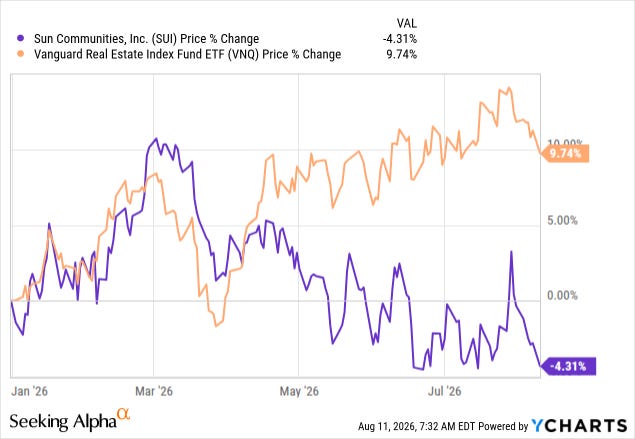
We think that this significant underperformance is an opportunity.
SUI owns one of the highest-quality portfolios in the REIT sector, with a strong focus on manufactured housing and RV communities in the United States. These are highly attractive assets with durable long-term growth prospects, limited new supply, and strong demand.
Yet today, the stock is underperforming.
Why?
We suspect that the main reason is its recent transformative transaction. SUI announced that it would sell its UK portfolio of manufactured housing communities, deleverage its balance sheet, and refocus on its core American operations.
The REIT market often reacts negatively to this type of news in the short run.
When a REIT sells assets, near-term cash flow can decline before the proceeds are fully reinvested. There can be timing issues. FFO per share may temporarily dip. Quarterly results can become a bit messy.
And since most investors are overly focused on short-term numbers, sentiment can turn negative even when the transaction creates long-term value.
We think that is what is happening here.
The market is focusing on the near-term bumpiness, while missing the bigger picture.
Why We Like The Transaction
We think this is the right move.
SUI’s expansion into the UK was never well appreciated by the market. Many investors questioned whether the company truly had a competitive advantage so far away from its core US markets. The UK assets also did not perform as well as SUI’s US assets, and the expansion increased leverage at a time when investors became much more concerned about interest rates and balance sheet risk.
The new management team is now effectively undoing that mistake.
They are selling the UK assets, refocusing the company on its stronger US platform, paying down debt, and buying back stock at a discounted valuation.
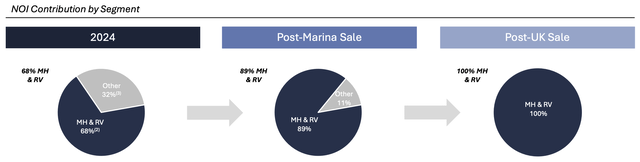
That is exactly what we want to see.
The US manufactured housing business remains highly attractive.


These assets benefit from one of the strongest secular tailwinds in real estate today: the housing unaffordability crisis.
Single-family homes have become increasingly unaffordable, especially after the high inflation of recent years and the sharp increase in mortgage rates. For many households, traditional homeownership is simply out of reach.
Manufactured housing offers one of the few viable alternatives.
Residents can still own their homes, but at a much lower cost than buying a traditional single-family house. This makes manufactured housing relatively more attractive when housing affordability is poor.
That is exactly the environment we are in today.
Demand for affordable housing is very strong, but new supply of manufactured housing communities is extremely limited. Local opposition is high, permitting is difficult, and few municipalities want new communities built nearby. There is virtually no new supply in this property sector for these reasons:
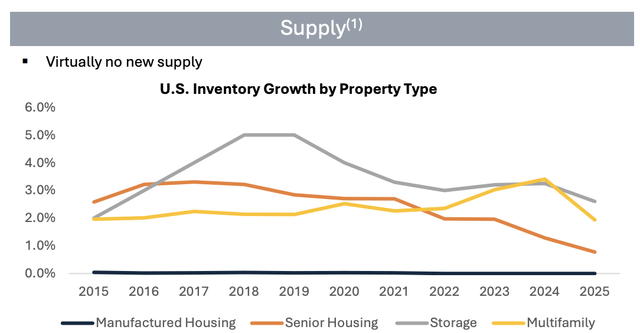
This combination of rising demand and limited supply creates strong pricing power for existing communities. It explains why rents have continued to rise and why same-property NOI growth has been so strong.
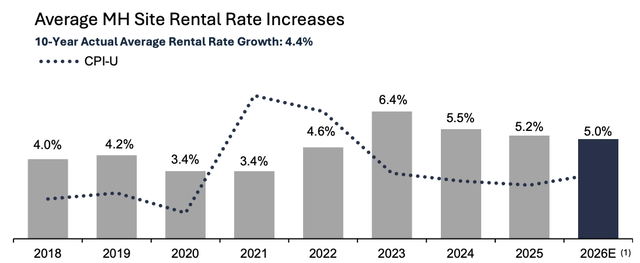
This is why manufactured housing REITs have historically been some of the best-performing REITs over long periods of time.
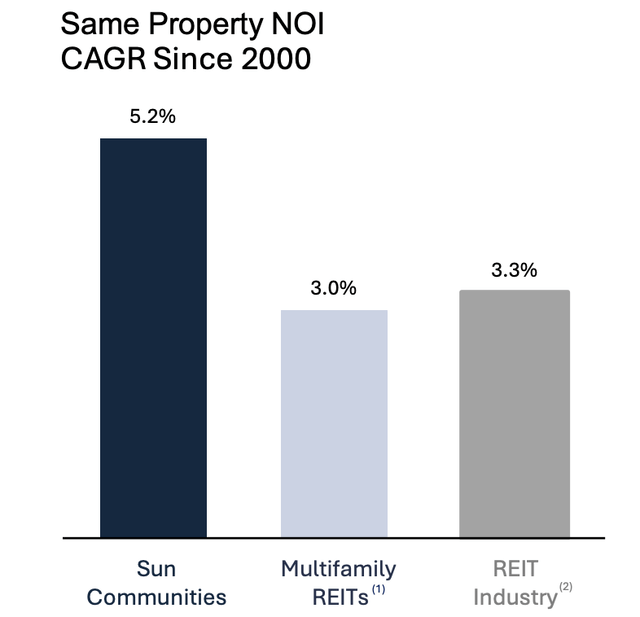
SUI owns one of the best portfolios in the sector, and its US operations are still doing very well.
The issue is not the quality of the business.
The issue is near-term uncertainty from the portfolio repositioning.
We think that the market is overreacting to that uncertainty.
Aggressive Buybacks Create Value
One of the biggest reasons we like this situation is that SUI is using the weakness in its share price to buy back stock aggressively.
This is exactly what a REIT should do when it trades at a large discount to NAV.
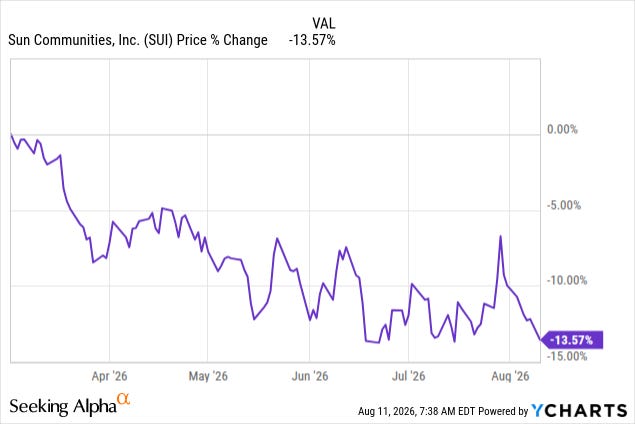
Instead of issuing equity to grow at any cost, management is shrinking the share count and increasing each remaining shareholder’s ownership in the underlying real estate.
During and after the second quarter, SUI repurchased approximately $200 million of common stock. Year-to-date, it had repurchased approximately $260 million of stock, and since launching its repurchase program last year, it has bought back about $800 million of stock.
That represents roughly 5.1% of the common shares outstanding at the time the program began last year.
The company still has approximately $800 million remaining under its current share repurchase authorization.
These are not token buybacks. These are some of the most aggressive buybacks in the entire REIT sector.
That speaks very highly for the opportunity. Management clearly believes that the stock is undervalued, and we agree.
SUI is currently trading near one of its cheapest valuations in about a decade. Its price-to-FFO multiple is around 16x, compared to a historical average closer to 22x, despite having one of the strongest portfolios and balance sheets in its history with low 3.7x Debt-to-ETBITDA.
It also trades at roughly 0.8x of its already depressed NAV, meaning that the public market is valuing its real estate at a meaningful discount to private market value. Its cycle peak NAV was estimated to be $207 per share and it has already been marked down to $145 as cap rates expanded. In comparison, its share price is currently at $118:
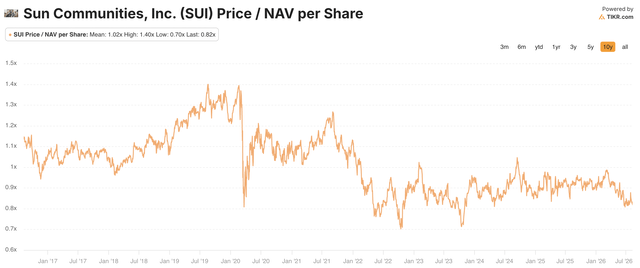
This makes buybacks highly accretive.
When a REIT buys back shares at a large discount to NAV, it is essentially buying its own real estate for a steep dsicount. That creates value for remaining shareholders, especially when the assets are high quality and the balance sheet is also improving.
This is the right type of capital allocation.
Not all REIT buybacks are smart. Some REITs buy back stock just to signal confidence, even when leverage is too high or the discount is not meaningful.
But in SUI’s case, the buybacks make a lot of sense.
The stock is cheap.
The assets are high quality.
The company is simplifying its business.
The balance sheet is improving.
And the long-term growth prospects remain attractive.
That is exactly the type of setup we like.
