



We are selling our entire position in Macerich (MAC), unlocking approximately $35,000 in capital that we intend to redeploy into more opportunistic REITs, while also keeping some cash aside for future opportunities.

This has been one of our biggest investment successes in recent years, and I want to take a moment to reflect on it because I think there are some valuable lessons here for all of us.
From One of Our Biggest Losers to One of Our Biggest Winners
Our investment in Macerich has been quite a roller coaster.
We initially bought shares before the pandemic, and in hindsight, we were far too early. The mall sector was already struggling with oversupply, declining investor sentiment, and the rapid growth of e-commerce. Macerich was heavily leveraged, and investors were increasingly pessimistic about the long-term future of traditional shopping malls.
Then came the pandemic, which made everything dramatically worse.
Malls were forced to close, retailers went bankrupt, and Macerich’s share price collapsed. At its lowest point, it dropped to around $5 per share, representing a decline of roughly 70% or more from some of our earliest purchases.
It was certainly not a pleasant experience, and I would be lying if I said that we had anticipated such a dramatic collapse.
But importantly, we did not give up on the investment.
We continued to believe that Macerich owned valuable, high-quality real estate that would remain relevant over the long run. We recognized that its balance sheet was risky, but we also believed that the market had become far too pessimistic about the company’s future.
So, instead of selling at the lows, we kept buying more shares, all the way down to approximately $5 per share.
These purchases significantly reduced our average cost basis, eventually bringing it down to just $7.50 per share.
Fast-forward to today, and Macerich has recovered to approximately $25 per share.
That’s a 233% capital gain on our average cost basis, and the shares purchased near the bottom have appreciated approximately fivefold. Add the dividends collected along the way, and our total return is even higher.
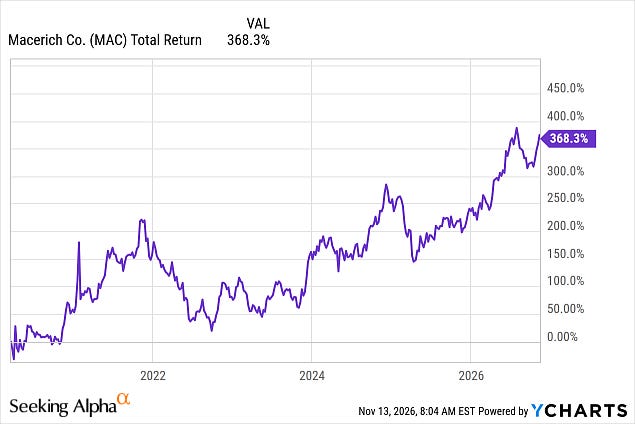
What initially looked like one of our worst investments has ultimately turned into one of our biggest winners.
An Important Reminder for REIT Investors
I think that Macerich is a particularly valuable example of why patience can be so important when investing in REITs.
Sometimes, you can be absolutely right about the long-term value of a property portfolio but still be far too early with your investment.
The market can remain pessimistic for years, and things can get considerably worse before they get better.
In fact, Macerich’s collapse leading up to and following the pandemic serves as a great reminder of just how inefficient the REIT market can become.
Investors often assume that the market is reasonably efficient and that share prices reflect the underlying value of the businesses they represent. But in reality, the market can have very little idea of how to value certain REITs, particularly when they are facing complex challenges and extreme investor pessimism.
In such situations, investors tend to become overly focused on the short-term outlook, extrapolating recent poor results far into the future and assuming that current difficulties will persist indefinitely.
They forget that real estate is cyclical, that supply and demand eventually rebalance, and that even troubled property sectors can recover.
This was certainly the case with Macerich.
The mall sector was oversupplied, e-commerce was gaining market share, and investors were increasingly convinced that traditional shopping malls were becoming obsolete. Then the pandemic arrived and pushed an already troubled sector into a full-blown crisis.
But the underlying real estate did not suddenly become worthless.
The best malls continued to have attractive locations, strong tenant demand, and significant long-term value. As the pandemic ended, retail fundamentals improved, and Macerich made progress with its balance sheet, investors gradually regained confidence.
For years, Macerich traded at what we believed was an enormous discount to the underlying value of its real estate. The market was simply unwilling to look beyond the immediate challenges.
And this mispricing persisted for years, not just weeks or months.
But eventually, as the fundamentals improved and the market recognized that its worst fears had been exaggerated, the share price recovered dramatically.
Those who had accumulated shares at deeply discounted prices were richly rewarded.
This is one of the reasons why we remain so attracted to REIT investing. Unlike many other businesses, REITs own tangible assets that we can analyze and value independently of their share prices. When market sentiment becomes excessively pessimistic, it can create opportunities to buy valuable real estate at extraordinary discounts.
Of course, it can take years for these discounts to close, and there is no guarantee that they ever will. But when the underlying investment thesis remains intact, patience can pay off enormously.
I think we have several other investments in our portfolio today that could potentially follow a similar path over the coming years.
One that immediately comes to mind is Alexandria Real Estate Equities (ARE).
Alexandria is currently one of our biggest disappointments, and its share price has suffered enormously. The life science property sector is struggling with oversupply, weak leasing conditions, and significant pressure on rental rates. Alexandria also carries a meaningful amount of leverage, which has made investors even more concerned in today’s higher interest rate environment.
These are real challenges, and we certainly do not want to underestimate them. But I also think that the market is making a similar mistake to the one it made with Macerich years ago.
Investors are extrapolating today’s difficult operating conditions far into the future, seemingly assuming that the life science property sector will remain oversupplied indefinitely and that Alexandria’s fundamentals will never recover.
We believe that this is excessively pessimistic.
New construction has slowed dramatically, and eventually, the supply of life science properties should become better balanced with demand. Meanwhile, the long-term drivers of demand for life science research facilities remain compelling, supported by aging populations, medical innovation, and the growing importance of biotechnology.
Alexandria also owns a high-quality portfolio of specialized properties in some of the most attractive life science clusters in the country.
We believe that its share price is currently trading far below the underlying value of its real estate, just as Macerich was years ago.
And while there are important differences between these two companies, I would not be surprised if, a few years from now, we look back at Alexandria and see a very similar success story.
Today, it is one of our biggest losers. But that does not necessarily mean that it will remain one.
If the investment thesis remains intact, the balance sheet remains manageable, and we have the patience and courage to continue accumulating shares at deeply discounted prices, the eventual recovery could be very rewarding.
Of course, we need to remain realistic. This strategy does not always work. Averaging down into a struggling investment can also compound your losses if the underlying business deteriorates permanently or its balance sheet becomes unsustainable.
Branicks, I’m looking at you here...
Not every beaten-down REIT will recover, and we have certainly made our share of mistakes over the years.
But the beauty of investing is that a single successful recovery can sometimes more than compensate for several unsuccessful investments.
Macerich has done exactly that for us.
And I think it is a valuable reminder of why we should not necessarily lose confidence in an investment simply because its share price has declined significantly. What matters most is whether the underlying assets retain their value, whether the business can survive its near-term challenges, and whether our long-term investment thesis remains intact.
Why We Are Selling Now
With all of that said, we believe that the time has come to move on.
This is not because we have suddenly turned bearish on Macerich. Quite the opposite: we still believe that the company owns valuable real estate, and its fundamentals have improved considerably since the pandemic.
Its recent operating performance has been encouraging, and there could still be further upside over the coming years.
However, at approximately $25 per share, we believe that Macerich is now approaching fair value, and the risk-to-reward has become much less compelling relative to some other REITs.
There are several reasons for this.
First, Macerich remains relatively heavily leveraged, even after making progress in strengthening its balance sheet. Higher interest rates have increased the importance of balance sheet quality, and we would generally prefer to own REITs with greater financial flexibility when valuations are otherwise similar.
Second, we are becoming increasingly mindful of the macroeconomic risks facing the retail sector. A weaker economy, pressure on consumer spending, and potentially persistent inflation could all create challenges for retailers and their landlords.
We are also watching how the AI revolution could affect retail over the longer run. While AI presents opportunities for nearly every industry, we suspect that it could also accelerate the adoption of e-commerce. As AI-powered shopping assistants become more sophisticated, consumers may increasingly rely on them to compare products, find the best prices, and make purchases online. It could also greatly reduce the cost of shipping thanks to autonomous delivery vehicles and make online marketing more personalized and therefore also more powerful.
This would not necessarily make high-quality malls obsolete, but it could create additional competitive pressure on physical retail over time.
Finally, Macerich is no longer particularly cheap compared to some of its higher-quality peers. For example, Simon Property Group (SPG) owns a similar portfolio of premier malls, but benefits from a more conservative balance sheet and offers greater financial flexibility. Yet, Macerich’s valuation is now broadly comparable to Simon’s on an FFO multiple basis.
We therefore struggle to justify taking the additional risks associated with Macerich when better-capitalized alternatives are available at comparable valuations.
