
Today, we are buying the dip in European listed real estate and making small additions to three of our existing investments: VGP (VGP / VGPBF) and Vonovia (VNA / VONOY), and Big Yellow Group (BYG / BYLOF).

European real estate stocks have come under renewed pressure as the war with Iran has escalated again in recent weeks. The ceasefire has broken down, the Strait of Hormuz remains severely disrupted, and the conflict is now also creating concerns around the Bab el-Mandeb Strait, another critically important shipping route connecting the Red Sea with the Gulf of Aden.

The situation in Yemen is worth clarifying because it is easy to get the different parties mixed up. The Iran-aligned Houthis have expanded their presence around this region and have been targeting Saudi interests and shipping, while Saudi-backed Yemeni forces are fighting against them. This comes at a time when traffic through Hormuz is already heavily impaired, which means that markets are increasingly having to consider the possibility of prolonged disruptions to global energy supplies.
Not surprisingly, oil prices have risen sharply, and this has once again increased concerns about inflation and interest rates. Higher energy prices feed into transportation, manufacturing, and eventually consumer prices. If they remain elevated for long enough, central banks may have less room to cut rates, or may need to maintain restrictive monetary policy for longer than previously expected.
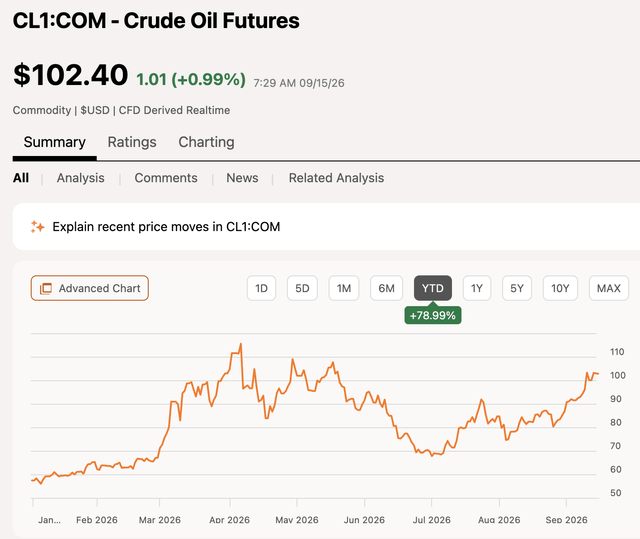
This has hurt markets around the world, but European listed real estate has been particularly weak, and I think there are two main reasons for this.
The first is Europe’s greater sensitivity to energy prices. The U.S. has become an enormous producer of oil and natural gas and is much closer to energy self-sufficiency. Europe, on the other hand, still imports a very large share of its energy needs. It has also spent the past several years restructuring its energy supply after losing access to much of the cheap Russian pipeline gas that it previously relied on.
Europe does not necessarily import most of its energy directly through the Strait of Hormuz, but that misses the bigger point. Oil and gas are global markets, and Europe is a large net importer competing for those supplies. Disruptions in the Middle East therefore have a greater impact on its terms of trade and economic outlook than they do on the U.S., which produces much of its own energy.
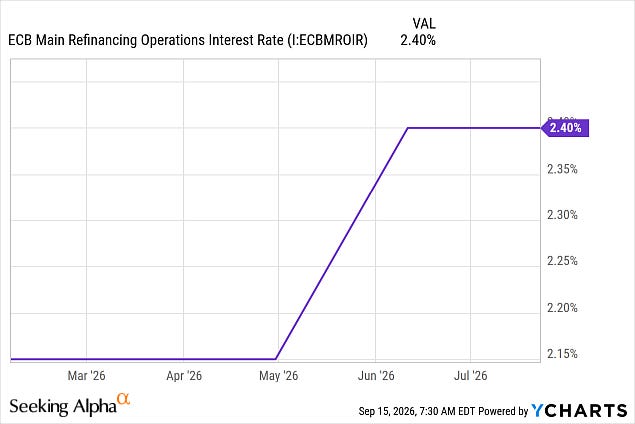
Importantly, this is no longer just a theoretical risk. The European Central Bank already raised interest rates by another 25 basis points on September 10, bringing its deposit rate to 2.5%. This was the second rate hike of the year, and the ECB specifically pointed to the conflict in the Middle East and the resulting inflationary pressures as a reason for tightening monetary policy. It now expects eurozone inflation to average 3.0% in 2026 and remain above its 2% target for an extended period.
The second reason is the balance sheets of European property companies.
Loan-to-value ratios in Europe are not necessarily dramatically higher than they are in the U.S. In many cases, they are quite comparable. But European real estate generally trades at much lower cap rates, particularly in sectors such as residential real estate in which growth is a lot steadier than in the US. As a result, companies can have reasonable LTV ratios while still carrying very high debt relative to their EBITDA.
To give a simple example, imagine two property companies that both operate at a 45% LTV. If one owns properties at a 4% cap rate and the other owns them at a 6% cap rate, the first company will naturally have far more debt relative to the income generated by its portfolio. This is one reason why debt-to-EBITDA ratios can look significantly higher in Europe even when the underlying LTV is not especially aggressive.
That makes European listed real estate particularly sensitive to changes in interest-rate expectations. When interest rates rise, refinancing costs increase and the discount rates used to value these properties also move higher. Companies with more leverage relative to their earnings will generally see a larger impact on their equity values.
This helps explain why European property stocks have been hit so hard by the latest escalation in the Middle East.
Clearly, this is not good news for real estate investors. Higher energy prices are inflationary, and if this situation persists, interest rates could remain higher for longer than we previously expected. It is a setback to the near-term thesis, and I don’t think it makes sense to pretend otherwise.
But I also don’t think that the war in Iran changes the bigger picture.
We have discussed in the past what I have called the “horsemen of disinflation.” There are a number of powerful structural forces that I think will continue to put downward pressure on inflation and interest rates over the long run. These include aging demographics, high debt levels, technological progress, and growing inequality, among others.
Most importantly, I think that technological development could become an increasingly powerful deflationary force over the coming decade. The AI revolution is still at a very early stage, but if it delivers even a portion of the productivity gains that its proponents expect, it could materially reduce the cost of producing a wide range of goods and services. Companies may be able to achieve the same output with fewer labor hours and lower operating costs, while automation and faster technological development could improve productivity across large parts of the economy.
This obviously does not mean that inflation will move lower every year, or that interest rates cannot remain elevated for another year or two. Geopolitical shocks, tariffs, fiscal policy, and energy shortages can all create periods of higher inflation. But these are mostly cyclical or event-driven forces, whereas demographics and technological progress play out over much longer periods.
Our long-term view therefore hasn’t changed materially. We still think that interest rates will eventually settle at lower levels than they are today, even if the path there ends up being much more volatile than markets had hoped.
The latest sell-off is giving us an opportunity to add to companies that we already liked at higher prices, and today we are increasing our positions in VGP, Vonovia, and Big Yellow Group.
VGP
Before going into this update, you can read our investment thesis by clicking here.
We recently initiated our investment in VGP and then doubled down after selling SEGRO (SGRO), which is being acquired by Prologis (PLD).
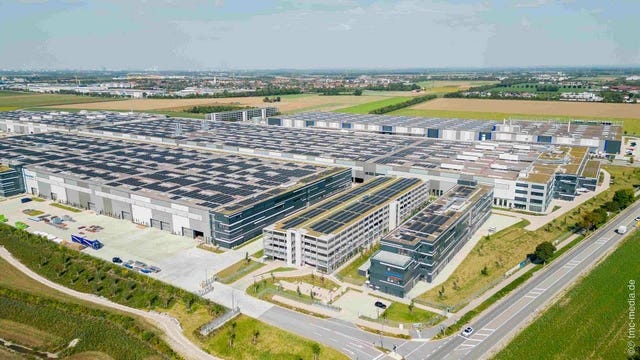
SEGRO was a successful investment for us, and I think its acquisition is also an important data point for the broader European industrial real estate market. Prologis is the largest industrial landlord in the world and probably understands this asset class better than almost anyone. The fact that it was willing to pay a significant premium for SEGRO tells you something about how it views the long-term opportunity in European logistics real estate.
Following the deal, SEGRO is now trading near its takeover value. VGP, meanwhile, has moved sharply in the opposite direction and is once again trading at a steep discount following the latest market sell-off.
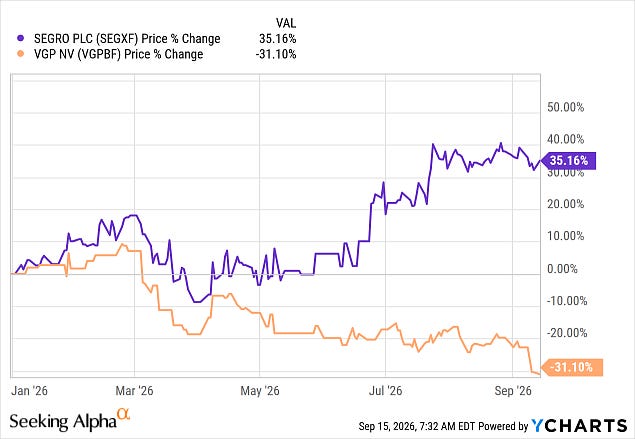
I find this disparity particularly interesting because VGP shares many of the characteristics that made SEGRO attractive.
It owns a large portfolio of modern logistics and industrial properties across Europe, but it also has a major development business, a large land bank, and an asset management component through its joint ventures. This allows VGP to develop properties, stabilize them, and then recycle capital into joint ventures while retaining an interest in the assets and earning fees.
There is also meaningful data center optionality. VGP controls a number of sites that could become valuable for data center development, including locations where it has secured substantial power capacity. Given how difficult it has become to source suitable land and power connections in Europe, I think this optionality could eventually prove to be worth a lot more than what the market currently gives it credit for.
In many ways, this is quite similar to the model that made SEGRO attractive: development, capital recycling, asset management, and growing exposure to data centers, at a low valuation.
Yet the valuation gap between these companies has widened considerably. Prologis was willing to pay a significant premium for SEGRO and is clearly making a large strategic bet on European industrial real estate, while VGP has sold off and is now available at a much lower valuation.
We think that is an unusual disparity, especially considering the similarities between their business models and long-term growth opportunities. The recent decline therefore gives us a good opportunity to increase our position.
Vonovia
Before going into this update, you can read our investment thesis by clicking here.