



So far this year, U.S. REITs (VNQ) have surged by about 11%, and we think that part of this is due to the emerging AI immunity trade.
The idea is simple.
AI is rapidly disrupting many traditional businesses. It reduces barriers to entry, increases competition, compresses margins, and makes it harder to predict which companies will still be dominant 10 years from now.
But real estate is different.
AI cannot replace an apartment, a warehouse, a grocery store, a self-storage facility, a data center, or a well-located piece of land.
In many cases, AI may even increase demand for certain types of real estate as it accelerates business formation, mobility, ecommerce, data consumption, automation, and the need for essential infrastructure.
This is one of the reasons why capital has begun rotating back into U.S. REITs.
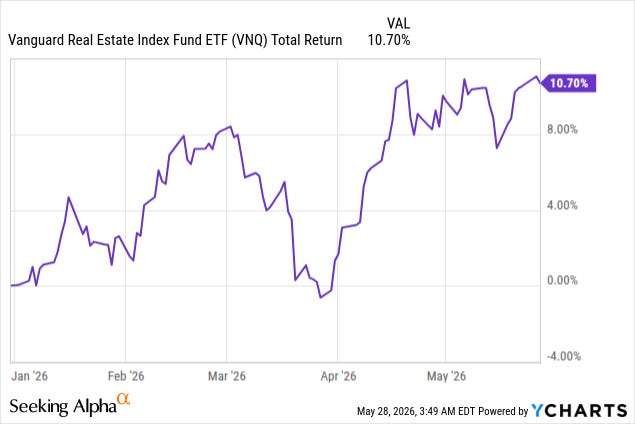
But European REITs have largely missed out on this rally.
In fact, many European REITs have moved in the opposite direction this year as investors have focused almost entirely on rising interest rate expectations. The war in the Middle East has pushed oil and gas prices higher, inflation expectations have risen, and the market has started to price in higher financing costs again.
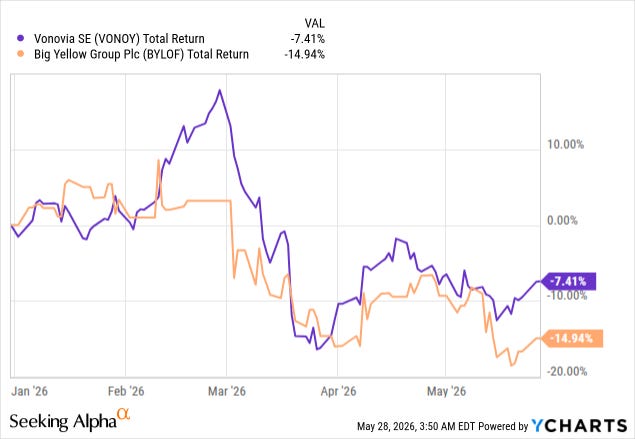
This has caused European REITs to sell off, even as their U.S. peers have rallied.
We think that this creates an opportunity.
European REITs appear to have missed out on the AI immunity trade. Investors have focused on the near-term rate shock instead of the long-term fundamentals.
This is not unusual.
The European market often reacts with a delay relative to the U.S. market, and this can create opportunities for astute investors who are willing to act before the same narrative spreads across the Atlantic.
The recent rise in rates is, of course, a setback, but we continue to think that this will prove temporary.
Before the recent spike in oil prices, real-time inflation indicators were already very low. Truflation had inflation running at roughly 1%, and this was before the full impact of the next wave of AI adoption had even started to flow through the economy.
We continue to believe that AI will become one of the biggest deflationary forces of this century.
It should lower the cost of labor, software, research, legal work, accounting, customer service, logistics, marketing, and many other services. It should allow companies to do more with less, increase productivity, and intensify competition across many industries.
This does not mean that the transition will be smooth.
It may be painful for many businesses and workers. But from a macro perspective, if AI causes major productivity gains and margin pressure across large parts of the economy, we think that it will ultimately push inflation and interest rates lower.
This would be very bullish for REITs, especially in Europe, where valuations are exceptionally low today.
We are therefore using this weakness to increase our exposure to two of our highest conviction European REITs.
