
Today, we are adding a small amount of capital to three European-listed real estate positions:
Vonovia (VNA / VONOY): 170 additional shares, increasing our position size by 10%.
Xior Student Housing (XIOR / XIORF): 140 additional shares, increasing our position size by 28%.
Shurgard (SHUR / SSSAF): 150 additional shares, increasing our position size by 10%.

The common theme is simple.
These companies sold off heavily as the war in Iran intensified, but they have failed to recover properly now that the macro shock is fading.
This creates an opportunity.
To understand why, consider what happened over the past few months.
The war in Iran caused a major spike in oil and energy prices. This was especially negative for Europe because Europe is more exposed to energy shocks than the U.S., and European-listed real estate companies are also typically more leveraged.
Higher oil prices mean higher energy costs.
Higher energy costs mean higher inflation.
Higher inflation means more pressure on the European Central Bank (ECB) to keep rates higher for longer, or even hike rates again.
And that is exactly what happened.
The ECB did not just talk about the risk of higher inflation. It already hiked rates by 25 basis points, bringing the deposit rate to 2.25%, and the market began pricing more rate hikes in the near future.
This is important for European-listed real estate companies as they are highly sensitive to interest rates, and it explains why the selloff was so aggressive.
Vonovia is a good example. Its share price fell from nearly €30 per share to closer to €20 per share in a relatively short period of time. The timing lines up very closely with the escalation of the Iran war and the spike in oil prices.
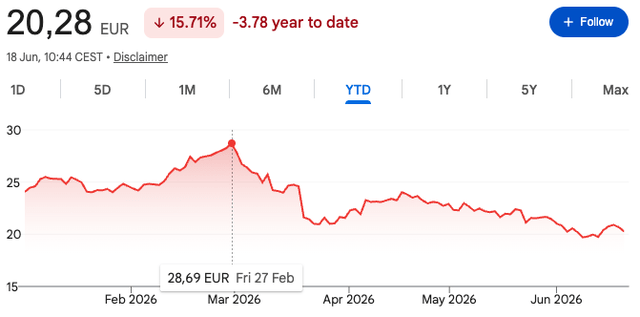
The same broad pattern can be seen across many other European-listed real estate names.
Xior and Shurgard also sold off, despite the fact that their company-specific fundamentals did not deteriorate anywhere close to the extent implied by their share price declines.
The market was essentially pricing in a much worse long-term macro environment:
Higher oil prices
Higher energy costs
Higher inflation
Higher interest rates
Lower property values
Higher refinancing costs
Lower investor appetite for listed real estate
This was a reasonable concern while the war was escalating.
But the setup has now changed.
The U.S. and Iran have now signed an interim agreement that is expected to extend the ceasefire, reopen the Strait of Hormuz, and allow more Iranian oil to return to the global market as some sanctions are waived.
As a result, oil prices have fallen sharply. WTI is now close to $75 per barrel, down from $115 in April.
This does not remove all risks.
The agreement is still preliminary. The final details matter. The deal could still break down. Oil prices also remain above where they were before the war, and the ECB is not yet ready to declare victory over inflation.
But the direction of travel is clearly positive. The main macro shock that caused the latest selloff is now fading.
This should reduce inflationary pressure. It should reduce pressure on the ECB to keep tightening. And it should improve sentiment toward European-listed real estate.
In other words, the reason why these stocks sold off is now reversing. Yet the stocks have not yet recovered. They initially bounced on the news on Monday, but since then, many of these names have come back down and continue to trade near their lows.
We think this creates an attractive opportunity.
The market punished these companies as if higher rates and higher energy prices were here to stay. But if the Iran agreement holds, then expectations for inflation and interest rates will come down, and that would be very positive for European-listed real estate.
Therefore, we believe that the risk-to-reward has improved materially as the fundamentals of these businesses remain solid, while their valuations have become much more attractive.
Vonovia remains Europe’s largest residential landlord. It owns a defensive apartment portfolio, mostly in Germany, and should benefit significantly if interest rate expectations come down. It currently trades at a 57% discount to its net asset value and offers a 6.2% dividend yield.