



Important Reminder!
I am excited to announce that we will be hosting our fourth live Q&A webinar, exclusively for subscribers of High Yield Landlord.
This is your opportunity to connect directly, ask questions, and dive deeper into REITs, real estate, and anything else we cover in the newsletter.
Event Details
Format: Live Zoom Q&A
Date & time: Wednesday 07/01/2026 at 1PM EST
Spots available: Only 300 — first come, first served
How It Works
You will be able to ask questions live in the Zoom chat during the session
You can also leave your questions in the comment section below in advance — I will try to answer as many as possible
If you cannot attend live, I will post a recording afterward for all subscribers
Reserve Your Spot
Due to limitations in our Zoom plan, we can only accommodate 300 participants for the live session.
If you would like to attend live, please reserve your spot as soon as possible — click here to register.
Looking forward to seeing many of you there!
---------------------------------------------------------
TRADE ALERT - Retirement Portfolio June 2026
Transaction Summary: I bought another 150 shares of Rexford Industrial Realty (REXR), increasing our position size by 20%.
---------------------------------------------------------
REITs have rallied significantly so far into 2026.
The average REIT is now up by about 13% year-to-date, and this has been driven by a combination of factors.
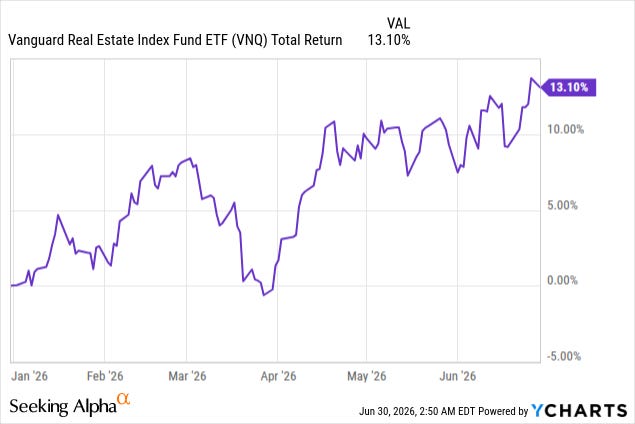
First, more investors are beginning to recognize the appeal of the “AI immunity trade”. A lot of capital has been concentrated in sectors that may be disrupted by AI, including SaaS and other asset-light technology businesses. But as investors start to reassess those risks, some of that capital is now rotating into sectors that are far more resilient to AI disruption.
REITs are a great example of that. They own essential, hard-to-replicate real assets. AI may change how businesses operate, but it will not replace the need for housing, warehouses, cell towers, hospitals, grocery-anchored shopping centers, casinos, farmland, timberland, and other real estate assets.
Second, REIT valuations were historically low coming into the year. Many REITs were trading at steep discounts to the private market value of their real estate, and this has not gone unnoticed.
Private equity players like Blackstone (BAM) and Brookfield (BAM) have become increasingly aggressive, buying REITs at large premiums to capitalize on this opportunity. We have already profited from four buyouts so far this year, and there have been several others across the REIT sector.
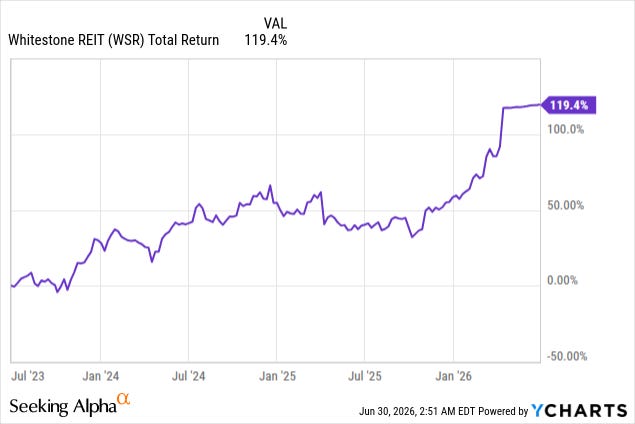
Third, REIT fundamentals are also improving.
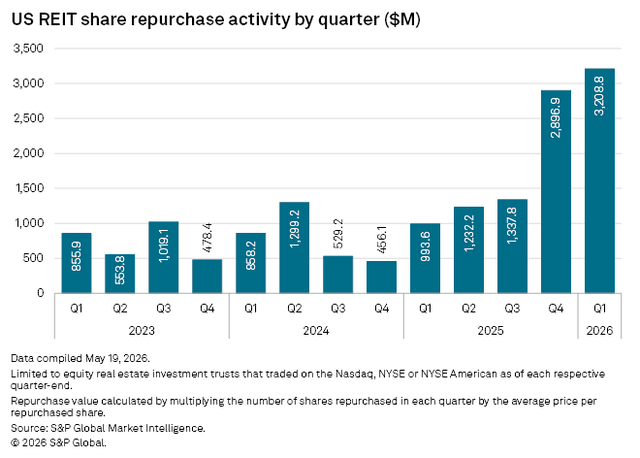
Rent growth is expected to accelerate in 2027 for many property sectors, and at the same time, interest rates could move lower. That is a powerful combination. REITs are now seeing the light at the end of the tunnel, and many of them have become more aggressive with buybacks.
As you can see from the chart below, REIT buybacks are now historically high by REIT standards:
This makes a lot of sense.
If a REIT is trading at a large discount to NAV, and it can sell assets at private market values to buy back its own shares at a much higher implied cap rate, that can be highly accretive to shareholder value.
Put all of this together: improving fundamentals, the AI immunity trade, better market sentiment, aggressive buybacks, and private equity buyers going after undervalued REITs, and it is not surprising that REITs have rallied.
But that is just the average.
Beneath the surface, there are still some very compelling opportunities, and one of them is Rexford Industrial Realty (REXR), to which we are adding more capital today.
Why Rexford?
One of my main takeaways from the recent REIT Week conference in New York City was that Southern California industrial real estate fundamentals are finally turning the corner.
This was not just the message from Rexford itself.
It was also the takeaway from listening to the roundtable discussions of Prologis (PLD), First Industrial Realty (FR), and EastGroup Properties (EGP). These are among the most sophisticated industrial landlords in the world, and all of them appear to be seeing the same thing:
Demand is improving, while new supply under construction has already dropped to historically low levels. Net absorption has not yet turned positive in every Southern California submarket, but it has already turned positive in some of them, and the broader direction is clearly improving.
This matters a lot for Rexford because it owns one of the best-positioned industrial portfolios in the country.
Rexford focuses exclusively on infill Southern California industrial real estate. These are dense, supply-constrained markets with very limited land available for new development. Over the long run, that has made them some of the strongest industrial markets in the entire country.
There is simply no more land available:


The recent weakness was not caused by a structural impairment of these assets.
It was caused by the bumpiness of the pandemic.
During the pandemic, e-commerce demand exploded, supply chains were disrupted, retailers overstocked inventories, and many tenants leased more space than they truly needed. Developers responded by building more space, and then, as the economy normalized, some tenants paused expansion plans or gave back excess space.
That created a temporary oversupply issue.
But temporary is the key word here.
