



This is the next installment in our monthly series on the portfolio of our macro analyst, Austin Rogers. Please note that our main focus will remain on the HYL Portfolios, but since many of you have expressed interest in knowing how Austin manages his portfolio, we are posting this to give you extra value.

Greetings from central Texas!
It’s springtime here. The bluebonnets are in bloom, the weather is lovely, and the grays & browns of winter have been replaced by a proliferation of green everywhere.
In my portfolio, however, it has been more of a mix between green and red.
REITs and other moderate-yielding dividend growth stocks enjoyed a strong start to the year as the overstretched AI trend gave way to rotation into value stocks. Then, in late February, bombs dropped in Tehran, setting off an ongoing conflict that quickly resulted in the closure of the Strait of Hormuz, through which 1/5th of global oil volume typically flows.
REITs and other rate-sensitive dividend payers hate higher oil prices, because higher oil prices pulls up overall inflation, which then pull up interest rates.
The good news is that this oil shock is expected to be temporary, even if painful.
The US Energy Information Administration forecasts the price of oil to gradually come down over the course of the year, assuming military hostilities wind down soon.
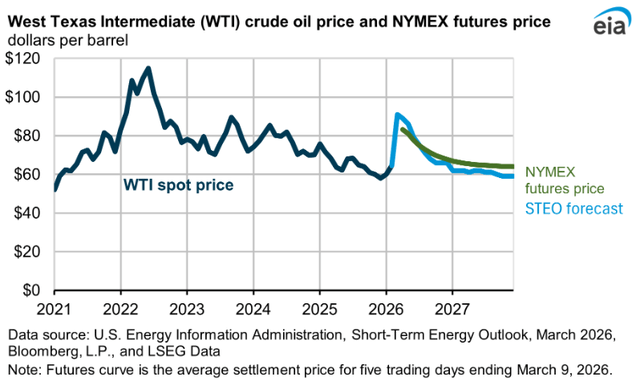
EIA Short-Term Energy Outlook
To quote the report:
We forecast the Brent crude oil price will remain above $95/b over the next two months, before falling below $80/b in the third quarter of 2026 and around $70/b by the end of the year.
As of this writing on March 31st, there have been news reports of both sides seeking to deescalate. How exactly this mini-war will end is above my paygrade, but we appear to be on an offramp.
That led to some excellent buy-the-dip opportunities among REITs and other dividend payers, many of which remain great buying opportunities.
For long-term investors comfortable with volatility, the alternative asset managers like Blackstone (BX), Brookfield Asset Management (BAM), Ares Management (ARES), and Blue Owl Capital (OWL) have been severely beaten down, offering depressed valuations amid the private credit panic.
In REITdom, there are some highly attractive buying opportunities, including among cell tower REITs, select senior housing/care REITs, and VICI Properties (VICI), which has sold off in sympathy with its tenant Caesars Entertainment (CZR).
But to tell you the truth, the investing theme I’m most excited about right now is technology.
Yes, technology.
I spent all last year in my public articles on Seeking Alpha bemoaning the market’s uncritical enthusiasm for AI. My argument was that while it is surely an amazing technology that will increase productivity over time, returns on the massive amount of AI investment being done are completely unknown, making the circular financing deals prevalent in the AI ecosystem look suspect.
This year, the pendulum has swung decisively the other way, rendering technology stocks an attractive buying opportunity (in my opinion) for long-term investors.
In what follows, allow me to lay out my broad thoughts on the economic backdrop today, followed by a glance at my top holdings and then the portfolio recycling carried out in Q1.
Three Major Economic Forces Today
While the Iran war and private credit redemptions create noise and headlines, I think there are three major economic forces having the most impact on the US economy and market fundamentals today.
1. Big Tech Capex Is The Primary Driver of Earnings Growth
Overall, US economic growth is decent but not strong. However, if you stripped out the massive level of AI infrastructure spending by Big Tech companies, US economic growth would be very weak or nonexistent.
The biggest driver of earnings growth in the stock market today is investment spending within the AI ecosystem.
The Big Beautiful Bill certainly helps by incentivizing other business investment, to be sure, but this source of growth pales in comparison to Big Tech capex.
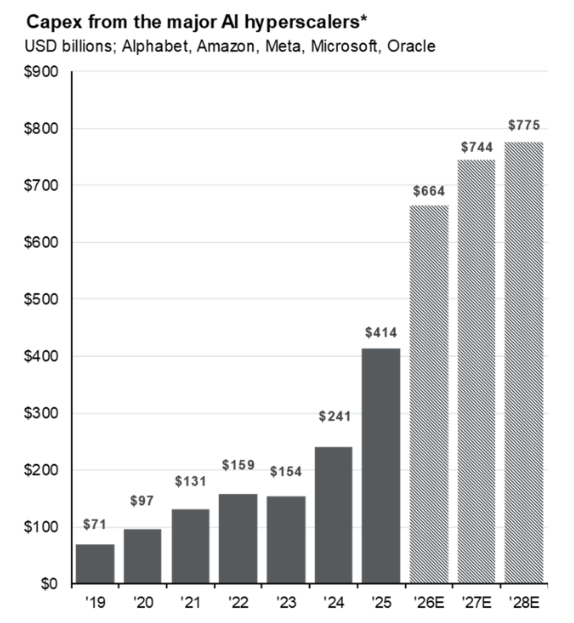
JP Morgan
Just the five major hyperscalers have projected collective growth of about 60% in capex. Substantially all of their operating cash flow is being funneled into AI infrastructure investment this year. This capex amounts to roughly 2% of US GDP -- more than almost any other new technology investment cycle in history.
One company’s spending is another company’s income.
Hence we find that the technology and materials sectors, two of the biggest immediate beneficiaries of Big Tech capex, are projected to enjoy incredibly strong earnings growth this year.
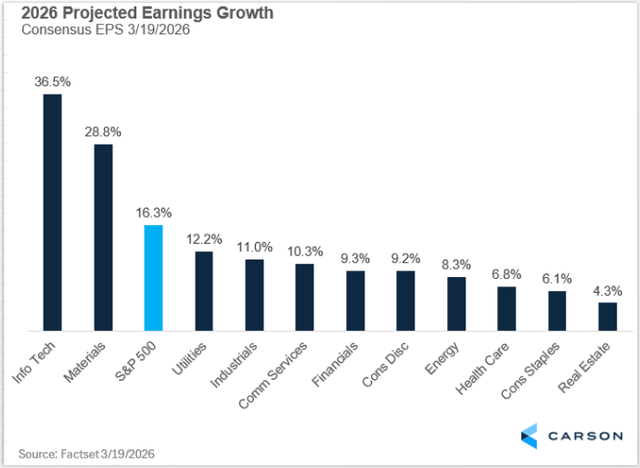
Carson Research
Obviously, income-seeking investors will balk at the 1-2% dividend yields among dividend payers in the technology space, but I would argue that long-term investors (including dividend growth investors like me) should seriously consider some tech stocks right now.
Despite having over double the projected earnings growth as the S&P 500 (SPY) this year, the US tech sector (XLK) recently came very close to valuation parity with the SPY:
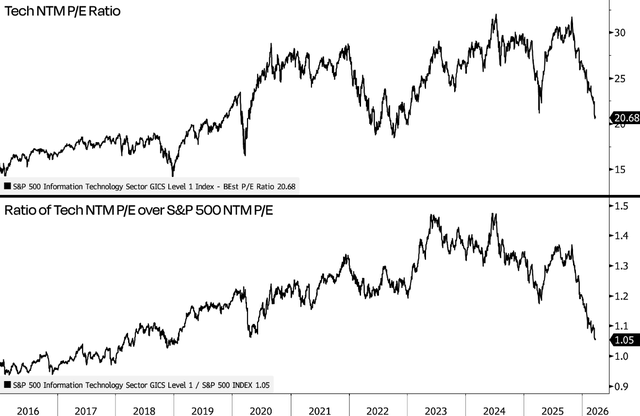
Daily Chartbook
That’s an incredible development, especially in the age of AI where developed economies around the globe become increasingly reliant on productivity growth over labor force growth.
My favorite two-pronged way to tap into this growth trend is the duo of First Trust NASDAQ Technology ETF (TDIV) and its covered call fund FT Vest Technology Target Income ETF (TDVI).
Although TDIV yields around 2% or a little less, I expect to see at least high-single-digit dividend growth from the ETF going forward.
And TDVI yields ~8%, trading capital gains for income. Its total return performance is basically equal to that of TDIV, minus its higher expense ratio of 0.75% compared to TDIV’s 0.5%.
Data by YCharts
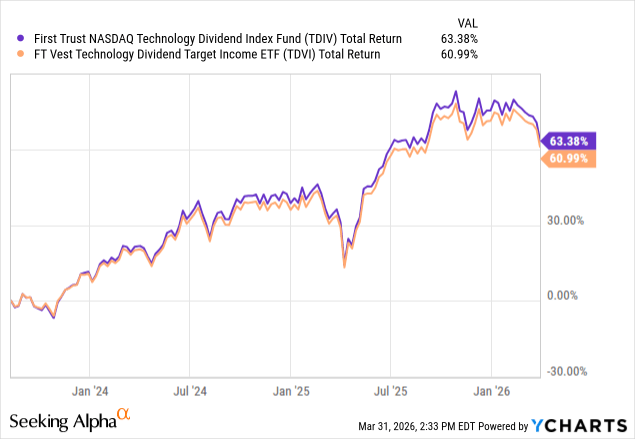
For those, like me, who are underweight tech, these two ETFs are arguably the best option for pure-play exposure to dividend-paying tech stocks.
2. “Let Them Eat Cake” - The K-Shaped Economy
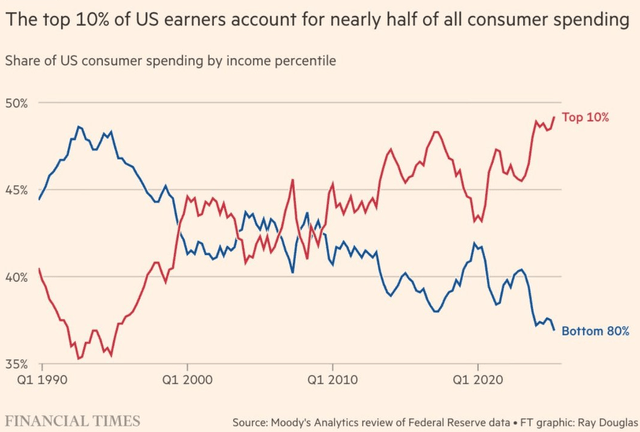
The financial media (myself included) has discussed the K-shaped economy ad nauseum over the last few years. But even if you’re tired of hearing about it, the trend is still there, and it is powerful.
The top 10% of households by income currently account for 49% of total consumer spending, while the bottom 80% have seen their share of consumption slide considerably over the last several years.
Financial Times
The top 20% of income earners account for over 60% of total consumer spending.
This is steadily reshaping the consumer economy to cater to the affluent, who are largely older people with large stock portfolios and fully paid-off personal homes.
It will also have electoral consequences. I would argue the main reason why the pendulum swung toward Republicans in 2024 was the “affordability” issue -- a codeword for negative economic sentiment and rising lifestyle envy. That issue has only gotten worse, which bodes poorly for Republicans’ electoral prospects later this year.
3. Net Immigration Has Halted
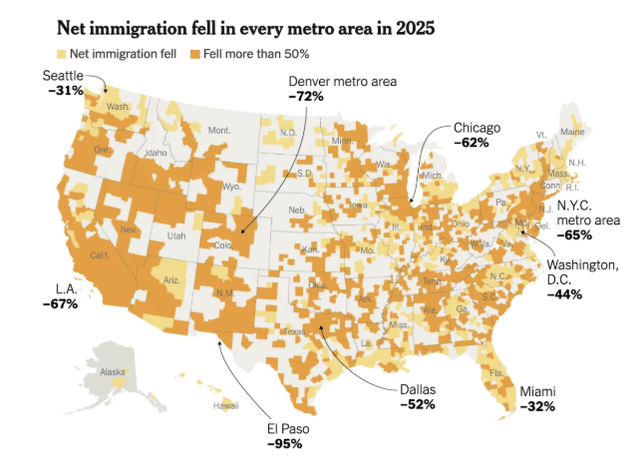
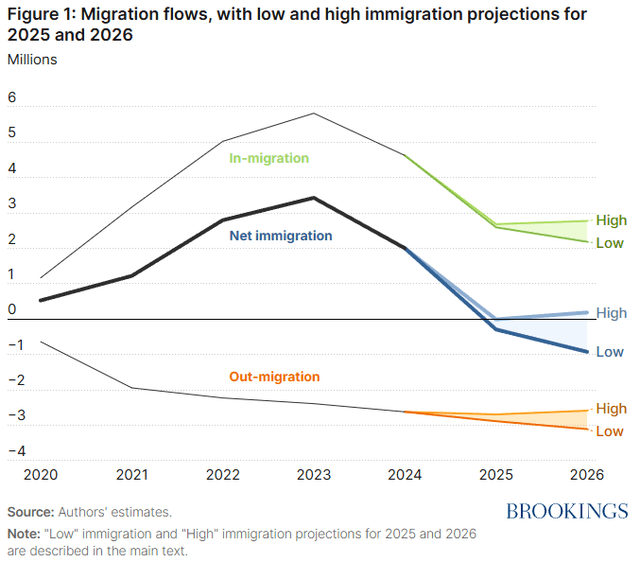
For the first time in at least 50 years, US net immigration turned negative in 2025.
In cities across the nation, net immigration absolutely collapsed, often into negative territory.
New York Times
Now, my personal view (which I believe is the majority view among Americans) is that the Biden administration was far too lax about immigration, allowing a virtually unrestricted and unfiltered flow of migrants for multiple years in a row. Too much in-migration too quickly almost always results in a political backlash.
From 2021 through 2023, well north of 10 million people migrated into the US.
Brookings Institution
This much immigration tends to make the native-born population anxious and frustrated, especially when a large portion of those migrants lack solid legal authorization.
But it is also my personal view (which, again, I believe is the majority opinion in the States) that the Trump administration has overcorrected to an extreme degree on the immigration issue. They have allowed in too few legal immigrants and been too aggressive on deportations.
This overcorrection has negative economic effects, including a dent in labor supply in many industries and a drop in aggregate consumption.
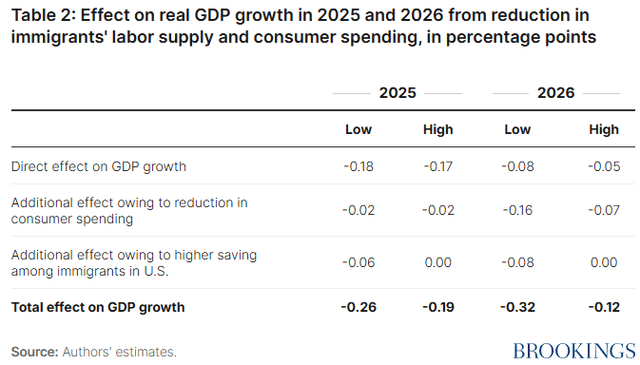
Brookings Institution
While this may seem like a small impact, it has a sizable impact when real GDP growth is already low.
If the US native-born population was still growing at a decent pace, perhaps zero net immigration wouldn’t be a problem. But unfortunately, the US has almost no growth in the native-born population either.
I think this cessation in population growth, especially among the working-age cohort, has played an outsized role in low job growth over the last year.
It is also why I am increasingly hesitant to buy residential REITs right now, despite how objectively cheap they’ve become. With little to no job growth and little to no working-age population growth, where is growth in demand for rental housing supposed to come from?
