



The entire story of the stock market in the second quarter of 2026 can be summed up in two letters: AI.
By far the biggest trend in the market right now is the artificial intelligence infrastructure buildout, which is denting free cash flows and investor sentiment for the hyperscalers while gifting semiconductor and tech hardware companies with fast-growing profits and stock prices.
Follow the money back far enough, and you’ll find that the source is what I call the “capex waterfall” -- about $1 trillion (and rising) being spent per year by the hyperscalers and other data center developers.
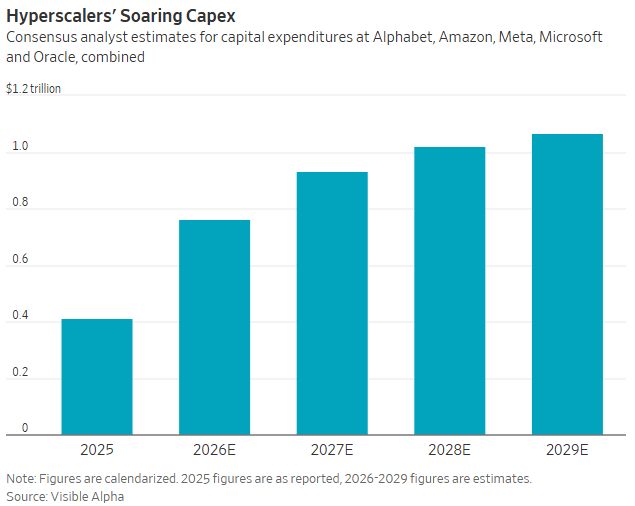
Megacap corporations like the five above are devoting all or most of their free cash flows to the AI infrastructure buildout, and a huge portion of that is flowing directly to chipmakers’ and tech hardware companies’ bottom lines.
This chart below tells the story better than words can. AI infrastructure suppliers have surged this year (after two very strong years in 2024-2025!), while the Magnificent 7 (MAGS) containing most of the hyperscalers is down slightly year-to-date. And tellingly, the S&P 500 excluding the tech sector (SPXT) is up only a little over 4% so far in 2026.
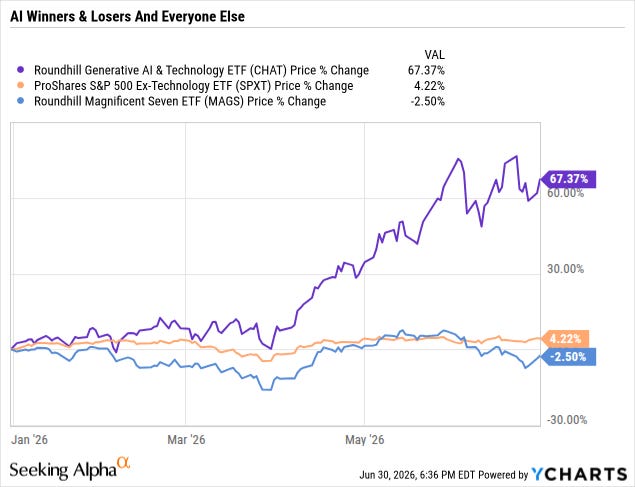
If you also excluded the energy sector, which is enjoying a one-time boost to earnings from the Iran conflict and its associated oil price spike, the US stock market would actually be down slightly this year.
Here’s a chart from Apollo Global Management’s Torsten Slok illustrating this phenomenon:
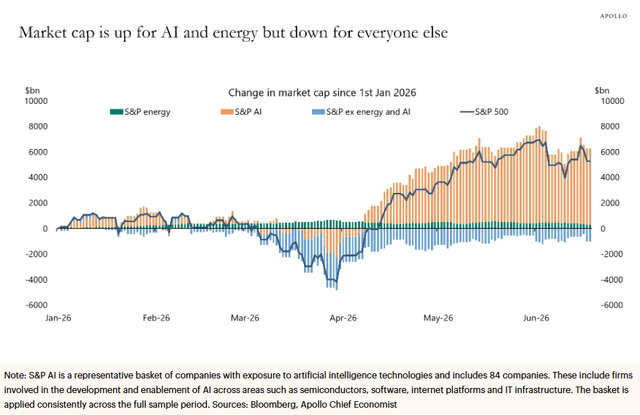
So what feels like a strong market this year boils down almost entirely to an incredible surge in AI-related stocks.
That’s it.
It is truly remarkable how dependent the stock market has become on the AI megatrend. By one measurement, tech & tech-related stocks now account for almost 60% of total stock market capitalization.
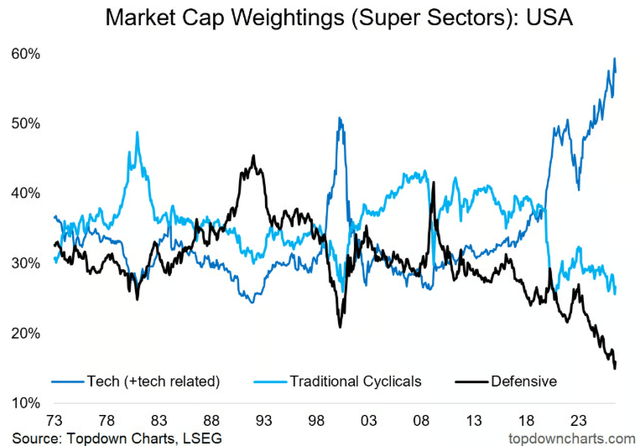
Notice that this is about 6-8 percentage points higher than the peak of the Dot Com bubble in 2000.
Meanwhile, shockingly, all defensive sectors (including REITs) combined now account for only about 15% of total market cap, while cyclical sectors account for somewhere in the high-20% area.
On its own, these charts above would scream bubble. Price movements like that look extremely stretched and totally unsustainable.
But then you look at the analyst consensus earnings growth over the next few years, it’s even more impressive than the price growth!
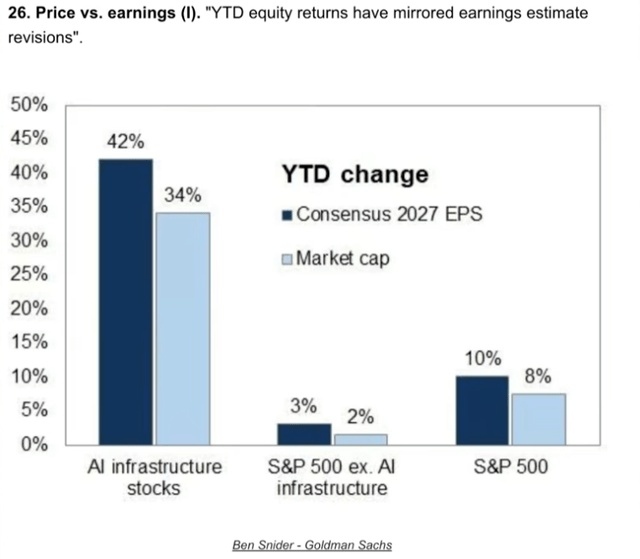
It doesn’t seem possible, but price movements have corresponded strikingly well with earnings estimates.
The market appears to be roughly efficient, at least insofar as earnings estimates can be trusted.
The tech sector (led overwhelmingly by chipmakers and hardware companies) foresees annual earnings growth of more than 40% over the next 3-5 years, according to the analyst consensus.
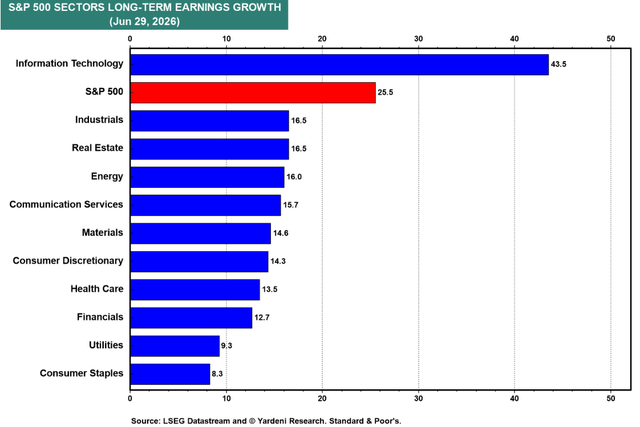
The biggest question in the market right now, then, is this:
Will the capex waterfall remain in place? Or will the tide turn and see hyperscalers begin to cut back on their capex plans?
As long as the capex waterfall continues, the AI-led bull market continues.
I’ve researched and analyzed various dividend-paying ETFs to tap into this AI infrastructure megatrend and gone back and forth about which ones I like best.
As of now, I own a mid-sized position in the FT Vest NASDAQ Technology Target Income ETF (TDVI), which pays a roughly 7% yield and tracks the First Trust NASDAQ Technology Dividend ETF (TDIV). I consider the latter a well-designed ETF in terms of its portfolio holdings, but it does have significant exposure to a few of the big spenders like Oracle (ORCL) and Microsoft (MSFT).
Lately, I have begun to favor instead the ProShares S&P Technology Dividend Aristocrats ETF (TDV), which has an expense ratio of 0.45% (somewhat high for my taste) but also sports a very strong portfolio of dividend-growing tech companies that are overwhelmingly on the supplier side of AI infrastructure rather than the spender side.
The ETF yields only ~1%, but I do believe it will be a very strong long-term dividend growth fund. Since I’m in my mid-30s and nowhere near retirement age, I think accumulating shares in TDV makes sense right now.
Perhaps even more than TDV, though, I like the Virtus Reaves Utility ETF (UTES), an actively managed fund overseen by the utilities experts at Reaves Asset Management. Over 30% of the portfolio is in the three big independent power producers, which I believe will be major beneficiaries of the AI infrastructure megatrend.
UTES yields only ~1.5%, but I think it will also prove to be a fantastic long-term dividend growth ETF thanks to robust growth in demand for electricity in the coming years.
REITs: Hedge Against A Potential AI Bubble
While I am allocating to what I believe will be beneficiaries of the AI capex waterfall, that does not mean I’m abandoning or selling REITs.
Real estate still makes up over 40% of my total portfolio. Really, I am just allocating incremental capital to AI capex beneficiaries.
I believe my large overweight to real estate should act as a great hedge against an AI bubble burst, if this is a bubble and if it bursts violently at some point.
Why REITs as a hedge? Well, in the years after the Dot Com bubble peaked, REITs performed swimmingly, basically ignoring the bloodshed in the tech sector.
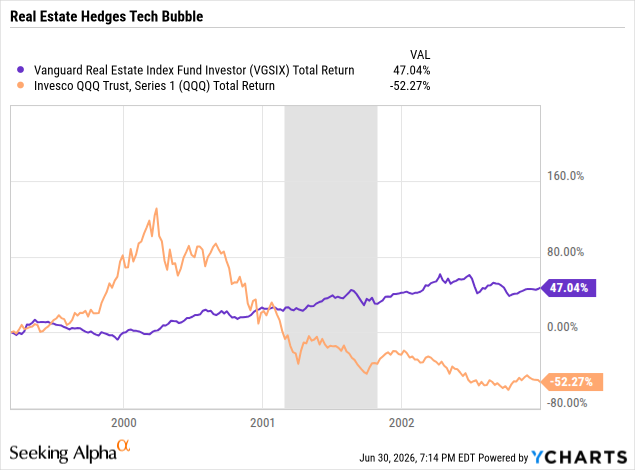
I don’t know if this AI bull market is or will become a bubble. But if it does, I believe REITs will drastically outperform during its bursting, just as they did in the early 2000s.
That makes a REIT allocation worthy of inclusion in one’s portfolio, especially if one is heavily invested in tech.
