



Quick Reminder:
We just held our quarterly webinar and discussed many of our top holdings, recent trades, and the opportunities that we are most excited about today.
Many of you joined us live, and I want to thank you for taking the time and for asking such thoughtful questions.
Here is a list of topics with timestamps for your convenience:
0:56 - Rising interest rates
5:12 - Realty Income (O)
7:16 - Essential Properties Realty Trust (EPRT)
9:16 - Agree Realty Corporation (ADC)
11:08 - Cash secured puts and covered calls
12:30 - Cibus Nordics (CIBUS)
13:33 - Tallinna Sadam (TSM1T)
15:15 - European REITs
17:20 - Branicks (BRNK)
19:35 - Canadian REITs
21:06 - Vital Infrastructure Property Trust (VITL.UN:CA)
23:10 - 5 REITs that are heavily discounted to NAV
25:05 - Current favorite REIT sectors
26:46 - Temporary crisis or permanent change in interest rate expectations
28:55 - CTP and Hamborner REIT
30:25 - ARMOUR Residential REIT (ARR)
31:23 - AH Realty Trust (AHRT)
34:15 - Accelerating rent growth
36:30 - Cold storage REITs
37:05 - Unite Group vs. Xior Student Housing
38:00 - Rising government debt levels
39:30 - Top REITs for the next 12 months
41:40 - Safehold (SAFE)
42:30 - Patria Investments (PAX)
44:30 - Realty Income (O)
45:10 - Agree Realty Corporation (ADC)
47:00 - Favorite Apartment REIT today
48:25 - Clipper Realty (CLPR)
49:40 - European vs. US REITs
51:45 - Agree Realty Corporation (ADC)
52:15 - Wynn Resorts (WYNN)
53:10 - RCI Hospitality (RICK)
54:40 - NewLake Capital Partners (NLCP)
56:10 - VICI Properties (VICI) vs. REIT Preferred Shares
58:20 - Best property sectors for a higher-for-longer environment
59:10 - Residential oversupply in Sunbelt markets
1:00:27 - Invitation Homes (INVH)
1:03:08 - Net Lease Office Properties (NLOP)
1:03:53 - NewLake Capital Partners (NLCP)
1:04:30 - Alexandria Real Estate (ARE)
1:06:55 - Kite Realty Group (KRG) vs. Kimco Realty (KIM)
1:07:25 - Closing Notes
What Austin Bought & Sold In Q3 2026
I don’t know about you, but it’s hard not to feel a little FOMO right now.
In 2026, the market has been dominated by two particular themes:
High oil prices, courtesy of the military conflict between the US and Iran
A ramp-up of AI infrastructure spending, fueling incredible earnings growth for AI suppliers (predominantly chipmakers)
With few exceptions, if you aren’t heavily invested in either the AI ecosystem (CHAT) or energy stocks (XLE), then you are probably having a mediocre year for returns.
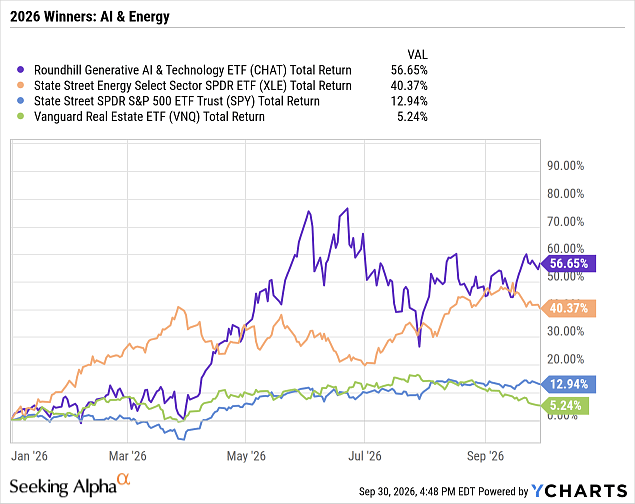
Note that while ~13% total returns are pretty respectable for the S&P 500 (SPY), the index is heavily concentrated in AI stocks. Without the tech sector (see chart below), the SPY’s performance would be much worse.
Note also that after outperforming the SPY for much of this year, the real estate sector (VNQ) has once again (*sigh*) turned down as rising interest rates start to bite.
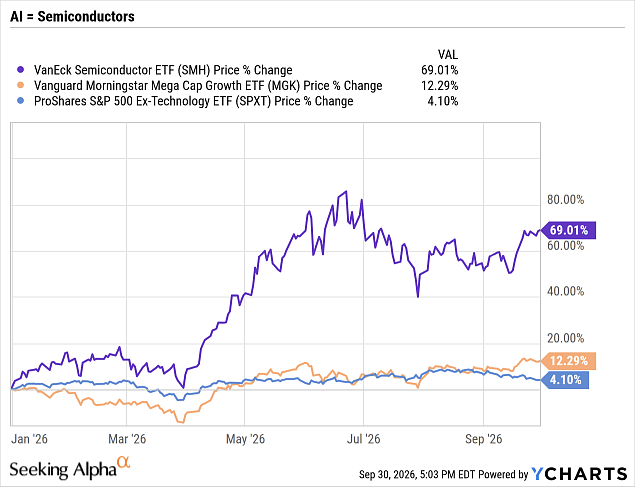
But market concentration is even more significant than many investors realize. Not every company in the AI ecosystem is soaring in price this year. It’s mostly semiconductor stocks (SMH). Megacap growth stocks (MGK) are performing slightly less well than the S&P 500 (not surprising, given their weight in the index), while the S&P 500 excluding tech (SPXT) is up only about 4% year-to-date.
So if you’re not a tech investor and your portfolio is treading water this year, I’m with you.
My portfolio is made up largely of REITs (35% of the portfolio), various financials (27%) like BDCs and alternative asset managers, and utilities (14%). All three of those sectors, which together make up 3/4ths of my portfolio, are having a rough year, due overwhelmingly to rising interest rates.
Aside from interest rates, the fundamentals of all three sectors are solid.
Regulated utilities are held back somewhat by regulatory issues and backlash against almost any new power generation projects, but they enjoy long-term tailwinds from growing electricity demand and data center proliferation.
Alternative asset managers may see their underlying asset performance flag somewhat amid higher interest rates, but fundraising continues to be strong, especially from institutional investors.
The higher-quality, mostly internally managed BDCs I own are having a decent year overall, although some (like Trinity Capital) are doing better than others (Hercules Capital) on the pricing front. Steady GDP growth and avoidance of the SaaSpocalypse have kept returns high and non-accrual rates low.
Finally, while higher interest rates mechanically weigh on REIT stock prices by creating a safe yield alternative for investors, most REITs themselves are far less vulnerable to higher rates than you might think. Most REITs (certainly all of the ones I own) have moderate to low debt levels with average maturities spanning from around 5 to 8 years.
More importantly, as we have been pounding the table about here at High Yield Landlord, REIT fundamentals enjoy a very strong tailwind for at least the next 2-3 years (if not longer) from extremely favorable supply-demand dynamics.
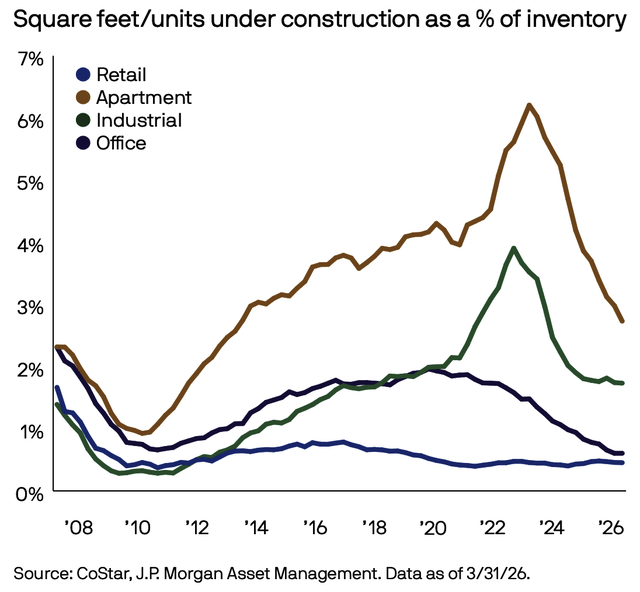
To put it simply, commercial real estate construction pipelines have collapsed across the board, while tenant demand continues to range from decent to excellent.
To be clear, my bullishness on most types of housing has waned quite a bit this year as demographic and immigration realities have set in. According to the Census Bureau, the total US population appears on track to peak sometime in the next several years, and the working-age population has probably also peaked.
Going forward, all growth in the US working-age population will come from net immigration. Right now, net immigration is extremely low. What little immigration inflows we have are largely if not entirely offset by deportations.
Who rents apartments? Mostly working-age folks.
Even after the collapse in the multifamily construction pipeline we’ve already seen, there’s still probably too much new housing supply coming to market.
I don’t mean to sound alarmist here. I just don’t think multifamily REITs will enjoy the same growth or returns in the future as they have in the past. That probably means apartment cap rates will gradually rise and that multifamily REIT valuations won’t rebound back to their pre-supply-wave levels. They may still make for solid investments — at the right price. But valuations, I think, have been permanently reset lower.
Demographics are destiny, as they say.
The one area of housing on which I (and the market generally) am extremely bullish is senior housing. While the huge Baby Boomer generation are just now beginning to enter their 80s, when a growing portion of them opt for senior housing solutions, the development pipeline for this type of real estate remains ultra-low.
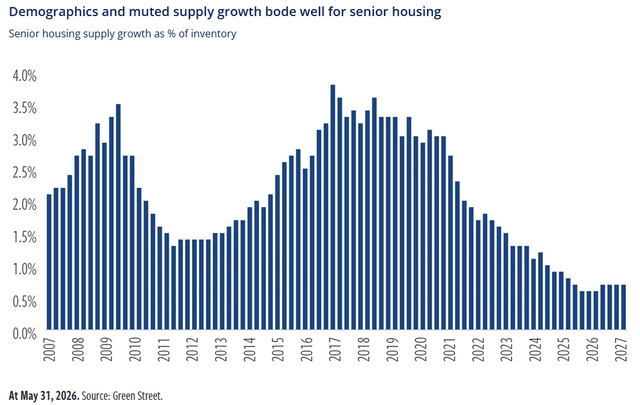
High interest rates, elevated construction costs, and labor shortages are keeping developers at bay, for the time being.
For at least the next few years, senior housing occupancy and rent rates will be allowed to continue growing with very little new competing supply coming to market.
My top pick in this space right now, a small position that I’m trying to grow aggressively, is Janus Health (JAN), the recent senior housing spinoff of Healthpeak Properties (DOC). The REIT has zero net debt and a high-quality portfolio of senior living facilities, most of which are continuing care communities where residents can smoothly transition from independent to assisted living and, if needed, skilled nursing.
JAN isn’t cheap at about a 30x FFO multiple, but its growth rate is astounding. The analyst consensus estimates put JAN’s price-to-2028 FFO at around 21-22x.
