



Healthcare real estate is made up of four primary sub-sectors:
Medical outpatient buildings (”MOBs”)
Life science / labspace
Hospitals
Senior housing / care facilities
In our Q3 2025 healthcare real estate earnings update, we provided up-to-date information about each of these sub-sectors. Since then, there has been very little new information to give.
In short:
Cost pressures and patient convenience continue to push care from hospitals to outpatient facilities. Federal healthcare spending reductions in the Big Beautiful Bill further exacerbate this trend.
The construction pipeline of all kinds of healthcare real estate remains very low, indicating that supply headwinds should continue to fade over the next few years, allowing occupancies to rise.
Senior housing is the biggest beneficiary of the current demand/supply mismatch. In 2025, net absorption outpaced new supply by almost 5 to 1. Senior housing average stabilized occupancy reached 90% in Q4 2025, the highest since 2017.
Fundamentals also look very strong for medical outpatient. CBRE projects the strongest rent growth in decades for MOBs in 2026.
Federal funding cuts and potential pharmaceutical tariffs continue to weigh on life science demand, but this sub-sector is expected to largely stabilize over the course of 2026.
AI-driven productivity gains in the biotech space should increase the number of phase 3 trials and eventually also demand for labspace.
With the decline in long-term interest rates and narrowing of credit spreads, the pressure on heavily leveraged, private equity-backed hospital operators has eased.
As you can see, it’s mostly good news across the healthcare real estate spectrum.
The outlook is very positive for senior housing and medical outpatient, and valuations mostly reflect that optimism.
Meanwhile, hospitals and life science are stabilizing while valuations continue to be undemanding.
CBRE’s 2026 outlook for MOBs includes flat occupancy at around 90% as well as robust rent growth.
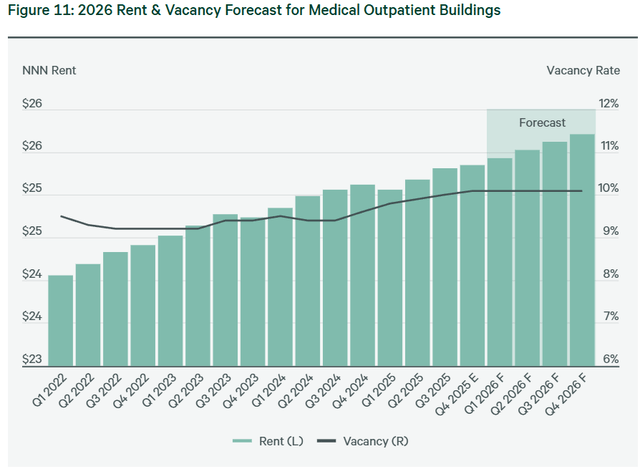
To be clear, a robust MOB growth rate is still in the single-digits. This is not a boom-and-bust property type. That’s one reason why medical outpatient REIT Healthcare Realty (HR) fits in our Retirement Portfolio.
But for a conservative sub-sector like MOB, this environment is about as good as it gets.
On the other hand, you’ve got life science, which is expected to see a significant slowdown in the rise of vacancies in 2026 while rent remains flattish.
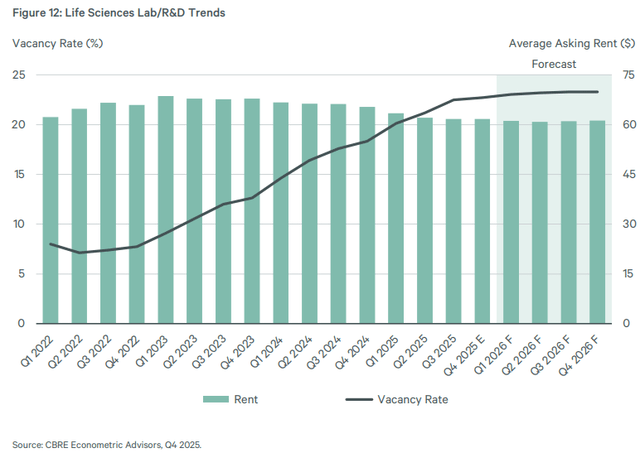
Life science was the hardest hit part of commercial real estate after COVID-19. The magnitude of development and redevelopment projects adding new space over the last several years has vastly outpaced net absorption. Hence the spike in the overall vacancy rate from around 7% at the end of 2022 to over 20% at the end of 2025.
This level of oversupply is akin to what we see in the traditional office sector. It will take multiple years to work through the oversupply, even if you consider only well-located Class A buildings.
Although, to be clear, the situation for Class A properties such as the mega-campuses owned by Alexandria Real Estate (ARE) is significantly less bad than it is for the average life science property.
With that, let’s turn to the Q4 2025 earnings updates for our four healthcare REITs:
