



Table of Contents
Opening Notes
Changes Portfolio Holdings
Changes to HYL Ratings
The Core Portfolio (Our Main Portfolio)
The Retirement Portfolio (Our Secondary Portfolio)
The International Portfolio (Our Optional Portfolio)
1. Opening Notes
The third quarter was a frustrating one for REIT investors, particularly toward the end of the period.
We entered Q3 with strong momentum.
As discussed in our Q2 Portfolio Review, REITs had performed very well during the first half of the year despite interest rates remaining elevated. Investors were beginning to recognize some of the themes that we had been highlighting for a while: valuations remained historically low, supply growth was slowing, rent growth prospects were improving in many property sectors, M&A and buyback activity were accelerating, and real assets were increasingly benefiting from concerns about AI disruption.
Unfortunately, the macro environment then took a turn for the worse.
The escalation of the war in Iran disrupted energy markets and caused oil prices to surge. This pushed headline inflation higher, led bond yields to rise, and ultimately forced the Fed to hike interest rates. The market sentiment of REITs is highly sensitive to changes in rates and reacted predictably: valuations fell sharply as investors once again worried about higher refinancing costs, higher cap rates, lower property values, and the relative attractiveness of bonds.
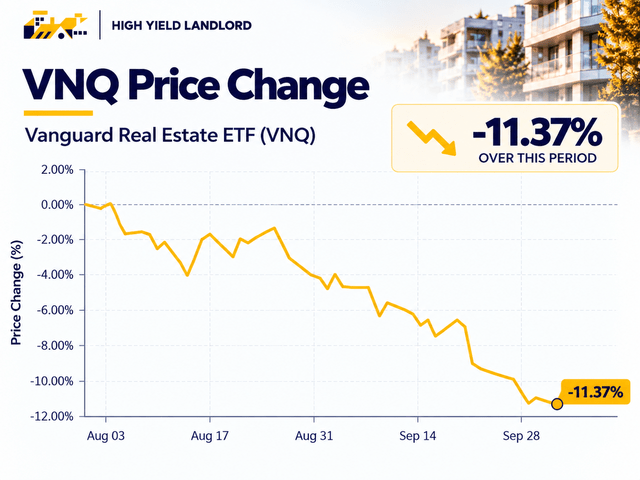
We recently discussed this in detail in our Market Updates, and I will not repeat everything here. The important point is that the recovery we were seeing earlier in the year has been interrupted. This has delayed the normalization in interest rates that we had been hoping for, and REITs have given back a meaningful portion of their earlier gains.
I understand why this is frustrating. REIT investors have had to deal with several years of rate volatility already, and every time it looks like conditions are finally beginning to normalize, something seems to push the recovery further out.
But I also think this is exactly when it is most important to remain patient.
Another Setback, Not A Broken Thesis
The first thing to recognize is that the recent inflation surge has largely been caused by energy.
The war disrupted energy markets, oil prices surged, and headline inflation moved higher as a result. But when we look beneath the headline numbers, the inflation picture is much less concerning. Core inflation has continued to trend lower, and many of the largest non-energy CPI components are showing stable or disinflationary trends.
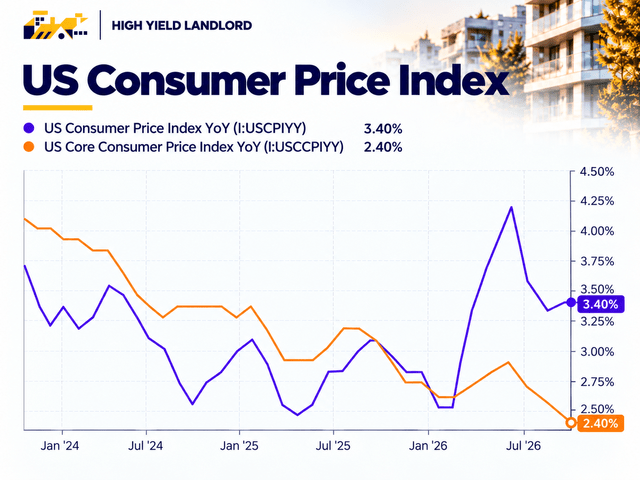
This distinction matters because an energy shock is very different from a broad-based overheating of the economy.
Higher oil prices can certainly remain elevated for longer than expected, and they can feed into other prices over time. I do not want to dismiss that risk. But energy shocks also tend to be self-correcting eventually. High prices reduce demand, encourage additional supply, and weaken economic activity. The war will not continue forever either, even if nobody can predict when or how it will end.
That is why I view the recent rate hike as a delay to the REIT recovery rather than a fundamental change in our long-term thesis.
We have been through similar periods before. During 2022 and 2023, REITs repeatedly sold off as rates climbed and investors concluded that higher financing costs had permanently impaired the sector. In hindsight, those periods gave us some of our best opportunities to accumulate shares at depressed valuations.
We did not know exactly where the bottom would be then, and we do not know today either. What we can do is assess whether the assets are still valuable, whether the balance sheets are sound, whether rents are likely to grow over time, and whether the prices we are being offered compensate us for the risks.
In many cases today, I think they do.
That is why we have continued buying gradually. We are not trying to call the exact bottom, and we are not putting all our capital to work at once. We are adding in phases, week after week, to our latest favorite opportunities to buy the dip.
If prices fall further, we will have an opportunity to buy more cheaply. If the sector begins recovering sooner than expected, we will already have increased our exposure.
Keep Your Eyes On The Prize
The bigger mistake, in my view, would be to become so focused on the latest Fed meeting that we lose sight of the longer-term forces that ultimately matter to our thesis for investing in REITs at these discounted levels.
Interest rates have trended downward over the past four decades, despite many temporary periods in which inflation and rates moved sharply higher.
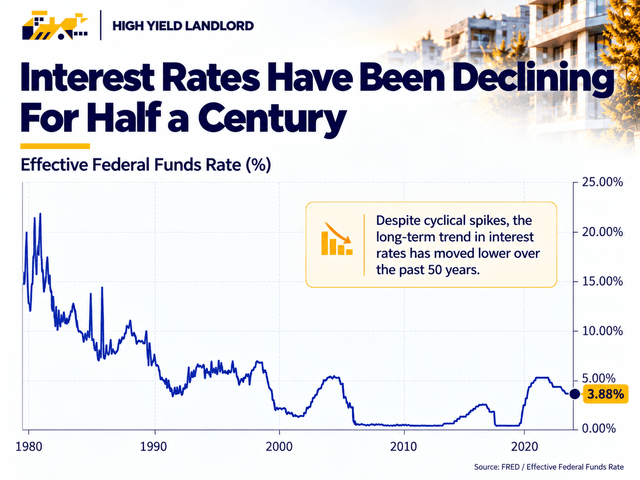
The reasons behind that long-term trend have not disappeared.
Aging populations tend to grow and consume more slowly. Population growth is slowing across much of the developed world. High debt levels make economies increasingly sensitive to elevated interest rates. Rising wealth inequality means a larger share of income is saved and invested rather than immediately spent. And technology continues to reduce the cost of producing goods and services.
We discussed these structural disinflationary forces in our recent Market Update, and I think they remain as relevant today as ever.
The technology component is particularly important because of AI.
Technology has always been deflationary to some extent. It allows businesses to produce more with less labor, reduces costs, increases competition, and improves productivity. But AI has the potential to accelerate this process dramatically.
We are already seeing AI automate parts of software development, customer service, research, administration, content creation, analysis, and many other forms of knowledge work. Over time, this will increasingly be combined with robotics, autonomous systems, and other forms of automation in the physical economy.
I do not think anyone can know exactly how quickly this will happen or how large the impact will ultimately be. But if AI delivers even a portion of the productivity gains that are currently being discussed, it could become one of the most important deflationary forces of this century.
That would have major implications for interest rates.
If technology allows companies to produce more at lower cost while also drastically reducing the need for human labor in many industries, central banks may eventually face a very different problem from the one they face today. Rather than fighting excessive inflation, they may increasingly need to support employment, especially if we face a difficult AI transition period with it eliminating a lot more jobs than it creates in the near term.
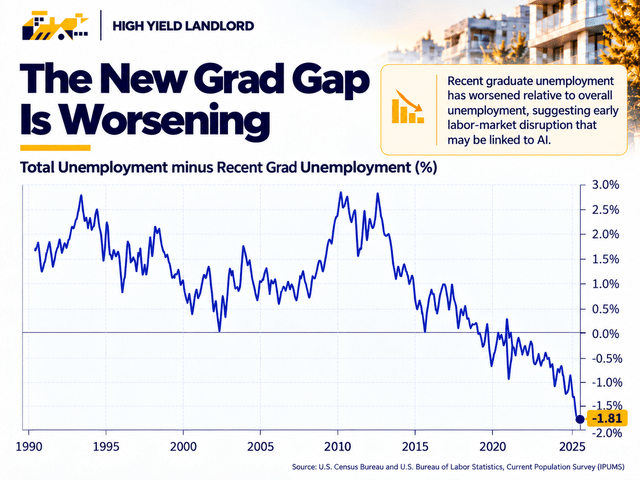
This is why I continue to believe that interest rates will eventually return to much lower levels.
Could they ultimately approach 0% again during a future downturn? I think that is entirely possible. I would not make that my base case for any specific year, because there are simply too many variables involved, but I also think investors are too quick to assume that today’s relatively high interest rates represent a permanent new normal.
The structural forces that pushed rates lower for decades are still here, and in some respects they are stronger than ever.
Why This Matters So Much For REITs
This is where today’s valuations become particularly interesting.
One of the main reasons why investors currently want little to do with REITs is precisely because interest rates are high. Investors can earn attractive yields from bonds without taking real estate risk, financing costs are elevated, and the possibility of higher cap rates weighs on property valuations.
All of this is reflected in REIT share prices.
But if rates eventually normalize to much lower levels, the economics could change significantly. REIT dividend yields would become more attractive relative to fixed income, refinancing costs would gradually decline, investment spreads would improve, and lower required returns could support higher property values.
Importantly, we would be entering that environment from today’s depressed valuations.
That is very different from buying REITs when valuations are already high, and investors are already pricing in low rates. Many REITs today trade at sizable discounts to the estimated value of their properties precisely because the market assumes that current financing conditions will persist for a long time.
If that assumption proves too pessimistic, there could eventually be substantial upside.
I do not think we need interest rates to return all the way to 0% for this thesis to work. Even a gradual normalization toward lower rates could improve refinancing costs, cap rates, investment spreads, and investor sentiment.
But the possibility of very low rates again at some point is one reason why I think investors should avoid extrapolating today’s conditions indefinitely into the future.
Value Is Still Building In The Background
There is also an important part of the story that has very little to do with short-term REIT share prices.
The current high-rate environment is making it extremely difficult to develop new real estate.
Financing costs are high. Construction costs remain elevated. Required returns have increased. In many markets, developers simply cannot justify starting new projects at today’s economics.
As we highlighted in our recent Market Update, construction lending has fallen sharply, and development pipelines have contracted across apartments, industrial properties, offices, and senior housing.
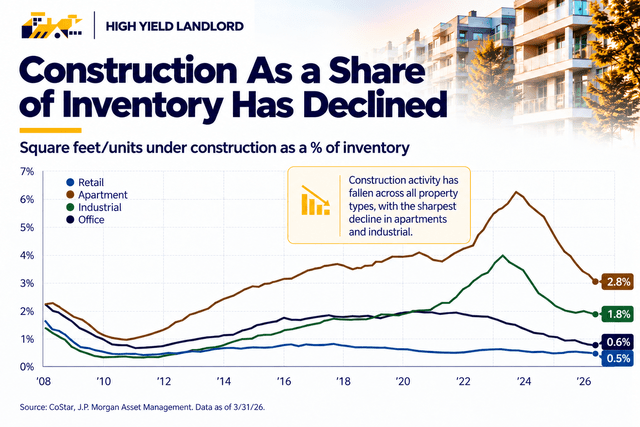
This creates an unusual situation.
Higher rates are hurting REIT valuations today, but at the same time, they are reducing the amount of competing real estate that will be delivered several years from now.
That is likely to be very valuable for owners of existing high-quality properties, as real estate is ultimately a supply-and-demand business. Once the projects that were started during the previous construction boom are absorbed, lower new supply should lead to higher occupancy, fewer concessions, and stronger rent growth in many property sectors.
We are already beginning to see this setup develop.
The market tends to focus almost entirely on the negative side of higher rates, namely higher interest expense and lower valuation multiples. But it pays much less attention to the fact that the same high rates are improving the future competitive position of existing landlords.
We have argued that this more favorable supply-demand backdrop could extend for several years. This means that value can continue to build even while share prices remain depressed.
Rents can rise.
Property-level NOI can grow.
Replacement costs can increase.
And because little competing supply is being built, existing properties can become more valuable relative to the cost of replacing them.
For now, some of that growth is being offset at the REIT level by higher interest expense. But if rates eventually fall, the situation could reverse. At that point, lower financing costs could begin to coincide with stronger rents and a much healthier supply-demand environment.
That is the outcome we are positioning for.
How We Are Reacting
Our strategy is therefore not changing because of the recent sell-off.
We are continuing to accumulate shares gradually, with an emphasis on REITs that have fallen sharply despite owning high-quality assets, maintaining solid balance sheets, and benefiting from attractive long-term supply-demand dynamics.
We are not assuming that the recovery will begin tomorrow. The war could continue. Oil prices could stay elevated. Inflation could remain stubborn for longer than we expect, and the Fed could keep rates high.
But we also do not need to predict the exact timing of the turn.
What matters much more is whether we are buying good assets at prices that offer attractive long-term returns.

Over the years, some of our best investments have been made during periods when sentiment toward REITs was extremely poor. Those opportunities rarely felt comfortable at the time. The headlines were negative, investors were losing patience, and there was always a reason to wait for greater clarity.
Greater clarity usually arrived only after prices had already recovered.
That is why we are willing to accept some short-term discomfort today.
We still believe that the long-term forces driving inflation and interest rates lower remain in place. We think AI could strengthen those forces considerably over time. Meanwhile, today’s high rates are constraining new construction and laying the foundation for stronger rent growth in many property sectors.
The timing of the recovery may have been delayed a bit, but the long-term opportunity, in my view, has not.
So we will continue doing what has worked for us during previous sell-offs: buying gradually, collecting dividends, and allowing the underlying real estate to compound in value while we wait for the macro environment to eventually improve.
We are also evaluating several potential capital recycling opportunities. Some of our holdings have held up relatively well during this recent sell-off, while other high-quality REITs have dropped much more sharply. In those cases, it may make sense to sell positions where the relative upside has become less attractive and redeploy the capital into names that now offer a better risk-to-reward.
We are reviewing several such opportunities right now and expect to share more soon. Stay tuned for our upcoming trade alerts.
Finally, in case you missed it, we just held our quarterly webinar and discussed many of our top holdings, recent trades, and the opportunities that we are most excited about today.
You can listen to the recording here:
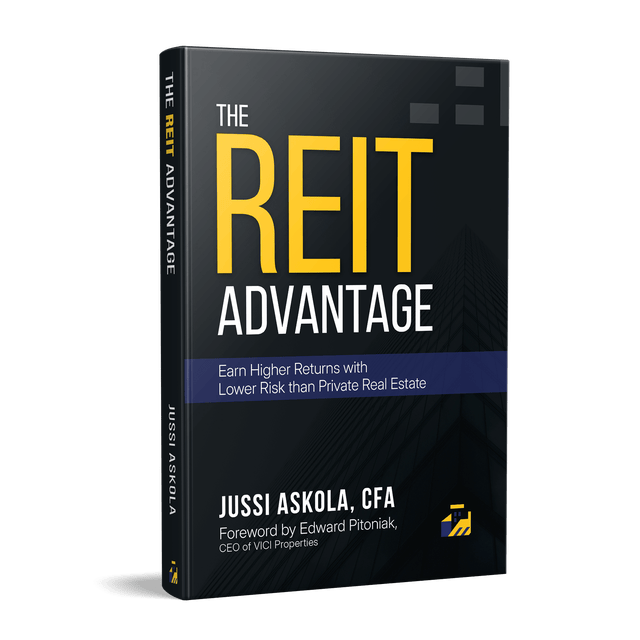
I also want to remind you that our book, The REIT Advantage, is still available for free to all members of High Yield Landlord.
I strongly encourage you to take the time to read it, as I truly believe it can help you make better investment decisions.
You can claim your free copy by clicking here.
Thank you for all your support, and as always, let us know if we can help with anything.