



This week, we continue to take advantage of the recent REIT market selloff by making small additions to some of our favorite buy-the-dip opportunities.
As we explained in our recent Market Updates, we think that the recent selloff is creating some particularly attractive buying opportunities.
Prior to the war in Iran, real-time inflation, according to Truflation, had fallen to just 1%, the 10-year Treasury yield had dipped below 4%, and the market was expecting several interest rate cuts by the summer of 2027.
The war disrupted this trend as surging energy prices pushed inflation and interest rate expectations higher, causing REIT valuations to drop sharply.
However, we continue to believe that this is primarily a temporary energy shock, and that as the war eventually ends and energy prices normalize, inflationary pressures should ease and interest rates could resume their downward trajectory.
Our long-term thesis remains unchanged. We believe that aging populations, slowing population growth, extreme wealth inequality, excessive debt levels, and technological innovation, particularly AI, are powerful disinflationary forces that should eventually push us back toward an era of lower inflation and lower interest rates.
The war has delayed this trend of declining interest rates, which has existed for nearly half a century, but we do not think that it has fundamentally changed it.
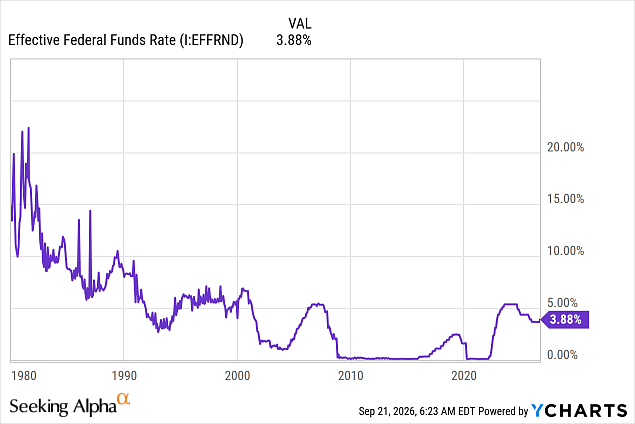
For this reason, we see the recent selloff as an opportunity to accumulate REITs at unusually attractive valuations, especially since their underlying fundamentals generally remain strong and higher interest rates are also restricting competing new construction.
The return potential is particularly attractive when you consider the 3 main components of REIT total returns:
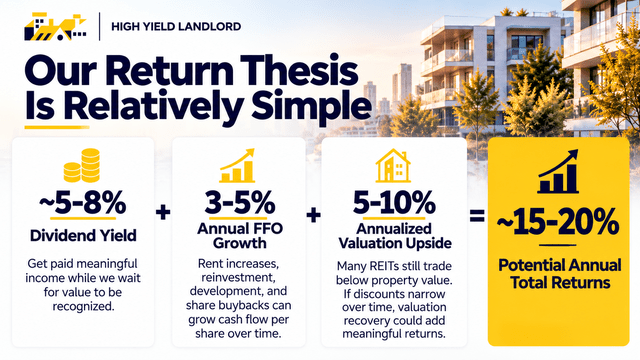
Today, a lot of REITs offer 5-8% dividend yields, have the potential to grow their FFO per share by another 3-5% annually, and could enjoy another 5-10% of annualized valuation upside as their discounts to NAV gradually narrow.
This suggests that 15-20% average annual total returns could be achievable for many REITs over the coming years, even without making particularly aggressive assumptions about rent growth or the pace of the valuation recovery.
Of course, there are risks, and we cannot predict when the market will recover. But we believe that the long-term risk-to-reward is very compelling at today’s valuations, and we are happy to continue gradually building larger positions while prices remain depressed.
This week, we are making small additions to 3 REITs that have suffered particularly large declines: 1 in our Core Portfolio, 1 in our Retirement Portfolio, and 1 in our International Portfolio.
Here is what we are buying and why.
