



A Quick Note Before Today’s Trade Alert
Before getting into today’s article, I wanted to share a short thank-you video from Ukrainian soldiers who received some of the trucks funded by High Yield Landlord members last summer.
Together, we raised $170,000 to purchase and equip seven trucks, with most of the donations coming from members of our community. Many of you contributed very generously, and I wanted you to see firsthand how much your support means to the soldiers receiving these vehicles.
I have said this before, and I will repeat it again: I believe this is one of the most impactful ways to support Ukraine.
There is a severe shortage of reliable trucks on the front lines, and this shortage costs lives. Soldiers often struggle to evacuate their wounded comrades, transport critical supplies, or escape incoming attacks simply because they lack the vehicles needed to move quickly. Something as basic as a pickup truck can literally mean the difference between life and death.
Our volunteers, including myself, also work entirely for free, take on the risks of delivering the vehicles into Ukraine, and contribute our own money to the effort. This allows us to direct donations toward purchasing and equipping the trucks, rather than paying salaries or unnecessary administrative overhead.
We have already purchased, equipped, and delivered more than 50 vehicles to Ukrainian soldiers, with much of the funding coming from our High Yield Landlord community. We have seen firsthand how important these trucks are on the front lines.
I am now preparing for my 12th convoy to Ukraine in December, and we are raising another €85,500 to purchase four more urgently needed vehicles. We have already reached approximately 80% of our target, but still need to raise the final €17,000 to complete the campaign.
I know I have asked for your support many times before, but the need remains enormous, especially as Ukraine faces another difficult winter.
As I have said before, for many of us, having an extra $1,000 in our investment accounts won’t make a meaningful difference to our lives. But that same $1,000 can make an enormous difference to Ukrainian soldiers who are risking their lives every day and desperately need reliable transportation to carry out their missions and evacuate the wounded.
If you are in a position to help, please consider making a donation. Whether it is $100, $1,000, $10,000, or more, every contribution brings us closer to funding the next convoy.
Click here to support our Christmas fundraiser and help us reach our goal.
And to everyone who has already contributed, thank you. Your generosity has made all of this possible.
Now, let’s get back to today’s investments.
TRADE ALERT - Core Portfolio November 2026
Today, we are redeploying some of the proceeds from our recent sale of Macerich (MAC) into two other REITs that we believe offer significantly better long-term upside potential at their current valuations.
As explained in our recent Sell Alert, we decided to exit Macerich primarily for capital recycling purposes. We still believe that its shares could enjoy further upside, but the stock was trading near its 52-week highs, even as many of our other Top Picks had recently declined toward their 52-week lows.
We therefore saw an opportunity to unlock capital at a relatively low opportunity cost and reinvest it in REITs that we believe offer more attractive long-term return prospects.
This is really the essence of our Core Portfolio strategy, which aims to maximize total returns by taking advantage of the market’s tendency to overreact to short-term challenges.
We commonly invest in contrarian situations where a REIT, or sometimes an entire property sector, has fallen deeply out of favor. Often, the business is facing legitimate operational challenges that could last for several years. Growth may stagnate, earnings may decline temporarily, and investors gradually lose patience. Eventually, the market begins pricing the REIT as if these challenges will persist indefinitely, even when its underlying real estate remains valuable and its long-term prospects are attractive.
As a result of this approach, our Core Portfolio will naturally tend to be made up largely of REITs that are currently struggling or have recently performed poorly. After all, we deliberately seek out companies that are going through difficult periods, and when one of our investments eventually recovers and becomes more fairly valued, we will often recycle that capital into another opportunity that remains deeply out of favor. This means that our portfolio may frequently look like a collection of current losers, but that is largely by design. We believe these are often the REITs that offer the greatest long-term upside potential, provided that their underlying investment theses eventually play out. Of course, not every turnaround will succeed, which is why we need to be selective and patient.
This was precisely the situation with Macerich. We initially invested before the pandemic, when malls were already deeply unpopular, and things got considerably worse during COVID. We continued buying shares as they declined, including purchases near $5, eventually bringing our average cost basis down to approximately $7.50.
Fast-forward roughly six years, and Macerich has become one of our biggest winners. We recently sold our shares for approximately $25, generating a 3.3x return on the share price alone, and closer to a 4x total return including dividends.
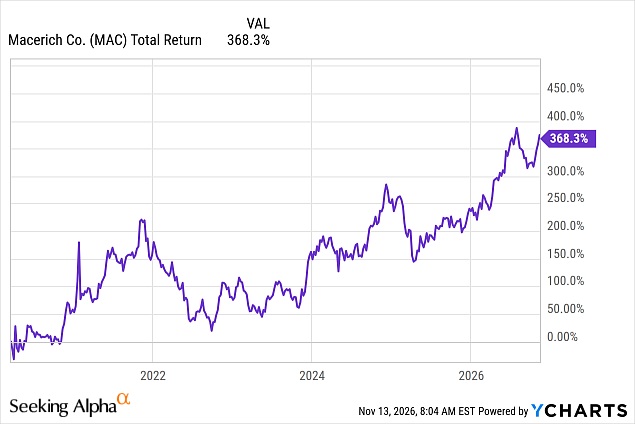

Importantly, the market’s perception of Macerich has also changed dramatically. Back then, investors were convinced that malls were in structural decline, with e-commerce threatening their future and many properties struggling with excess retail supply. Today, high-quality malls are increasingly recognized as valuable assets benefiting from very limited new construction, improving tenant demand, and a much more favorable supply-and-demand outlook.
The same properties that investors once wanted nothing to do with are now attracting considerably more interest, and their shares have repriced accordingly.
Our goal is to repeat this success elsewhere. We are not necessarily looking for REITs that will report spectacular results next quarter. Instead, we are looking for high-quality real estate businesses that are temporarily struggling, trading at deeply discounted valuations, but positioned to enjoy much stronger fundamentals over the next five to ten years.
These opportunities often require patience. The recovery may take two or three years, sometimes even longer, and the stock may remain unpopular throughout much of that period. But if we are right about the underlying real estate and its long-term earnings potential, the eventual change in market perception can produce very substantial returns, and we earn dividend income while we wait.
Today, we are buying more shares of:
