



Table of Contents
Opening Notes
Changes Portfolio Holdings
Changes to HYL Ratings
The Core Portfolio (Our Main Portfolio)
The Retirement Portfolio (Our Secondary Portfolio)
The International Portfolio (Our Optional Portfolio)
1. Opening Notes
This first quarter was a real roller coaster ride.
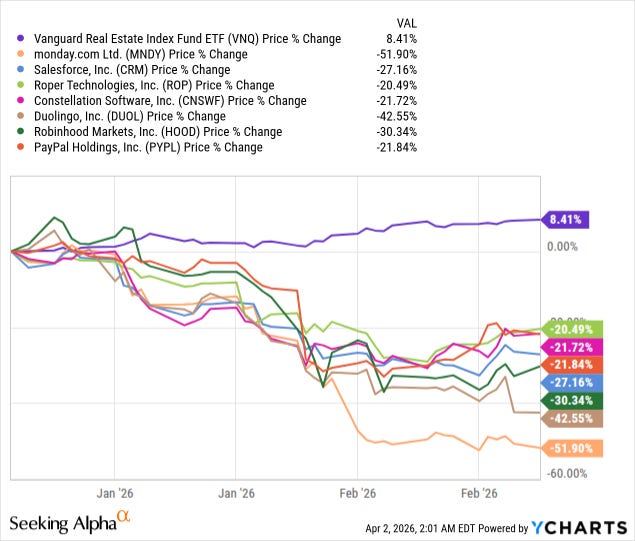
It started strong with REITs surging nearly 10% in value as the market became concerned about AI, and capital rotated from AI-disrupted businesses like SaaS companies towards AI-resilient businesses like REITs:
But then shortly after, the attacks on Iran began, and what was initially expected to be a short military operation turned into a broader war that’s still ongoing as I write this.
Iran retaliated by blocking the Straight of Hormuz, through which about 20% of the world’s oil shipments pass, triggering a supply shock that pushed oil prices above $100 per barrel.
The market immediately began to worry about inflation, long-term interest rates surged higher, and REITs gave up all their recent gains and then some:
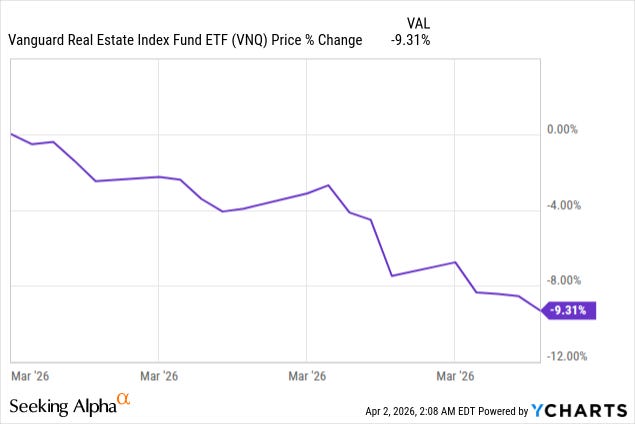
I would add here that this is just the average of the REIT sector.
Many REITs, especially those with higher leverage, dropped far more than this. Some have dropped as much as 20-30% over the past month.
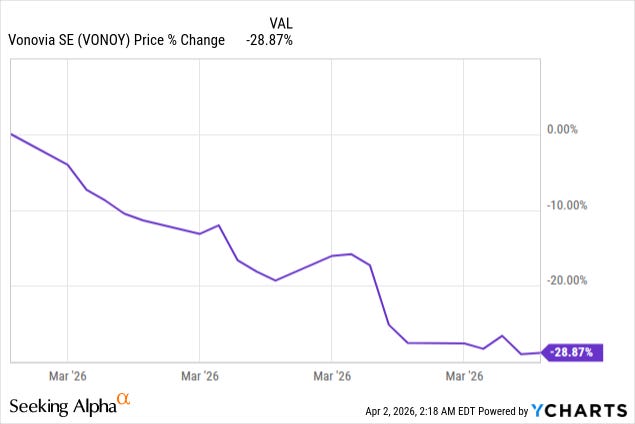
Vonovia (VNA), the biggest landlord in Europe, is down nearly 30%, for instance, as it has quite a bit of leverage, and the energy crisis could impact Europe even more than the rest of the world:

How did we react to this crisis?
We first assessed how much it is expected to impact inflation and concluded that the impact would likely be modest and temporary.
As we wrote in our recent market update, energy makes up only 3% of the total CPI basket, and while it will also indirectly impact other components of the basket, the biggest basket of all, which is shelter, making up 35% of total CPI, remains in a very powerful disinflationary trend today.
We concluded that $100 oil prices, if sustained, would likely add 0.5 to 1 points to the CPI rate, bringing it to about 3% by year-end.
This is not the end of the world.
Importantly, we think that this should be a transitory increase followed by an eventual return to the pre-war disinflationary trend.
That’s because:
1) Drilling is immensely profitable at over $100 oil and will lead to a surge in new supply.
2) Consumers do not immediately change their consumption behavior, but they will if energy prices remain this high, skipping a flight, for instance, due to increased cost, reducing the demand.
3) Finally, while it is impossible to predict how long this war will last, the Trump administration has repeatedly signaled that it wants out of it as soon as possible, possibly already over the coming weeks, and its allies have refused to get dragged into it. There is significant political and economic pressure on President Trump to calm things down with the mid-term elections coming up. Iran also has a strong economic incentive to eventually reopen the Straight of Hormuz, at least partially to “friendly nations”, as it heavily depends on oil revenue.
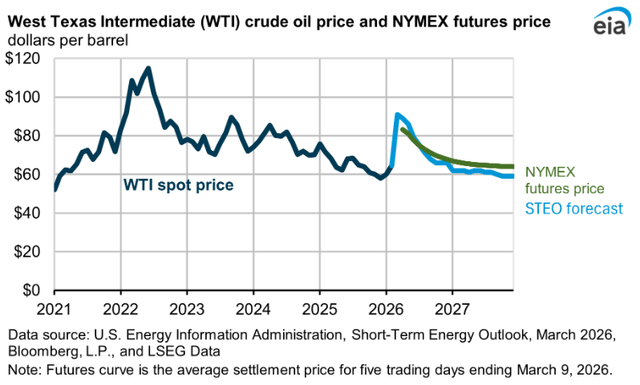
For these reasons, the US Energy Information Administration forecasts that the price of oil will gradually come down over the course of the year:
To quote the report:
“We forecast the Brent crude oil price will remain above $95/b over the next two months, before falling below $80/b in the third quarter of 2026 and around $70/b by the end of the year.”
But no one has a crystal ball, of course, and it could well take longer than this for energy prices to come back down.
My point is simply that this is likely to be a short-term setback, and it does not change our long-term outlook for inflation or interest rates.
We still think that other factors, primarily technological advances in AI and robotics, will ultimately have a much greater impact on inflation over time and bring interest rates back to lower levels.
Therefore, we are not changing our approach. We are simply turning this setback into an opportunity to buy the dips and bulk up our positions in anticipation of even greater gains in the future.
In the last quarter, we bought the dips in the following companies, and you can read our investment thesis by clicking the links below:
Going into the second quarter, we expect to do more of the same, unless the outlook changes. Right now, the companies that are the highest on my priority list for new additions are the following:
Invitation Homes
Camden Property Trust
Blue Owl Capital
Rayonier
Shurgard
Vonovia
In case you missed it, we discussed many of these companies on our recent quarterly webinar. You can listen to the recording here:
Finally, I want to remind you that our book, The REIT Advantage, was recently released, and we are giving it for free to all members of High Yield Landlord. I strongly encourage you to take the time to read it, as I truly believe it can help you make better investment decisions. You can claim your copy by clicking here.
Thank you for all your support, and let us know if we can help with anything.

==============================
2. Updates to Our Portfolio Holdings:
We have had 14 “Trade Alerts” in Q1 2026:
#1 TRADE ALERT - January 08th, 2026 (Retirement Portfolio)